
Self-Guided Tour
Celebrating Women’s History
Each of the artists featured in this self-guided tour explores history, culture, race, religion, and women’s experiences through a variety of mediums. This guide highlights a very small selection within Mia’s collection and invites you to seek out, reflect on, and celebrate these diverse artists and their art.
As you move through the galleries, we hope you’ll slow down and really look. There is no right or wrong way to experience art—just your way.
Maïmouna Guerresi: Supha, 2008 (Gallery 242)
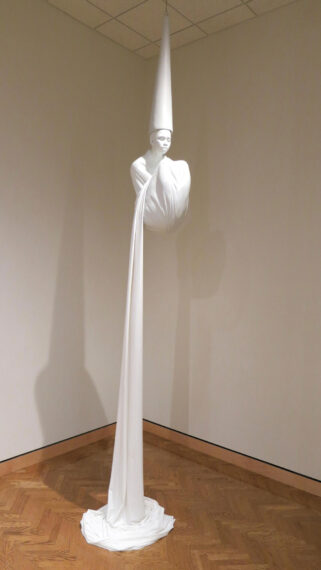
Maïmouna Guerresi, Italian (active Senegal; b. 1951). Supha, 2008. Resin, Lycra, and iron. The P.D. McMillan Memorial Fund. 2014.43.1a-d. © Maïmouna Guerresi
When Maïmouna Guerresi converted to Islam in 1991, her work shifted toward recurring themes of mysticism and feminine spirituality. Supha hangs from the ceiling, draped in fabric. The white outfit is reminiscent of those worn by Muslim Sufi mystics, who through meditation and trance enter into direct contact with the divine. The figure’s closed eyes and floating position suggest spiritual introspection and detachment from worldly concerns.
Shahzia Sikander: Arose, 2020 (Gallery 243)
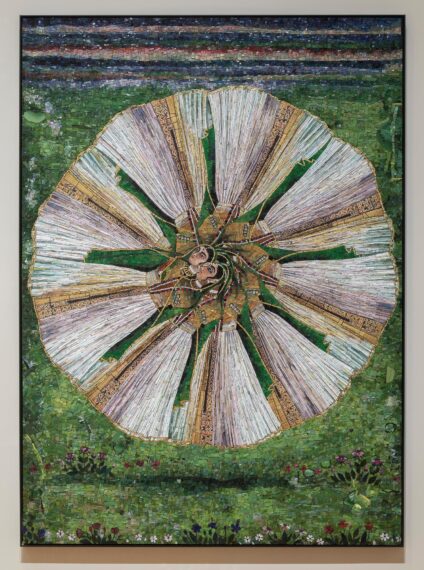
Shahzia Sikander, Pakistani (active U.S.; b. 1969). Arose, 2020. Glass mosaic with patinated brass frame. Gift of funds from Mary and Bob Mersky. 2021.10
Shahzia Sikander often riffs on traditional Indo-Persian mediums and subjects. Here she focused on two motifs: the court lady and the flower, popularized in South Asian royal court painting during the Mughal period (c. 1526–1857). Sikander supersized them, pixelating their forms with the use of mosaic tile.
Christi Belcourt: It’s a Delicate Balance, 2021 (Gallery 259)
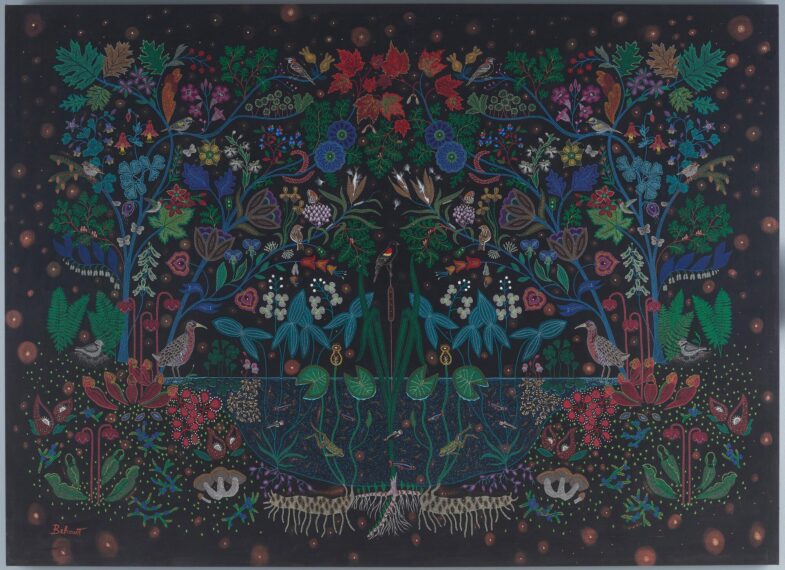
Christi Belcourt, Canadian, Métis (b. 1966). It’s a Delicate Balance, 2021. Acrylic on canvas. Gift of funds from Andy and Meg Ubel in honor of Mia’s Docent Class of 2015. 2021.30. © Christi Belcourt
For most Indigenous communities, all life—plants, animals, insects, microbes—are kin and are to be treated with respect and care. Most of the living beings that Christi Belcourt depicted here are currently threatened, endangered, or at the edge of extinction in the Upper Midwest. Each of these species is critical for the balance of our ecosystem and interconnected to all of life, including humanity. Belcourt painted these creatures as if she were beading them on hide, starting at the bottom and drawing on designs and motifs found in Michif beadwork.
Jordan Casteel, Minnesota, 2020 (Gallery 280)
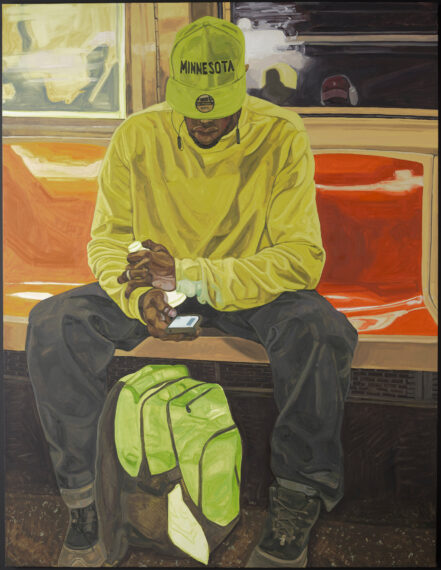
Jordan Casteel, American (b. 1989). Minnesota, 2020. Oil on canvas. Private collection, promised gift on long-term loan to Mia. L2020.125
Jordan Casteel is known for her bold, large-scale portraits that capture people and everyday scenes. Her canvases—rich with intimate details such as quick glances or intertwined hands—are painted from life in the very settings where she encounters her subjects. Casteel’s empathetic, observational approach to storytelling shows us the humanity and connection found in daily life.
Ingeborg Westfelt-Eggertz: Self-Portrait with Cigarette, c. 1890 (Gallery 359)
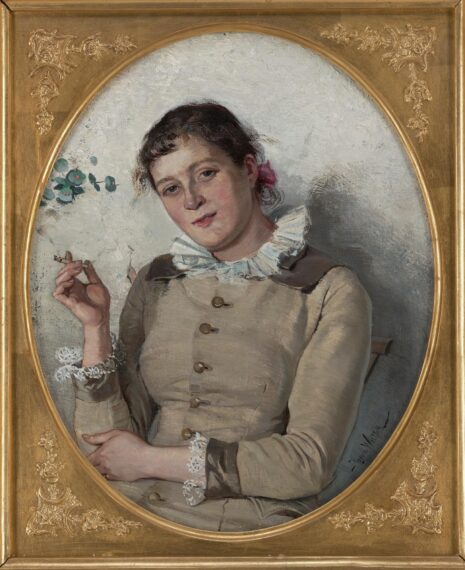
Ingeborg Westfelt-Eggertz, Swedish (1855–1936). Self-portrait with Cigarette, c. 1890. Oil on canvas. Gift of funds from the Paul and Sheila Steiner Charitable Trust. 2024.82
After seven years spent studying and working in Paris, Ingeborg Westfelt-Eggertz returned to Stockholm in 1890 at the age of 35. She painted this self-portrait around the same time, looking out at the viewer with an appraising half smile. She even took it one step further to show herself with a lit cigarette at a time when smoking was viewed as an unacceptable habit for Swedish women of her status. She did not depict herself as an artist but as a citizen of the world, looking out at the viewer with confidence.
Emma Amos, Out in Front, 1982 (Gallery 369)
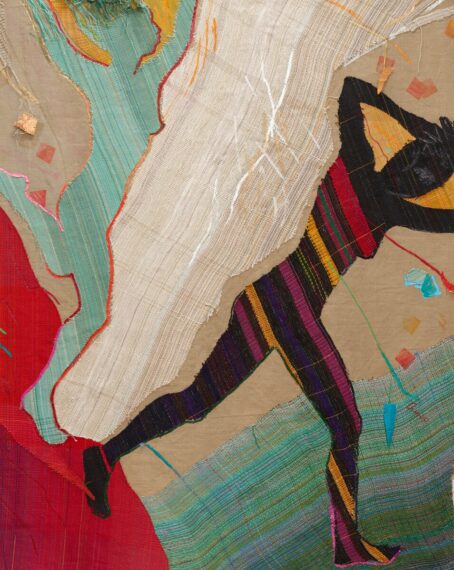
Emma Amos (American, 1937–2020), Out in Front, 1982. Handwoven cotton, synthetic, and metallic fibers with pigments on linen. Gift of Mary and Bob Mersky. 2020.44.1. © Emma Amos / Licensed by VAGA at Artists Rights Society (ARS), New York
Emma Amos was a painter, printmaker, and weaver known for exploring culture and identity. Her work was shaped by modern European art, Abstract Expressionism, the civil rights movement, and feminism. Amos used her art to question racism, sexism, and ideas about who belongs. Color played a key role in her work. She used it not just for beauty but to think about how people see and judge the world. As a mixed-race artist, she understood that color carries many meanings. In her 1982 piece Out in Front, Amos wove fabrics, cut them apart, and rebuilt them into a new image.
Magdalena Abakanowicz, Hand, 1976 (Gallery 375)
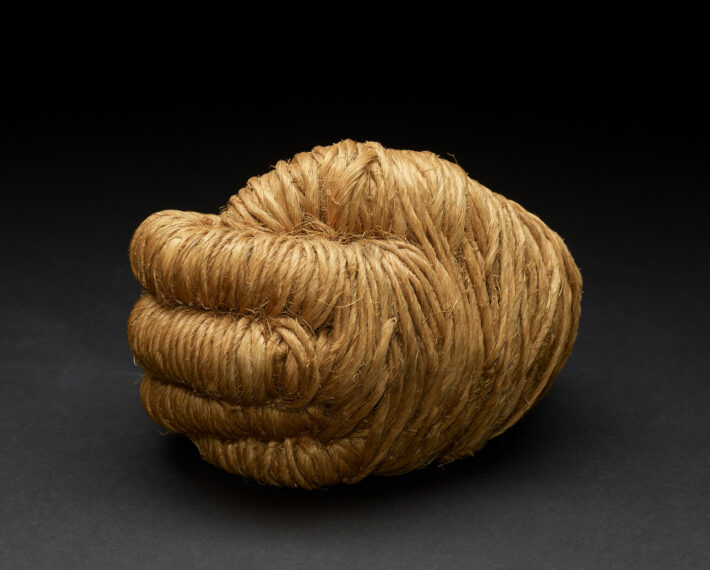
Magdalena Abakanowicz, Polish (1930–2017). Hand, 1976. Jute; wrapped fibers. Gift of the Kaufmann Collection. 99.38.5. © Magdalena Abakanowicz
As a young girl growing up in Poland, Magdalena Abakanowicz spent a lot of time outdoors, foraging for twigs and stones in an attempt to understand the mysteries separating her from nature. Her interest in natural materials is reflected here, through her use of rough, textured jute fibers. In the 1960s, Abakanowicz was one of the first artists to establish the use of traditional fiber techniques as a valid medium in contemporary art. Although she is now known for her powerful, large-scale bronze sculptural installations that also focus on the human body, in Hand, which is just five inches tall, Abakanowicz proves that power is not dependent on size.
Ambreen Butt, Namaloom (Unknown #2), 2018 (Gallery 375)
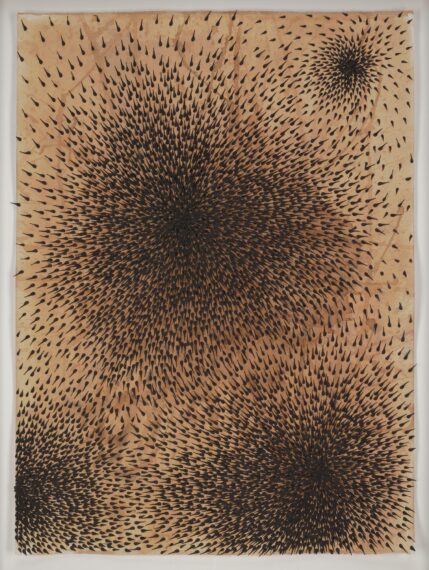
Ambreen Butt, Pakistani (active United States, b. 1969). Namaloom (Unknown #2), 2018. Collage on tea-stained paper. Gift of funds from Mary and Bob Mersky. 2025.19
Ambreen Butt, a Pakistani American artist trained in Indian and Persian miniature painting, blends that genre’s intricate visual language with contemporary political themes. Her work addresses violence, oppression, free speech, and feminism, often through open-ended questions rather than fixed ideology. Namaloom—Urdu for “unknown”—refers to the unknown civilian casualties of the U.S. war on terrorism. Butt’s recurring teardrop motif symbolizes blood in red and the unseen in black. Here, each teardrop encloses the word “unknown.”