
Self-Guided Tour
Celebrate Hispanic Heritage at Mia
This self-guided tour invites you to discover the rich artistic traditions and histories of Hispanic cultures at your own pace. From colonial Peruvian silverwork to contemporary painting and photography, each stop offers an opportunity to connect with art through observation, curiosity, and personal reflection.
Peru, Salt cellar, c. 1620 (Lobby, First Floor)
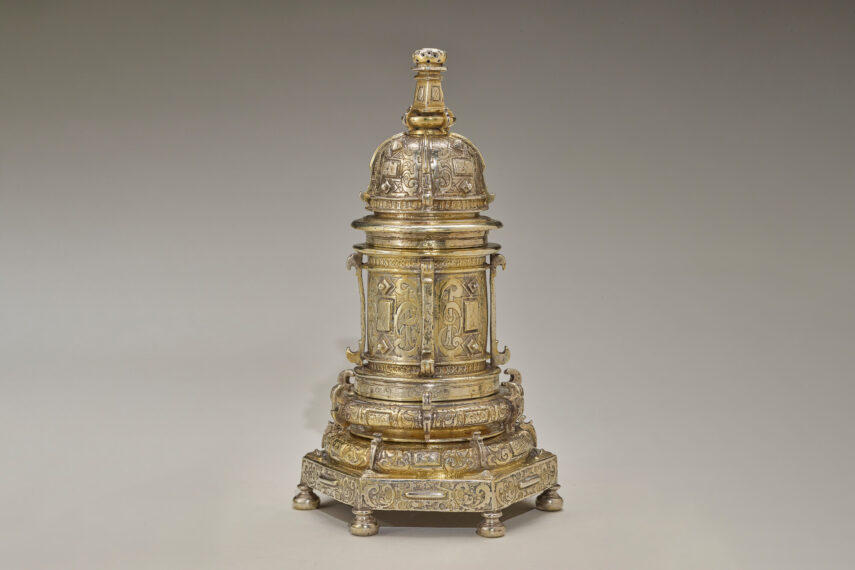
Salt cellar, c. 1620. Peru. Silver gilt. The Walter C. and Mary C. Briggs Trust Fund and the Mary Ruth Weisel Endowment for Africa, Oceania, and the Americas. 2026.2a-e
Examine the object’s form and decoration. What might it reveal about wealth, trade, or daily life in the colonial Americas?
This elaborate salt container represents a time when salt was a valuable commodity. In the first decades of the 17th century, salt on a dining table signaled status and sophistication.
This particular salt cellar was recovered from the Nuestra Señora de Atocha treasure galleon, bound for Spain, which sank in a hurricane off the Florida Keys in 1622. In 1975, a private expedition, led by Mel Fisher, located the principal wreck site. This salt cellar was recovered in 1985.
Francisco Zúñiga, Reclining Nude of Dolores, 1976 (Gallery 103)
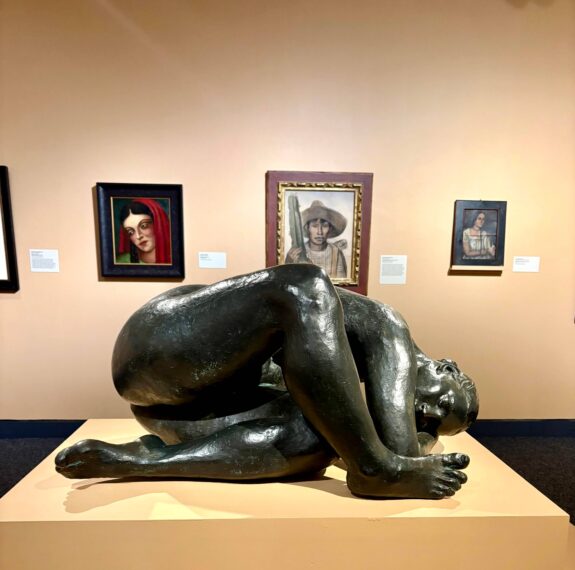
Francisco Zúñiga, Reclining Nude of Dolores, 1976
Observe the figure’s pose and sense of weight. How do these choices convey strength, presence, or emotion?
The son of two sculptors, Francisco Zúñiga received his early artistic training in his father’s workshop in his native San José, Costa Rica. In 1936, he moved permanently to Mexico. There, he cultivated a deep interest in Aztec imagery and pre-Hispanic art forms, influences that would remain at the core of his practice.
His work, centered on the human figure, emphasizes mass over anatomical detail, an aspect that lends his sculptures their distinctive monumental presence.
Maya artist, Mask, c. 250–600 (Gallery 260)
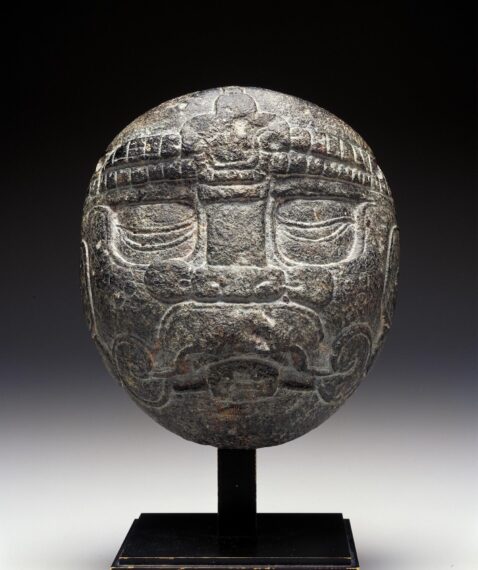
Maya artist, Mesoamerica. Mask, c. 250–600. Stone. The Putnam Dana McMillan Fund. 99.3.1
Study the mask’s features and markings. How might wearing it have transformed the wearer or connected the wearer to the spiritual world?
This mask represents the Maya jaguar god. Such masks, often made of stone, wood, or copper, were used in rituals by high-ranking members of society. Mask wearers were ceremonially transformed into the being portrayed and could interact with the spirit world. The jaguar god, one of the Maya’s most powerful deities, represented night, shadows, war, and sacrifice.
The three dots on each cheek symbolize the jaguar’s spots. Maya royalty used jaguar imagery on clothing, jewelry, armor, and masks to demonstrate power and emphasize their relationship with the god.
Saltillo artist, Serape, c. 1900 (Gallery 260)
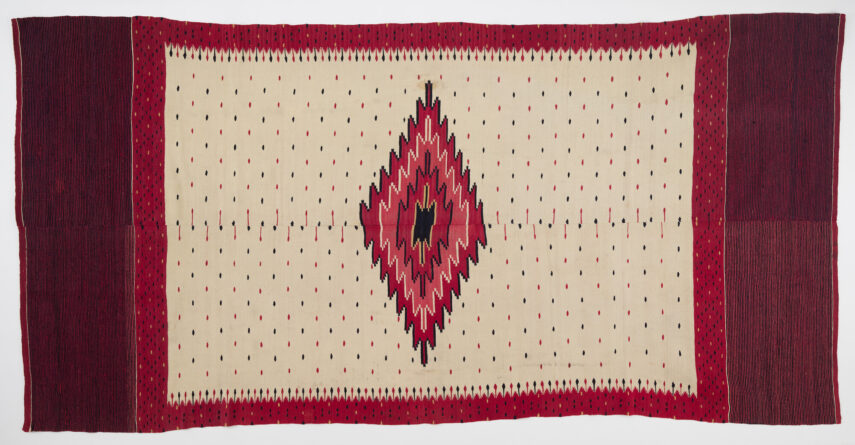
Saltillo artist, Mexico. Serape, c. 1900. Cotton, pigments. Gift of Elissa and Paul Cahn. 2017.127.17
Look closely at the colors, patterns, and weaving. What do they reveal about the maker’s skill and the value of this textile?
The Mexican serape is among the most vibrant North American textile traditions. Produced as early as the 1500s, it remains a popular item today.
Serapes have long been used in a variety of ways—as rugs, shawls, wall hangings, saddle blankets, and, when featuring a neck slit, ponchos. By the 1880s, the serape was highly sought after by American tourists. Its bold, geometric patterns became a source of inspiration for Navajo and Rio Grande weavers in the U.S. Southwest and far beyond. By the late 19th century, imitations of the textile were printed and sold in Germany.
Mauricio Hernandez Chepetla (Lead Artisan), “Immigrants” Chinelo Costume, 2024–25 (Gallery 281)
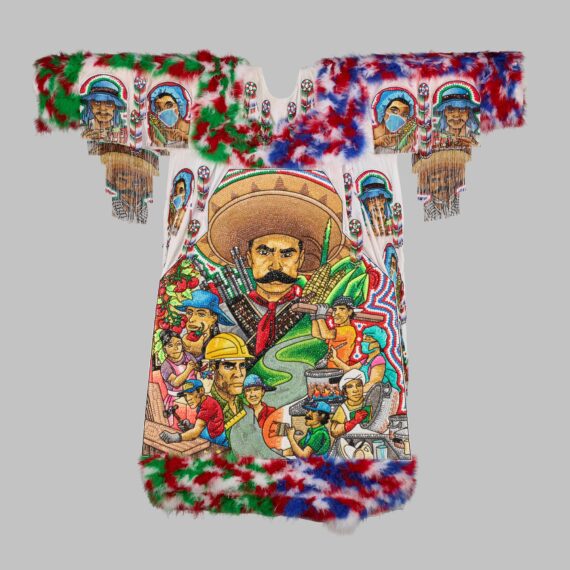
Mauricio Hernandez Chepetla lead artisan, Mexican; Maria Rendon Cruz, Mexican; Viridiana Chepetla Rendon, Mexican; Karla Bautista Galindo, Mexican; Esau Chepetla Rendon, Mexican. Robe from “Immigrants” Chinelo costume, 2024–25. Plastic beads, sequins, cotton cloth, velvet, palm. Given in honor of the Yautepec, Morelos artisans, and the Morelos community in Minneapolis, St. Paul. 2025.82.1
Look closely at the robe’s colors, symbols, and details. What stories do they tell?
The word chinelo is derived from the Nahuatl word zineloquie, which means “disguised.” Workers wear chinelos during events such as Carnival, allowing them to make fun of the elites. Chinelos also reflect the cultural imagination and dedicated craftsmanship of artisans within and beyond Mexican borders.
Immigrants was created over many months by members of a generations-old family business in Morelos and St. Paul, Minnesota. It’s a powerful testament to the pride of Minnesota’s Mexican American community and their contributions to American life.
Manuel Álvarez Bravo, Two Pairs of Legs, 1928–29 (Gallery 368)
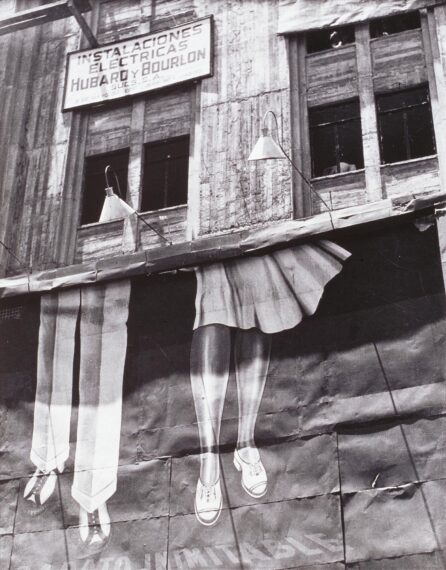
Manuel Álvarez Bravo, Mexican, 1902–2002; Acorn Editions, Ltd., Publisher. Two Pairs of Legs, 1928–29. Gelatin silver print (printed 1977). Gift of Louis H. Stumberg. 82.125.10. © Archivo Manuel Álvarez Bravo SC. All rights reserved.
Before reading the label, what do you think is happening? How does the artist use perspective to create mystery?
Two oversize pair of legs, one trousered and one topped by a skirt, appear to be dangling from a quartet of windows in this photograph of a sunlit building. Are these halved and gigantic figures emerging from the sill above them, or disappearing slowly into it? Manuel Álvarez Bravo cropped our view of this street-side advertisement intentionally, framing an otherwise everyday object as unsettling or mysterious.
Manuel López, Starting anew again (Mexican blanket draped over an IKEA chair), 2025 (Gallery 374)
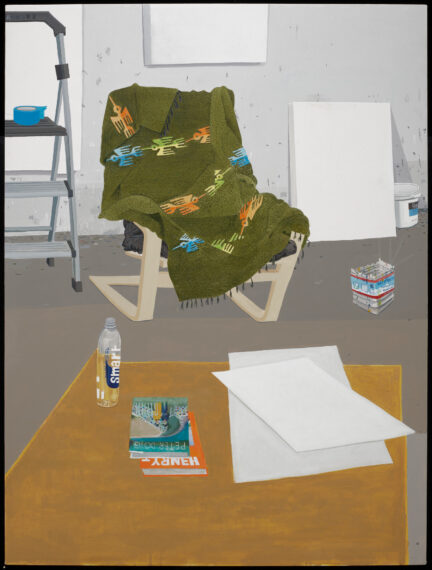
Manuel López, American, born 1983. Starting anew again (Mexican blanket draped over an IKEA chair), 2025. Acrylic on canvas. The Tess E. Armstrong Fund. 2025.47
Notice the everyday objects and how they are arranged. How does the artist make the ordinary feel meaningful?
Manuel López draws inspiration from his immediate environment to communicate the vitality and beauty of the everyday. Here he presented a glimpse of his Los Angeles studio, a personal space containing a chair draped with a Mexican-style blanket, a metal stepladder, art materials, and other items resting on a low table. Though it appears informal, the scene is a kind of still-life composition, drawing the viewer’s attention to details of form, color, contrast, texture, perspective, and design.
Rufino Tamayo, The Family, 1936 (Gallery 376)

Notice the figures’ expressions, poses, and colors. What do they suggest about the family’s relationships or emotions?
In 1936, Rufino Tamayo moved to New York, where one of his closest friends, Mexican artist Miguel Covarrubias, introduced him to the rich cultural scene in Harlem. Whether this painting portrays an African American family from Harlem is uncertain, though. Tamayo often depicted characters with dark skin as a way to suggest mestizo or Indigenous ancestry. The figures’ masklike faces can be seen as an indication of the artist’s interest in ancient cultures, in his native Mexico and beyond.