
Back from Storage: How Mia Conserved a Rare Italian Renaissance Tapestry
By Laura Silver
July 28, 2026—Beth McLaughlin, senior textile conservator at the Midwest Art Conservation Center (MACC) in Minneapolis, spent months working right to left, two feet at a time, restoring an enormous Italian Renaissance tapestry. It was rolled up lengthwise on a huge tensioner (an adjustable device that applies controlled, even tension), in a large basement workroom at MACC.
She started from the right-hand vertical side, she says, because that’s how it would have originally been woven, all 17 by 15 feet. McLaughlin did see it unrolled once, briefly, but she’d never seen it displayed in all its glory—and neither had anyone at Mia. The Meeting of Dante and Virgil—“the most important Italian Renaissance tapestry in America,” according to Max Bryant, Mia’s James Ford Bell Associate Curator of European Decorative Arts and Sculpture—spent nearly 70 years in storage. Until now.
Thanks to a grant from The European Fine Arts Foundation (TEFAF), in partnership with the Bank of America Art Conservation Project, McLaughlin worked to stabilize and conserve the tapestry. Visitors can now view it in the exhibition “Back from the Underworld: Mia’s Dante Tapestry Restored,” a rare opportunity to experience the work in person.
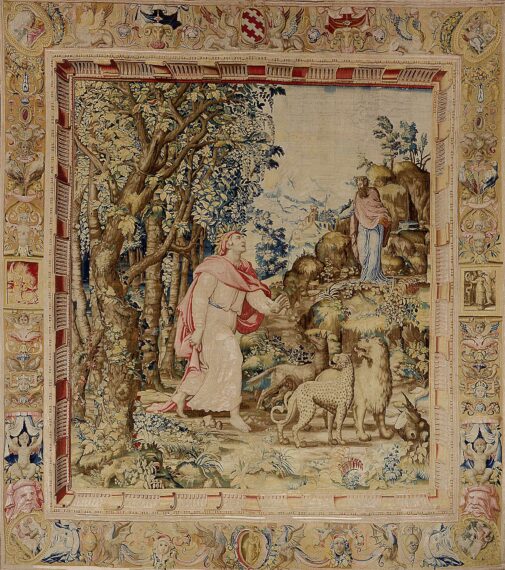
Francesco Salviati (cartoonist) (Italian [Florence], 1510–1563), The Meeting of Dante and Virgil, 1546–49, wool, silk, tapestry weave. Gift of Mrs. C.J. Martin for the Charles Jairus Martin Memorial Collection, 15.35
A Golden Age of Tapestry
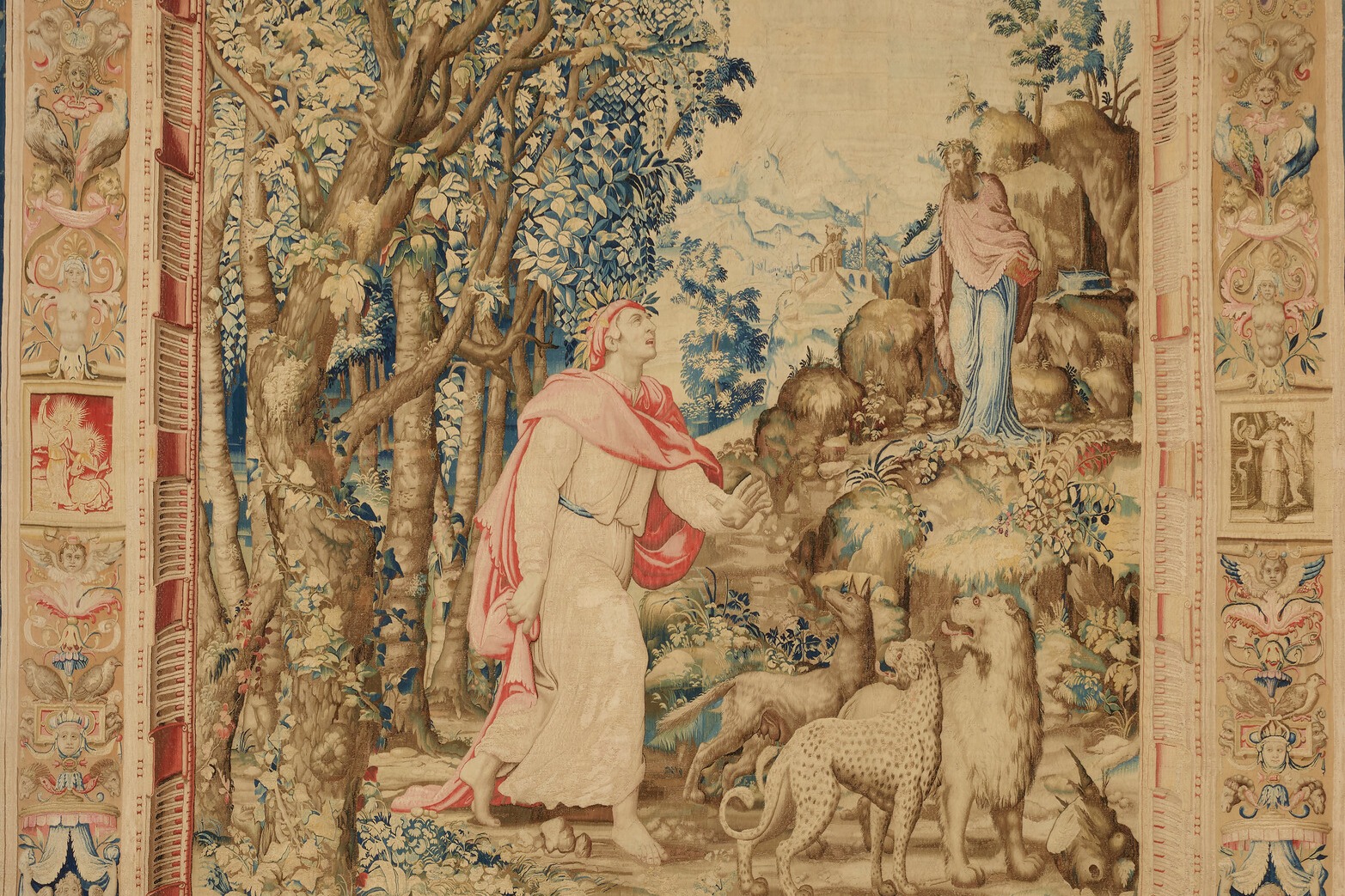
Francesco Salviati’s tapestry The Meeting of Dante and Virgil (1546–49) was one of the first tapestries woven in Florence at the brand-new workshop established by the Grand Duke Cosimo de Medici. It depicts Dante’s imagined first encounter with the Roman poet Virgil at the beginning of the Inferno, the story of a descent into hell that opens Dante’s epic 14th-century poem The Divine Comedy.
It’s a scene that would have been electrifying to 16th-century viewers: Dante is saved from wild beasts by his literary hero, Virgil, connecting classical learning, Christian tradition, and Florentine cultural identity in a single image.
Cosimo was ambitious. He wanted Florence to rival the great tapestry workshops of Brussels, recruiting expert weavers from Belgium and the Netherlands—including Jan van Rost, the weaver of Dante and Virgil. Once established in the famous Medici garden in Florence, where artists like Botticelli and Michelangelo absorbed the classical ideals of the Renaissance, the workshop set in motion one of the greatest periods in the history of tapestry, one of unmatched technical complexity and artistic refinement.
The tapestry is set within an illusionistic frame that is surrounded by a border of fantastical, comical scenes and creatures. In the corners, recumbent figures read scrolls. Eyes bulge and tongues waggle—amusing details that can barely be seen from a viewing height of five or six feet. McLaughlin’s favorite is a figure she calls “Mr. Potato Head,” who bears a striking resemblance to actor Nathan Lane.
“He’s beautiful,” she says, “just gorgeous from a weaving standpoint.”
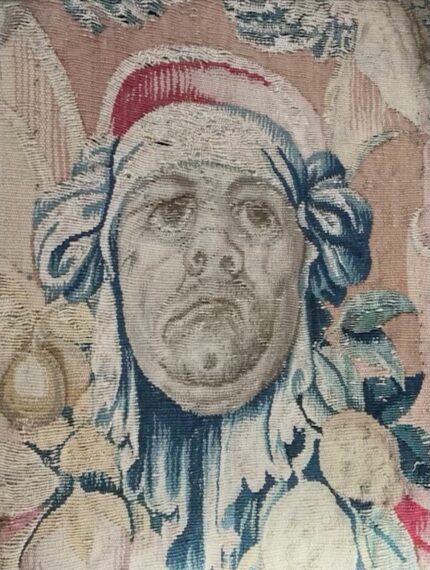
McLaughlin’s favorite detail: Mr. Potato Head aka Nathan Lane
Emerging from Storage
The tapestry has been in Mia’s collection for over a century, and from 1915, when it was purchased, to about the 1930s, it was shown continuously, likely opposite a large window. Sunlight is one of the enemies of art, and a photo from that era shows it to be much more vivid than it is today.
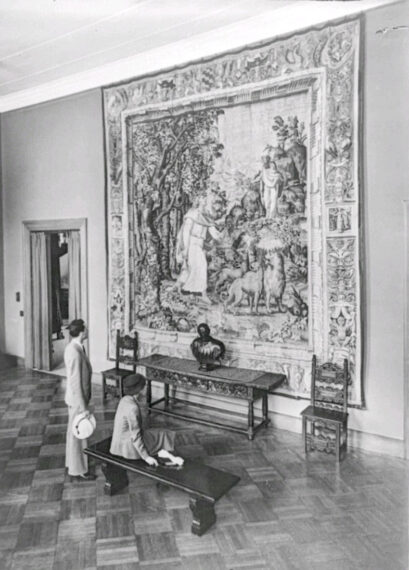
Dante and Virgil on display at Mia, c. mid-1920s. It was most likely hung in Gallery 243, where Mia now displays Islamic art.
When Bryant, who is curating “Back from the Underworld,” and McLaughlin first examined the tapestry, they saw, in addition to color fading, open slits, weak areas, and silk thread loss. McLaughlin proposed stabilizing and relining the tapestry, essentially a kind of triage, and Mia’s art team would give it a modern hanging system, making it displayable.
“It’s problem solving,” McLaughlin says. “We’re trying to make sure it’s in stable condition to be hung, without causing any harm.”
The Conservation
Since work began last December, McLaughlin rolled the tapestry from one side to the other three times: first to remove the existing straps (header) and lining; second to “encapsulate,” or sandwich, the weakest areas of silk between layers of tulle; and third, to attach a brand-new lining. Mia will preserve the old lining for future research.
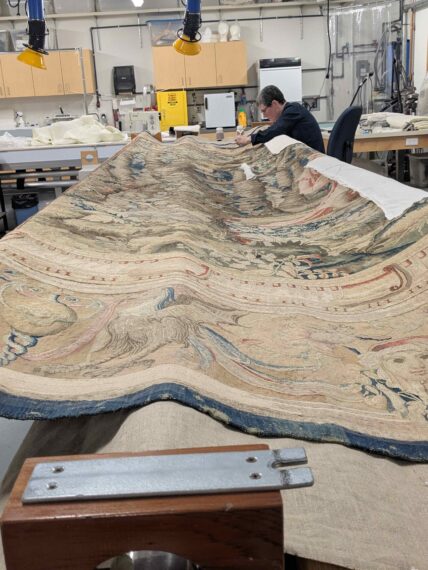
Textile conservator Beth McLaughlin worked on Dante and Virgil since December 2025.
As she rolled, McLaughlin used a contrasting-color thread as a kind of plumb line or guide, to keep her stitches from straying from the area of focus. She stitched by hand, using the tulle to bridge one strong area to another. The tapestry is entirely visible through the nearly transparent mesh. McLaughlin had some help—two other women volunteered part-time.
Discoveries and Surprises
During conservation, McLaughlin identified a few mysteries that, according to curator Bryant, have no precedent in the scholarship of Florentine tapestry. The first is the discovery of drawing in areas of the weaving. The pigment is barely visible but, unfortunately, water soluble, so the tapestry could not be wet cleaned as originally planned. (McLaughlin used a suction disk for localized cleaning.)
“We don’t know who did [the drawing] or when it was done,” she says. “Was it by a weaver or after it had been hanging for 200, 400 years?” Future tests will reveal more.
Second, McLaughlin discovered a horizontal band of warp (foundation) threads near the top of the tapestry that was “plied” with two colors (as in 2-ply), creating an unusual speckle effect. “There seems to be . . . no logical explanation for why multicolored warps would be used in this case,” Bryant says.
Thirdly, McLaughlin was able to see evidence of the very different hands working on this tapestry. One who wove with a loose, gentle hand, another who wove very, very tightly. Who they were is a mystery, but further research may offer clues.
With the removal of the header, a relatively modern addition, McLaughlin found that it was made of recycled military ammunition belts, probably left over from World War II. Who chose this unusual material, when, and why? Future art scholars, you have your assignments.
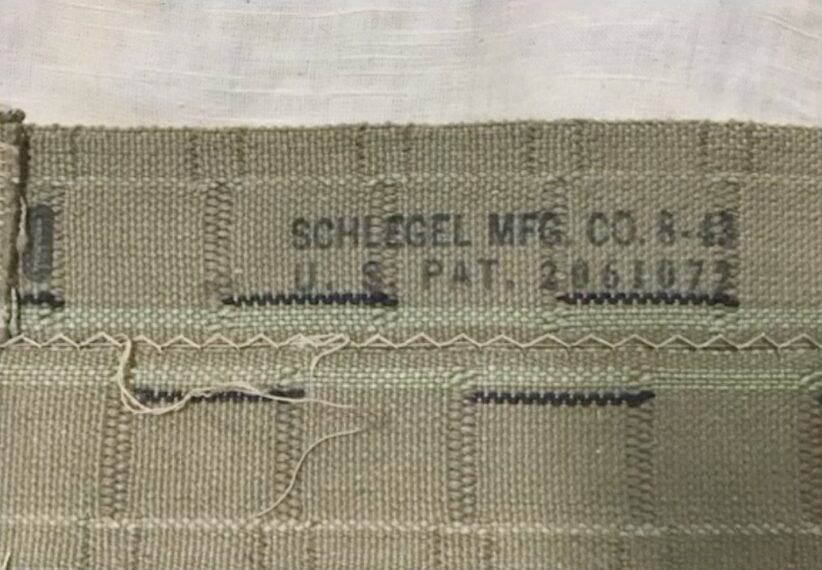
The header was made of recycled WWII ammunition belts, designed to hold 50 or 100 bullets.
With the removal of the lining, the original colors were revealed. Unlike the front of the tapestry, which remains forever faded, the reverse has been protected from sunlight. This is the first time the reverse of Dante and Virgil has ever been photographed in color.
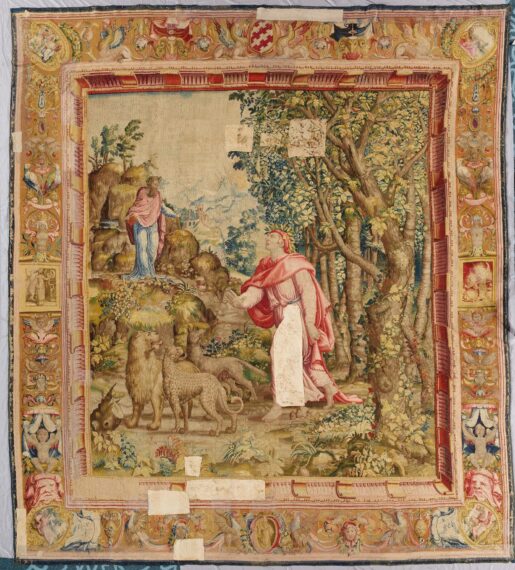
The reverse of the tapestry reveals the vibrant colors that reflect the tapestry’s original state
Reinstallation
Once the tapestry was strong enough to display, it needed a modern hanging system. (Historically, Renaissance tapestries were hung directly from hooks or nails or attached to wooden poles or rods.) So Charles Capistrant, Mia’s head preparator, designed an aluminum frame that supports the tapestry on all sides with hook-and-loop fastener. Its design is modular, so it can be disassembled and packed up with the tapestry if it ever goes out on loan. The tapestry will be rerolled for storage.
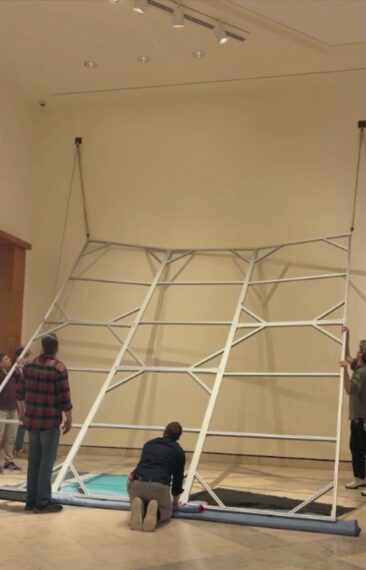
Mia’s art crew tests the prototype hanging system. “A work of art in its own right,” says curator Max Bryant.
Despite the care, expertise, and money that have gone into making the tapestry safe, putting it on display does shorten its life—just a tiny bit, says Bryant. “But it’s a very, very small sacrifice for something that is incredibly rewarding. Which is to encounter, in person, the art form of popes and kings and emperors.”
Visit the Exhibition
You can encounter The Meeting of Dante and Virgil at Mia until January 31, 2027, in the Miles and Shirley Fiterman Gallery (330).
Learn More
Hear from Mia curator Max Bryant and see the tapestry’s conservation and installation in progress in this short video.