
The Original Slow Fashion: Maya Huipiles
By Tara Kaushik
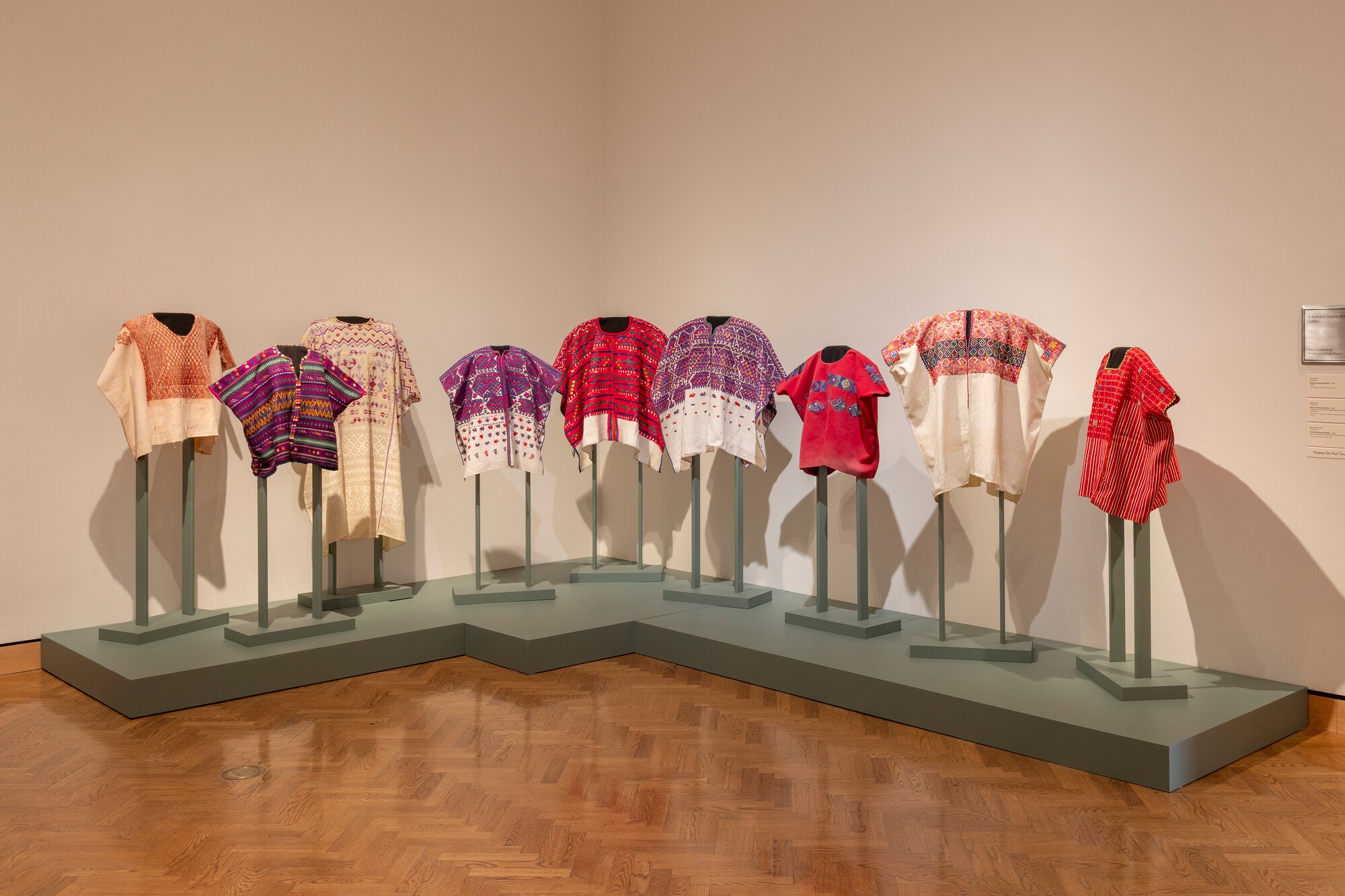
June 5, 2026—It’s not just eye-catching. The huipil, a traditional Maya blouse, represents a 1,500-year-old creative tradition that exemplifies environmental, cultural, and economic sustainability. Maya women have worn huipils since before the 16th century, when the Spanish arrived in the region. Frida Kahlo famously wore the garment and more recently Mexican President Claudia Sheinbaum wore one as a symbol of cultural pride. Huipils remain especially prevalent in Guatemala’s highlands, where a majority of Maya communities live today.
Anatomy of a Huipil
A huipil is a rectangular garment constructed from two or three panels of cloth. Unlike Western tailoring, which often generates significant fabric waste through cutting and shaping, the huipil is woven to size on a backstrap loom, producing four finished selvages—meaning the edges of the pieces of fabric are completed on the loom itself and don’t require any cutting, leaving zero waste.
Huipil weavers historically used Ixchcaco, a brown cotton native to Guatemala that requires no chemical dyes. When dyes were used, they were derived from plants, vegetables, and minerals. The weaving process is incredibly labor-intensive, and a single ceremonial huipil can take months to complete. While many modern weavers have adapted to using machines, chemically treated cotton, and synthetic dyes, Maya people continue to preserve and practice their costumbre, or collective traditions.
Wearable History
The intricate designs on a huipil are a visual language, rich with symbolism and stories of Maya cosmology.
Sunrays
The sunburst design, often placed at the neck opening of the huipil to be at the center of the composition, represents the centrality of the sun in agricultural life and Maya mythology.
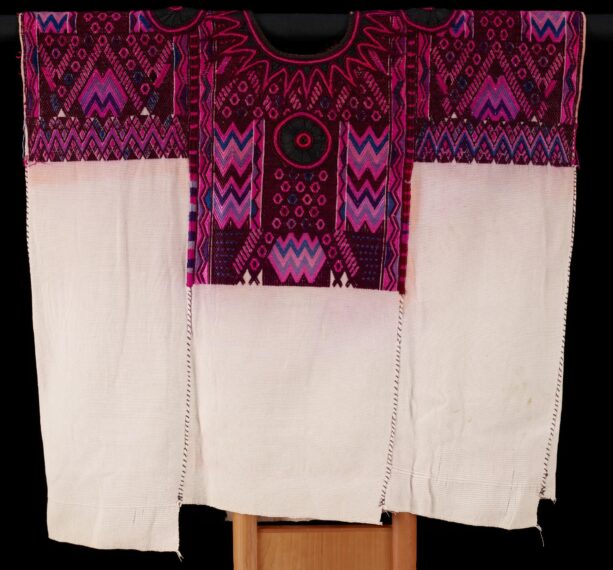
Ceremonial blouse (Huipil), c. 1930–40. Maya artist, Guatemala. Cotton, silk; supplementary weft patterning, embroidery. Gift of Richard L. Simmons, 2007.97.31
The Feathered Serpent
This motif, represented by horizontal zigzags, is among the most widespread symbols in Maya textiles. It symbolizes the feathered serpent K’uk’ulkan, god of wind, rain, and storms, who is closely associated with the creation of the world and the cyclical nature of time.
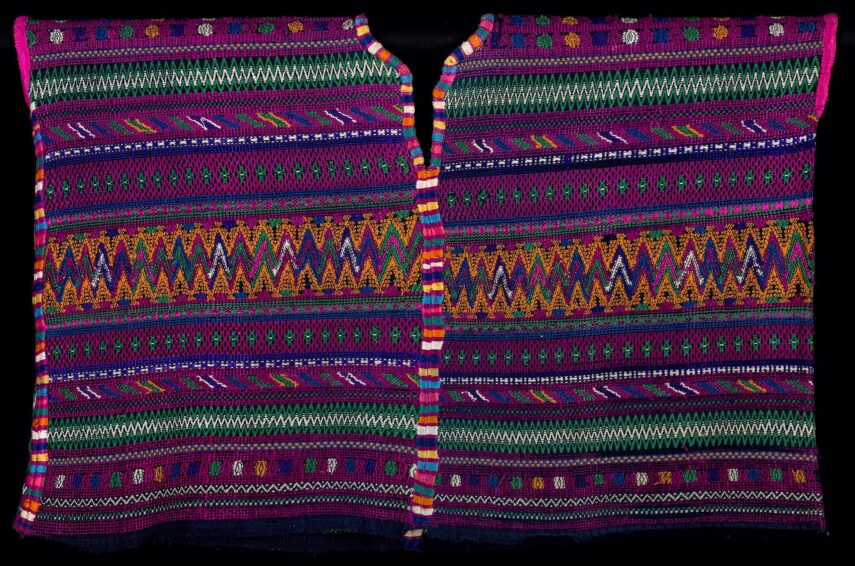
Woman’s ceremonial blouse (Huipil), 1955–60. Maya artist, Guatemala. Cotton, silk; supplementary weft patterning, embroidery. Gift of Richard L. Simmons in memory of Roberta G. Simmons, 95.116.23
The Double-Headed Eagle
Seen mostly on huipiles from Quiché, Chichicastenango, Palín, Escuintla, Nahualá, Sololá y Chuarrancho, and Guatemala City, this deity represents duality in many forms. One head looks to the future and one to the past, one toward the earth and one toward the sky, one toward good and one toward evil.
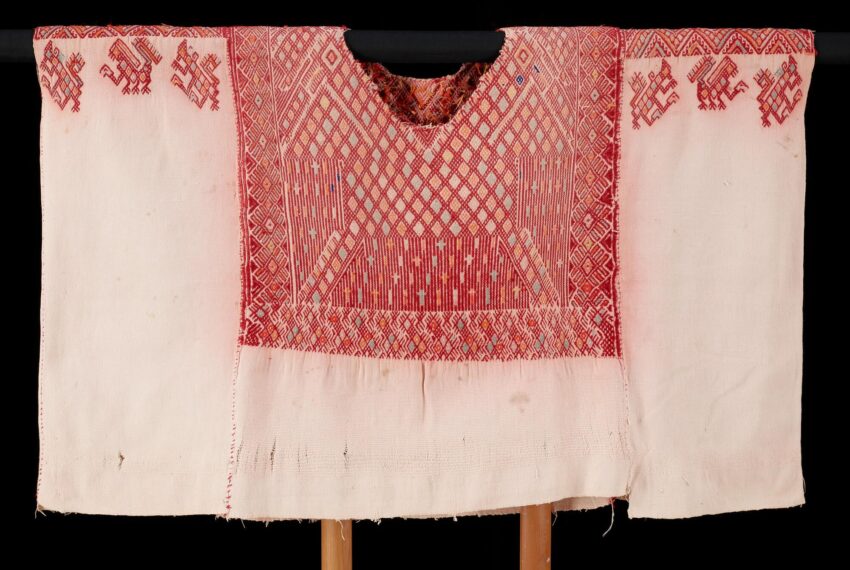
Cofradía blouse (huipil), c. 1910. Maya artist, Guatemala. Cotton, silk. Gift of Richard L. Simmons in memory of Roberta Grodberg Simmons, 2004.169.100
Adaptation and Survival
The Maya people survived centuries of Spanish colonial rule and a 36-year civil war that forced many to abandon their traditional traje, or dress, to avoid targeted violence by the Guatemalan government. Yet traditions like the huipil have persisted, enduring through strategic adaptation.
For example, rather than wearing a huipil that identifies them with a single village, it’s common today for younger, urban women to mix styles from different regions. This cross-community borrowing represents a unified Indigenous identity, resilient in the face of ongoing dispossession and marginalization. Such adaptations have allowed the tradition to remain relevant for a new generation.
Watch: Selecting Huipiles for “An Indigenous Art: Huipiles from Mia’s Collection”
Economic Innovation
To generate reliable income, Maya weavers have formed backstrap weaving cooperatives, such as Oxlajuj B’atz’ (Thirteen Threads), and expanded their repertoire. Translating traditional huipil motifs—birds, flowers, and geometric sunbursts—into rugs, Maya weavers have managed to tap into tourist and export markets without sacrificing their cultural heritage. The rugs are often made from recycled materials or leftover yarns, further demonstrating the resourcefulness inherent in Maya artistry.
About the Exhibition
“An Indigenous Art: Huipiles from Mia’s Collection” is on view through August 2, 2026, in the Robert and Marlyss White Gallery (G281).