

Worker Elves or Trolls? The Peculiar Story of the Purcell-Cutts House Windows
May 19, 2026—The story of the Purcell-Cutts House windows is kind of a race to the finish line. The house was supposed to be completed in time for architect William Gray Purcell and his family to move in by Christmas 1913. The exterior construction was just wrapping up in the fall, and the house had to be sealed up before Minnesota’s winter hit, so the workers could finish the interiors.
The windows weren’t ready, but the local art glass contractor, E. L. Sharretts’ Mosaic Art Shops, had an idea: They would bring over every piece of sheet glass they had available to tack into the frame stops, a temporary fix while they finished the art glass windows. It gave the house a fascinating, patchwork look. Purcell described it as much in his writings:
“Arriving at the job next evening, I was struck dumb at the sight, and for the mental condition of the neighbors there were no words. In all the 72 window openings were great sheets of bright blue, yellow, green, red, wine, and orange glass. There were sheets of frosted and office partition glass, diaper [the term for a decorative pattern that is added to the glass with paint] church panes with angels, mottoes, and shields. It was a sight for an asylum of trolls. The neighbors had thought the house at best was wholly insane—not one thing inside or out was like any house they had ever seen—and this was the final neighborhood insult.” (No photos mark this for the record, but one panel of opaque glass is still hidden in the upstairs master bedroom closet.)
What the house was destined to have—and did have by the time the Purcells moved in—were sparkling, semi-transparent screen-like windows with a diamond pattern and rectangular borders, designed by George Grant Elmslie, Purcell’s architectural partner.
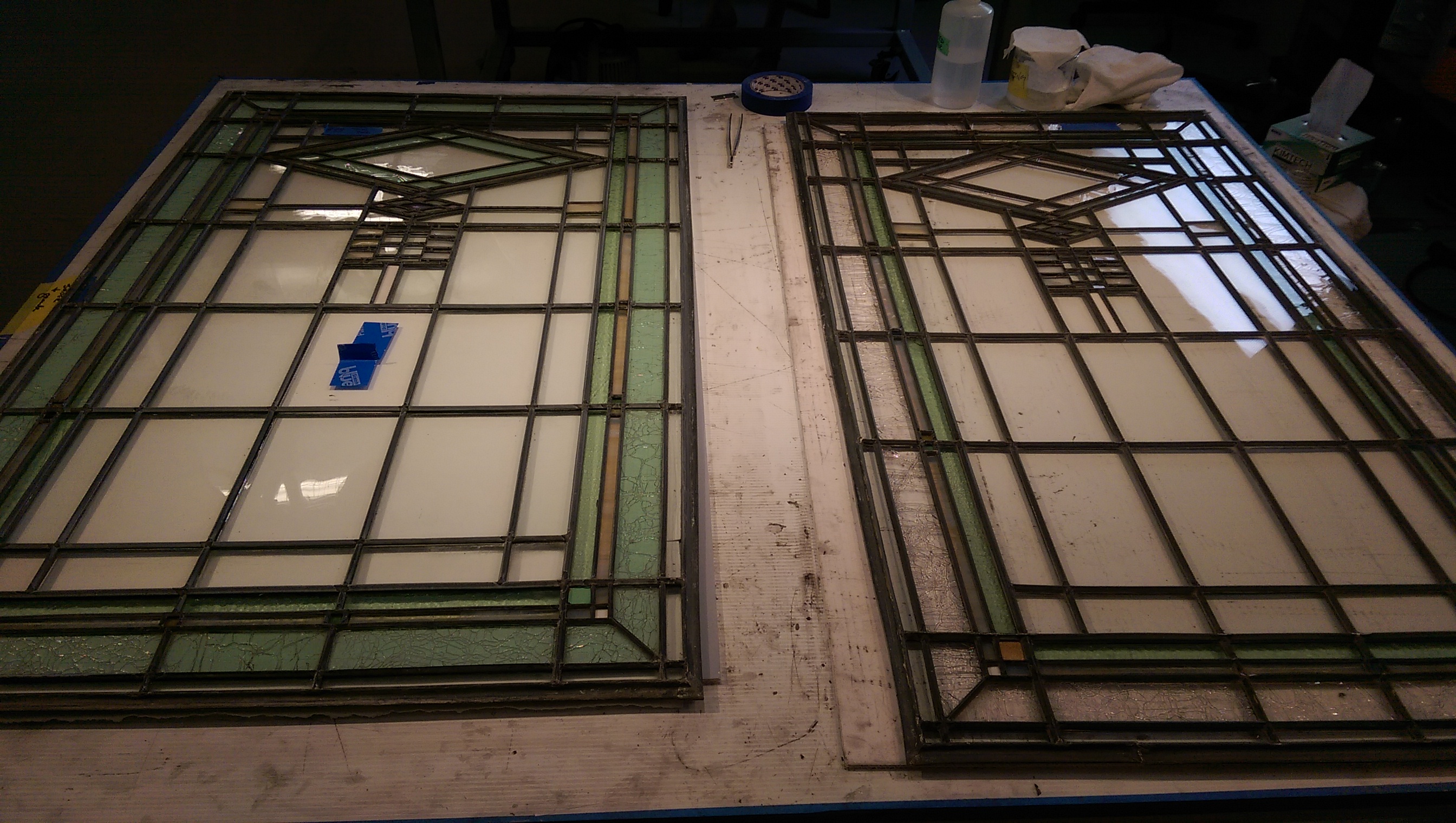
Two of the eight windows that underwent conservation. The slightly wider window on the left is a fixed window, while the narrower one on the right is a casement window.
Clues of a Rushed Assembly Line
The experts at the Midwest Art Conservation Center (MACC) who worked on the Purcell-Cutts House window conservation project noticed some interesting bits about the windows that are consistent with the story of Mosaic Art Shops’ race to finish them.
The windows are high quality. But as the conservators removed the old grout, the crucial connector between the zinc cames—the slender, grooved metal strips used to hold together individual pieces of glass in stained glass—and the glass, they noticed elements that suggest the studio was rushing to meet the deadline.
Sharretts’ staff probably cut all the small glass pieces at once, for an assembly-line approach to manufacturing (heck, the order was for 80 windows, doors, and bookcase doors—you’d want a system in place, too). Most of the upstairs windows are 46 by 25 inches, though several have slightly wider dimensions, because they were the few that were fixed or non-opening windows, not casements like the majority (the photo at the top shows many second-floor casement windows open).
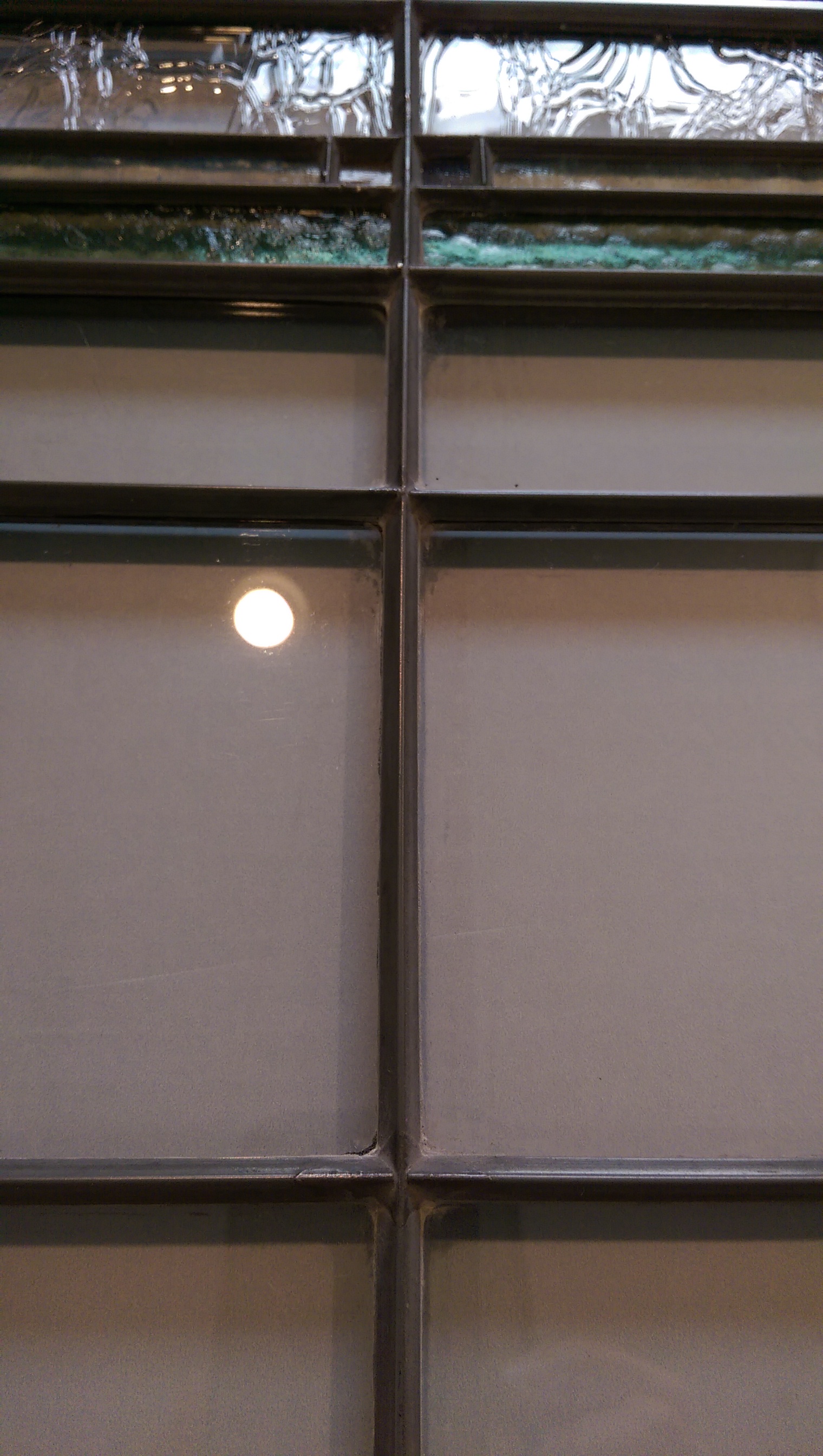
This detail of zinc caming on a conserved window shows the clean solder joints of experienced glass artists.
Gillian Thompson, a stained-glass specialist contracted by MACC for the project, found that in places, some of the original glass pieces were a bit too small for the window cames, especially on the slightly larger windows. Instead of cutting new ones—which would have been time-consuming and expensive for specialty glass—the artisans just added more grout to keep the glass pieces in place.
She also noticed differences between the most beautiful solder joints, made by those with plenty of experience with this exacting alternative to lead, and those made by assistants—not quite as perfect—even within the same window. You could draw an analogy to a Renaissance painting workshop, where the master would complete one part and assistants would finish the rest.
A Masterpiece of Trust and Playfulness
Thompson was quick to add that “even in haste, they did a good job,” remarking that the windows, with their hand-blown craquelure glass and iridescent glass, would have been expensive luxury items for any homeowner. She also noted that the “crisp, clean, elegant” lines of zinc are perfect for the house’s angular style. Sharretts’ staff had the facility to use three or four different thicknesses of came in the glass, which Thompson likened to a line drawing in three dimensions.

In this conserved window panel, you can see that various thicknesses of zinc caming were used for emphasis.
It’s a testament to the level of trust that Prairie School architects had in their crucial craftsmen, those who helped realize their vision. Purcell and Elmslie trusted E. L. Sharretts’ firm with the glass for most of their projects, giving them freedom within the designs to insert punctuations of color, as seen along the border of the Purcell-Cutts House windows, where tiny boxes vary in color and number throughout the house. This sense of playfulness was perfect for the house Purcell and Elmslie called “The Little Joker,” surely a delight to move into for the Christmas of 1913.
Tour the Purcell-Cutts House
The Purcell-Cutts House, designed and built by William Gray Purcell and George Grant Elmslie, is a masterpiece of Prairie School architecture. The house has been extensively restored and is now a part of Mia’s collection. Tours of the house take place the second full weekend of each month.
 The Purcell-Cutts House Window Conservation project was financed in part with funds provided by the state of Minnesota from the Arts and Cultural Heritage Fund through the Minnesota Historical Society.