
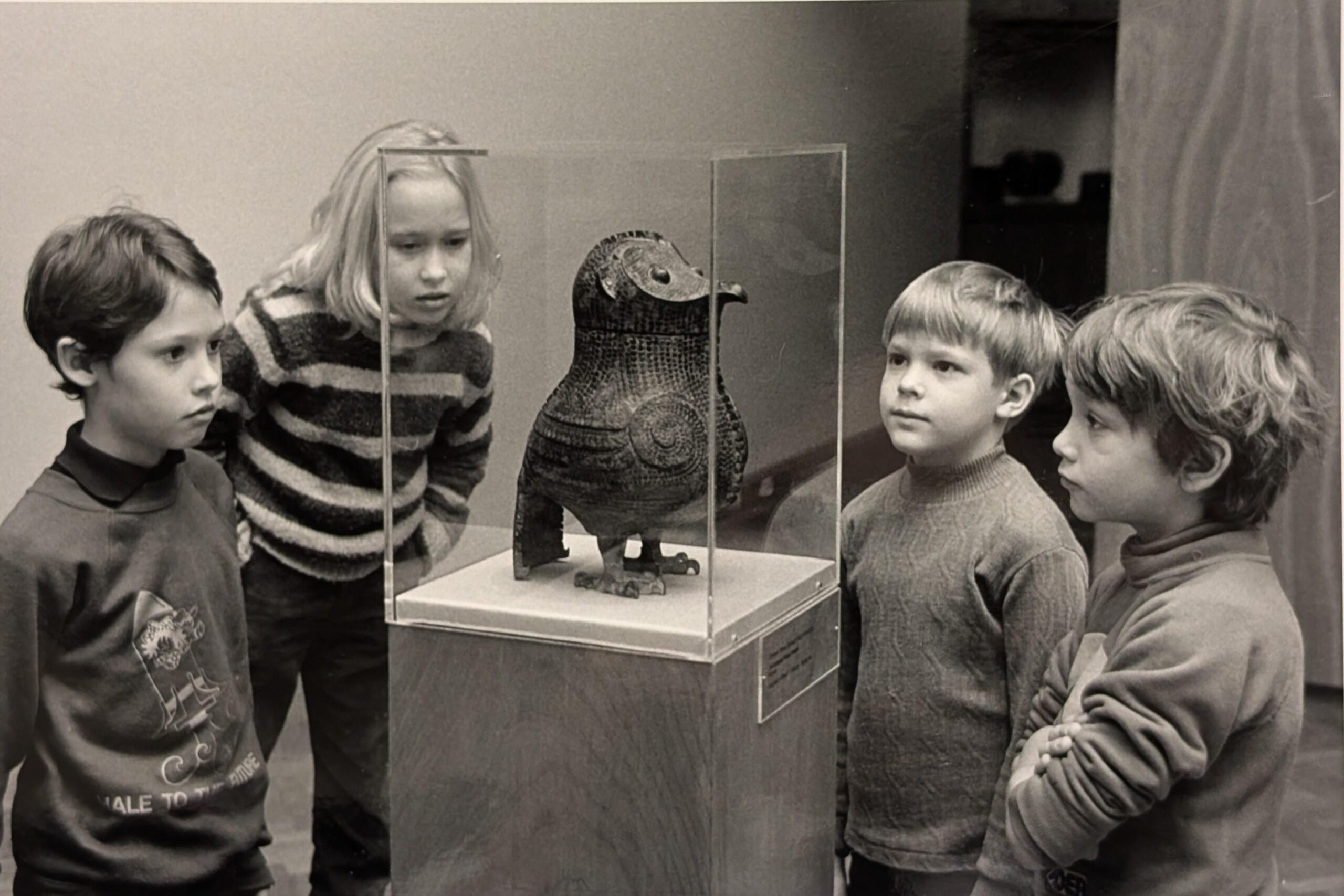
The Return of the Pillsbury Owl: Conserving a Shang-Dynasty Masterpiece
By Tara Kaushik
March 18, 2026—This story has a happy ending. The 13th–12th century BCE Zun wine vessel in the shape of an owl, fondly known as the Pillsbury Owl, will return to Mia’s galleries on April 11, 2026.
Three years ago, a visitor accidentally knocked the owl off its plinth during the exhibition “Eternal Offerings: Chinese Ritual Bronzes.” It would take a cross-continental group project of sorts to conserve the much-loved, 3,200-year-old object, a fixture of Mia’s collection for more than 70 years.
A Bit about Bronzes
The Pillsbury Owl is a zun, a type of bronze wine vessel used by Shang-dynasty (c. 1600–1046 BCE) aristocrats. Divided into two parts—the head, which is a removable lid, and a hollow body—the vessel belongs to a small group of Shang bronzes shaped like animals. Examples have also survived in the form of buffalo, boars, rhinoceroses, elephants, and rams. The Pillsbury Owl is one of the oldest among the few remaining owl-shaped zun.
A belief in the afterlife and the continuity of the spirit guides the use of these vessels. Bronze was a precious metal at the time, a symbol of power, and the vessels were designed for ritual use during temple ceremonies honoring ancestors. Each had a different use—some, like the owl, were designed to carry wine, others, food—all intended to make offerings to, and commune and connect with, ancestral spirits.
The owl was among 150 ancient Chinese bronzes bequeathed to Mia in 1950 by Alfred Pillsbury, son of John F. Pillsbury, cofounder of the Pillsbury Company. Pillsbury was a long-standing philanthropist in Minneapolis, president of the Park Board, chairman of the board of trustees at Mia, and a prolific collector of Asian art. In his will, he left a million dollars’ worth of Asian art to Mia, at the time the most valuable collection ever given to the museum.
Pillsbury began collecting jade shortly after World War I, giving several hundred pieces to Mia, before branching into Chinese and Persian pottery, Chinese tomb figurines, and ultimately Chinese ritual bronzes. A summary of his donations, published by Mia in 1948, described the bronzes as “the ultimate in Chinese art” and his collecting of them as “the natural last step” as well as the “most satisfying” of his collecting career.
After Pillsbury’s passing, Mia continued to expand its collection of Chinese bronzes, amassing one of the largest collections outside China. But there’s no doubt about it—the owl is the star, popular with visitors, scholars, and in Mia’s promotional and educational resources. “It’s simply beautiful. And this owl has personality, with a witty, curious expression on its face,” reads an article about “Eternal Offerings” in the Sarasota (FL) Herald-Tribune.
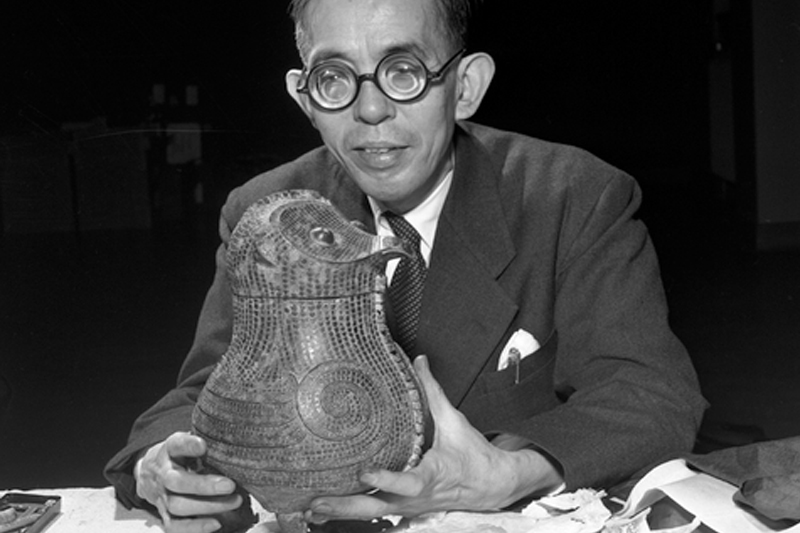
Umehara Sueji, professor of archaeology at the University of Kyoto, examines the owl on a visit to Mia in January 1954.
A Group Effort
Conservation of the owl was entrusted to Japanese conservator Keisuke Sugimoto, widely respected for his expertise in restoring Chinese bronze masterpieces for museums and private collectors. Using X-ray images taken before the accident, Sugimoto identified both recent damage as well as evidence of earlier restorations, indicating that this wasn’t the first time the owl had been damaged and repaired in its long life.
The Bank of America Art Conservation Project and the Sumitomo Foundation generously funded the restoration. Mia was selected as one of the 2025 Bank of America Art Conservation Project awardees—one of 16 projects from around the world, and the fourth Mia object to receive the honor since 2013.
Since 2010, the Bank of America Art Conservation Project has funded more than 275 conservation efforts in 40 countries, preserving works of historical and cultural significance, including national treasures.
“Supporting the arts is a cornerstone of our commitment to the communities we serve, and Bank of America’s Art Conservation Project invests in the direct preservation of irreplaceable historic and cultural treasures,” says Bank of America Twin Cities president, Lucas Giambelluca. “Helping to conserve the owl is a highlight of our long-standing partnership with Mia and ensures that this legacy and inspiration remain accessible for generations to come.”
The extent of the damage meant the owl could not be fully reassembled using its original material. A small number of missing elements had to be cast in bronze anew and then soldered. While conservators in the West tend to use artificial, nonmetal replacements like epoxy resin for such work, experts in East Asia use metal—a sturdier and more authentic method of restoring bronze objects. These traditional methods have been used for centuries, with good reason—the owl is now much less fragile than it was before.
Consultation with Liu Yang, Mia’s chair of Asian art and curator of Chinese art, ensured that the owl’s distinctive interior indentations, a feature typical of works cast in southern China in the late Shang dynasty, were carefully preserved.
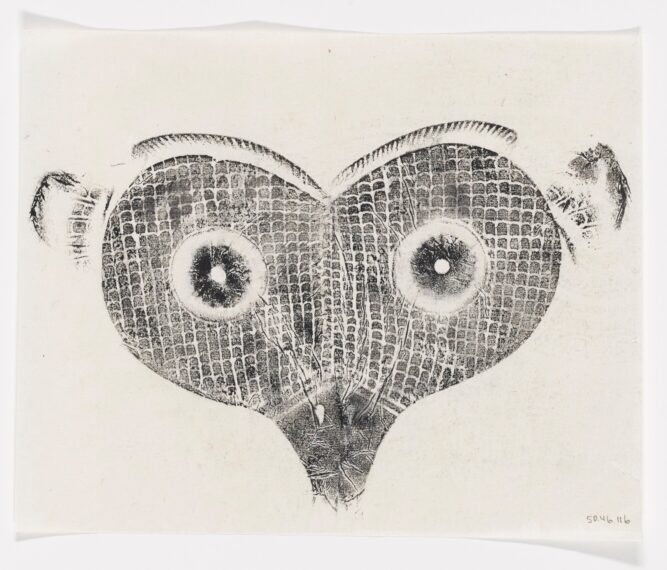
A graphite rubbing of the Pillsbury Owl.
From an Old Bird, New Insights
Conservation presented an unexpected opportunity to learn more about this historical object. Liu, Sugimoto, and conservators at the Midwest Art Conservation Center (MACC), housed at Mia, were able to study the methods used to reassemble the owl during the original conservation process before Pillsbury acquired it. Using leftover fragments, the team analyzed the vessel’s metal composition, unique to Chinese bronzes—an alloy of copper, tin, and a copper-lead mixture known as xi.
Their findings will help identify the foundry that produced the owl and refine the object’s dating. New X-ray images taken after conservation will also enhance understanding of the vessel’s construction and the differences between northern and southern bronze-casting techniques during the late Shang period.
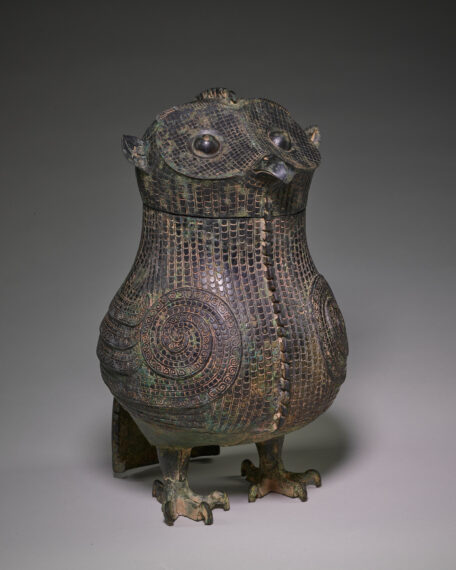
China, late Shang dynasty (c. 1300–c. 1046 BCE), Zun wine vessel in the shape of an owl, 13th–12th century BCE, bronze. Bequest of Alfred F. Pillsbury, 50.46.116A, B
Back to the Galleries
What is it about the Pillsbury Owl? It’s an ancient ritual object, one with tremendous scholarly and cultural significance, a testament to Shang-dynasty bronze mastery that has survived millennia and more than one instance of damage. It’s also very cute.
“It’s a lovely bird,” says Liu. “Highly naturalistic. If it was just a vessel, perhaps no one would pay attention to it. The form is very attractive. It has these almost innocent features.”
Restored and resilient, it’ll soon be back on its perch.