

Inherent Vice: Saving a Beloved George Morrison Painting from Itself
December 8, 2025—An untitled 1960 painting by Ojibwe painter and sculptor George Morrison, a beloved Minnesota artist, spent 18 years lying on its back in storage. And for good reason.
It certainly wasn’t unloved. The striking abstraction of an urban landscape had been hanging in an office at Mia for years, a favorite of one of the museum’s former directors. But in 1999, curators noticed that its condition was deteriorating. The painting had what is known in the conservation world as inherent vice: Due to one or more of its intrinsic characteristics—in this case, Morrison’s thick, topographical paint strokes—deterioration and self-destruction of the painting were inevitable.
The paint was actually weighing down the canvas, and as the canvas aged, it could no longer support the sheer weight of the paint on the surface. The more years it spent hanging upright, the more slack the painting became. Conserving it was too costly at the time. So into storage it went, lying down to prevent further damage, almost as though it had been laid to rest.
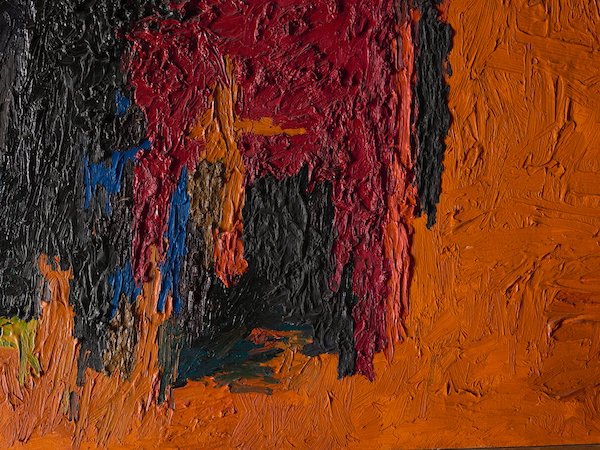
A detail of George Morrison’s untitled painting from 1960.
The Restoration Process
In 2015, when Mia acquired another Morrison painting, the untitled work was suddenly resurrected. Curators decided to have the painting moved to the Midwest Art Conservation Center (MACC), housed at Mia. Paula Vesely, a long-time admirer of Morrison’s work and a prior participant in MACC’s Adopt-a-Painting program, generously offered to fund the project.
MACC already had the perfect person for the job. David Marquis had been working as a conservator at MACC for 33 years when the Adopt-a-Painting funds to restore the work were procured—in fact, it was right before his retirement.
Marquis not only admired Morrison’s work but had also taken painting classes with Morrison while an undergraduate student at the University of Minnesota. When Marquis was earning his MFA, Morrison served on his thesis committee.
“If I had known when I was 25 that when I was 68, I’d be a conservator and working on one of George’s pieces, I never could have imagined that,” he said.
Morrison would pay graduate students to help move some of the large wood pieces he was working on in his studio, and Marquis was often among those hired to help.
“You know that wooden collage they’ve got up there?” Marquis said of Morrison’s Collage IX: Landscape, a staple in Mia’s galleries. “I helped move that! Those things were so heavy.”
A Labor of Love
Morrison’s painting would finally be restored, but that didn’t mean it would be easy. The work’s inherent vice necessitated numerous stages of restoration.
“The paint was stronger than the canvas, so it started making the canvas deform and do what it wanted to do,” Marquis said.
As a result, many passages of the painting were insecure and lifting, and required consolidation to prevent additional losses. And both consolidation and cleaning were challenging because of the thick texture of the paint.
“In conservation, the painting always tells you what it needs,” Marquis said. “But before you proceed on any treatment, you test and retest.”
Over the course of about 60 treatment hours, Marquis reattached and consolidated areas of lifting and insecurity using a thermoplastic adhesive and controlled heat, filling in voids with pigments and wax. After the paint was secure, he cleaned the highly textured surface using a delicate “dry cleaning” technique generally used in paper conservation.
Marquis reattached the canvas to a new, heavier-weight stretcher prepared with a “loose lining” for added support. Although the painting had not previously been framed, Marquis recommended framing it to further maintain the work’s structural integrity. He chose a design that stylistically matched other framed Morrison pieces.
For Marquis, it was serendipity—this would be his last project as a conservator.
“It just felt right that I should be doing that,” he said. “I had a big personal as well as professional interest. After it had been in storage for so many years, I never thought I’d see that painting again. The odds of it happening at that particular time are pretty amazing.”
The painting is on view in Gallery 303, and Marquis believes it would have the Morrison stamp of approval: “I think he’d be proud to see it as it is now.”
Learn More
Watch as Mia curators explain Morrison’s unique and sometimes uncomfortable place between two worlds, the New York art scene, and his native roots in Minnesota.