
Education Guide: Paris Couture
Recommended for Teachers and Students in Grades 5–12
This guide to “Paris Couture” is designed to help learners make connections between high fashion as it developed in Paris beginning in the 1880s and their own lives today. Brief essays introduce students to historical periods and the cultural changes that influenced fashion, while highlighted artworks illustrate innovations from each period. Short activities encourage close looking, critical thinking, and connection. Use this guide in your classroom before visiting the museum or in the galleries to inform a self-guided experience.
The guide also includes a short introduction to the elements and principles of fashion design to assist you in talking about the fashion creations with students of all ages.
Looking to visit the exhibition with your students? Simply request a free guided tour (for groups of 60 or fewer students). You can also register your group of 10 or more students for a self-guided experience using the same form. We look forward to seeing you at Mia soon.
Introduction
“Paris Couture” brings together 83 couture works from the Palais Galliera, plus ephemera, photographs, drawings and accessories, spanning the late 1800s to today. The exhibition explores how fashion can tell the stories of history, culture, innovation, and changing social values. Drawing from the renowned collection of the Palais Galliera, the exhibition traces the
evolution of Parisian haute couture from the opening of the first modern fashion house in 1858 to contemporary design. Through clothing, students can discover how fashion reflects the world around it, responding to shifts in technology, economics, gender roles, and artistic expression.
The exhibition highlights key moments in fashion history beginning with the groundbreaking designs of Charles Frederick Worth in the late 1800s and the rise of sportswear and changing lifestyles in the early 1900s. It illustrates how cultural movements, including new freedoms for women in the 1920s and the impact of economic hardship and war in the 1930s and 1940s inspired major changes in fashion. After World War II, Christian Dior’s influential “New Look,” the bold geometric styles of the 1960s, and iconic garments such as the Chanel suit show how fashion can shape and reflect identity across generations.
Beyond its historical narrative, the exhibition offers insight into the design process, craftsmanship, and creativity behind these extraordinary garments. By examining the artistry, technical skill, and problem-solving involved in haute couture, students can make connections to subjects such as history, visual arts, design, engineering, and social studies, while gaining a deeper appreciation for fashion as both an art form and a cultural record.
The Birth of Couture (1890–1919)
Haute couture (oat koo-TOOR), which literally means “high dressmaking” or “high sewing,” is a professional trade. Since the 1600s, the city’s skilled “artisans de l’élégance” (expert craftspeople who make custom clothing and accessories) have been admired across Europe. However, haute couture really began to grow during the Second Empire (1852–1870), when Paris was being redesigned. Large building projects in the 1850s changed how people moved around the city. Wider, cleaner streets and new parks gave people places to walk, and major roads and train stations were connected, making the city easier to get around.
In 1858, Charles Frederick Worth and his partner Otto Bobergh created a new way to sell luxury fashion. Before this, designers showed customers fabric samples and made clothing based on their requests. Instead, Worth and Bobergh presented fully finished outfits that they designed. They organized their designs into seasonal collections, shown in large, well-lit rooms and modeled by real women. Their innovation changed the role of designers from following orders to being creative leaders.
After Worth & Bobergh, many fashion houses (“maisons de couture”) opened. They combined the speed of sewing machines with detailed decorations made by hand. Skilled workers like embroiderers, feather makers, and pleaters all helped create unique pieces, making Paris a center for new ideas in fashion.
The fashion houses’ fame attracted clients from around the world, including many American women who traveled by ship to find the latest fashions. In 1870, Worth opened his own fashion house and became known as a “grand couturier,” a designer whose artistic vision was highly respected. He even signed his garments with his name, like an artist signing a painting, to show that each piece was created by him.
Around 1900, Paul Poiret also became recognized as a grand couturier. He had worked for the House of Worth before opening his own studio in 1903. He was known for his bold personality and love of craftsmanship. His designs used bright colors inspired by modern Fauvist painting and styles influenced by Neoclassical fashion from after the French Revolution. He also played a role in the movement away from tight corsets, which had shaped women’s bodies in the 1800s, replacing them with wide belts made of a strong fabric called grosgrain. Although he is often seen as someone who freed women’s bodies in fashion, he was actually part of a larger social movement happening across Europe at the time.
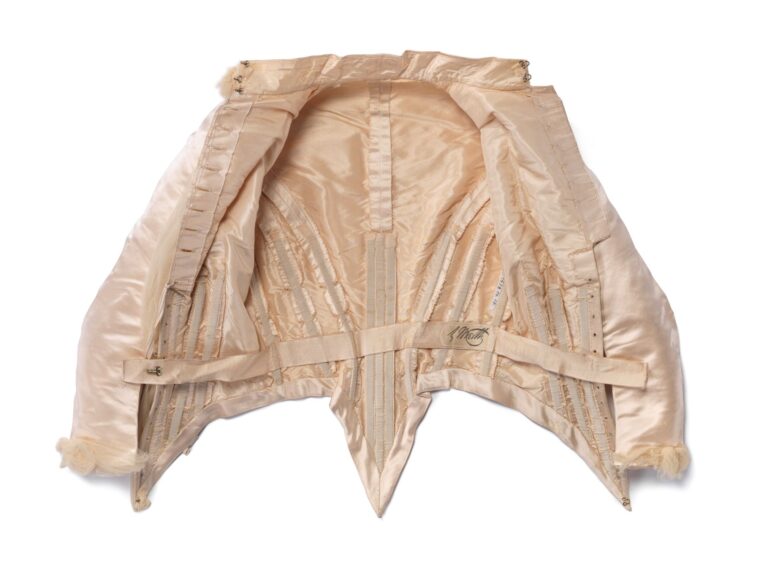
Charles Frederick Worth (British, 1825–1895), bridal bodice, c. 1880, silk satin and silk tulle exterior, figured silk twill waistband, silk taffeta lining, metal boning. Palais Galliera, gift of Mme M. R. G., 1959.10.15
Reproductions of Charles Frederick Worth’s handwritten signature initially appeared printed on labels sewn onto his designer garments—an indication that the couturier was an artist. Later, Worth’s signature was woven directly into the garment, as on the waistband of this bridal bodice.
Activity: Read and Discuss
30–45 minutes
Select two or three questions to discuss in small groups or as a class.
• In what ways can fashion designers be considered artists?
• How do modern fashion designers, influencers, or brands shape trends today?
• What modern technologies have transformed fashion in ways similar to the sewing machine’s impact in the 1800s?
• Who benefited most from the growth of haute couture, and who may have been excluded from it?
• To what extent is fashion driven by artistic creativity versus business interests?
• Why do societies often celebrate individual designers when many skilled workers contribute to the final product?
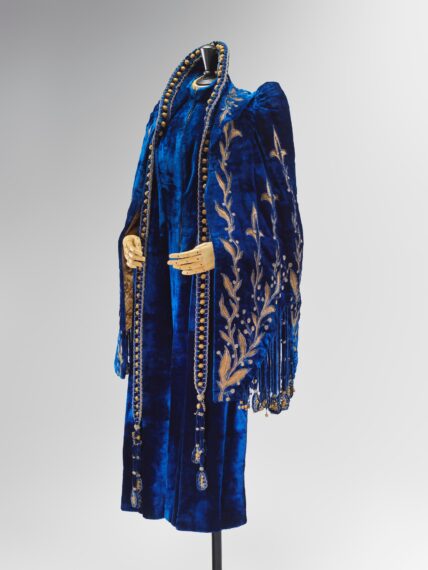
Gilles J. and Co., visite (visiting coat), c. 1890, cut silk panne velvet,
silk cannelé (fluting), metallic threads, passementerie (decorative
trim), quilted silk satin lining. Palais Galliera, gift of Mme Claude Ritter, 1958.61.7
Following the example of Charles Frederick Worth, fashion houses combined the speed of machine-made clothing (made possible by the modern sewing machine) with detailed handmade embellishments. Haute couture was known for its detailed designs, but it usually did not create completely new styles of clothing. Instead, it enhanced garment types that were already in fashion, such as the visite, or visiting coat. The visite, an important outer garment in the second half of the 1800s, had a special bodice shape that used an inner waistband to follow the natural curve of the back. Though fashionable, the angled sleeves limited arm movement.
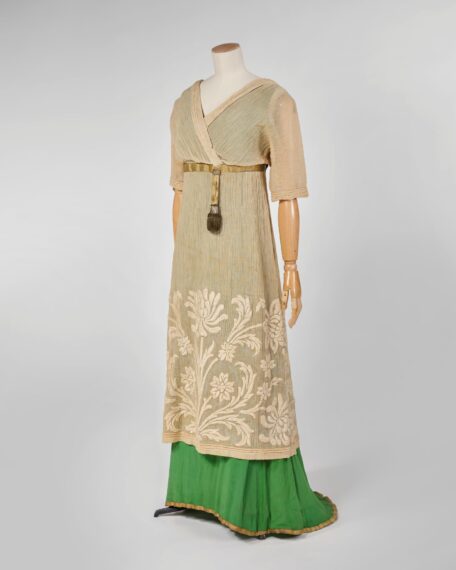
Paul Poiret (French, 1879–1944), formal dress, Spring/Summer 1910, pleated and embroidered cotton crepe with dotted Swiss pattern, lamé, metallic thread tassel, Chinese crepe. Palais Galliera, gift of Georges Combe, 1969.15.5
Starting in 1906, Paul Poiret’s designs broke away from the tight, corseted S-shaped styles of the 1800s. He was inspired by clothing from the Directoire period (1792–1804) after the French Revolution, when dresses had waistlines placed just below the bust. The high waist of this elegant dress is highlighted with a tassel made of gold metallic thread. Its long vertical shape is emphasized by layering a white tunic over a bright green sheath dress. The bold green color reflects the strong colors used by Fauvist painters at the time.
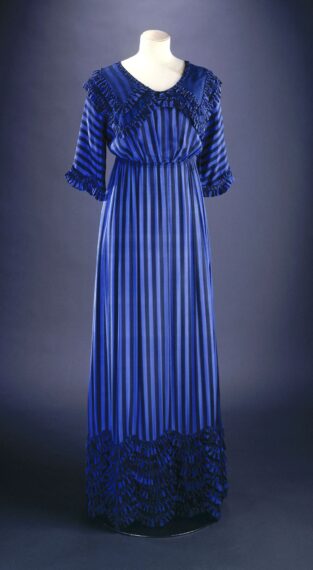
Jeanne Lanvin (French, 1867–1946), “Feuille morte” (Fallen Leaf) formal dress, Spring/Summer 1914, printed silk crepe, piping appliqué, silk tulle. Palais Galliera, gift of Mmes Vincendon and Dallemagne, 1965.47.16
The “Feuille morte” dress, made in Jeanne Lanvin’s signature blue, shows her great skill as a designer. The collar, sleeves, and ruffles on the skirt are decorated with piping, small tubes made from the same striped silk fabric as the dress. A layer of tulle covers the collar and the ruffles. These details, which were a sign of understated luxury at the turn of the century, were recognizable to people involved in haute couture. The dress’s high waist and slender silhouette, highlighted by the fabric’s vertical stripes, recall the fashions of the Directoire period (1792–1804) to which many designers at the time looked for inspiration.
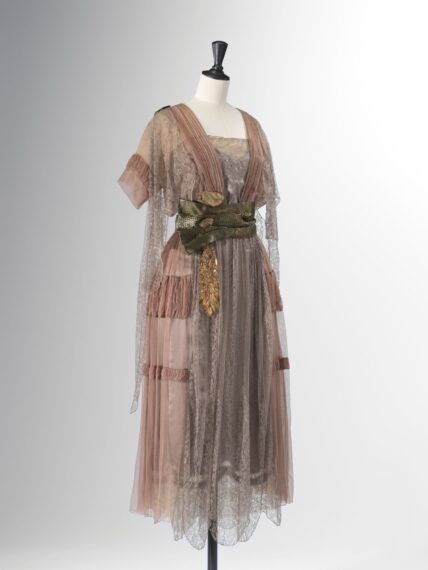
Lucile (Lucy Christiana, Lady Duff-Gordon, British, 1863–1935), formal dress with imitation crocodile belt, c. 1919, Dress: silk satin, machine-made silk lace, ladder lace, mousseline; Belt: satin, lamé embroidery. Palais Galliera, acquired by the City of Paris, 1987.2.22A–B
Lucy Christiana, Lady Duff-Gordon, born to a Canadian family living in London, began working in dressmaking in the early 1890s to support herself and her daughter following a divorce. In 1893, she opened Maison Lucile in London. Its success allowed her to open other stores, beginning with New York in 1910.
In 1912, she survived the Titanic disaster along with her husband. Lucile’s reputation remained strong despite rumors that their lifeboat, which was only one-quarter full, did not return to help people in the water. That same year, she opened a workshop in Paris, followed by another in Chicago in 1915.
In the dress shown here, she skillfully combines materials in soft colors that were fashionable at the time. The dress includes mauve muslin, old rose lace folded over pearl gray satin, and two shades of deep green satin decorated with gold lamé embroidery.
Activity: Look and Discuss
20 minutes
Look closely at the coat and three dresses above. What words would you use to describe each one? Based on your observations, what are some of the important design elements of the styles that early haute couture fashion houses created during the period from 1890 to 1919?
Compare and contrast the three dresses. What do they have in common? How are they different?
What does this photograph from 1915 (below) tell you about the fashion of the times? What can you learn from the photo that you cannot learn from seeing the dresses on mannequins?
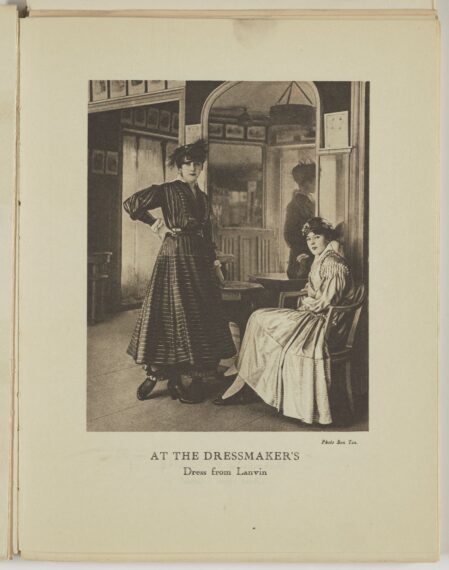
“At the Dressmaker’s” (Lanvin), a photograph from The 1915 Mode as Shown by Paris, a souvenir issue of Gazette du Bon Ton (Gazette of Good Taste) published in America and France in partnership with Condé Nast. Minneapolis Institute of Art, P.22.288
Couture Merchandise
As Parisian haute couture grew in the 1910s, fashion houses began exploring new ways to promote themselves and build their brands. Paul Poiret hired well-known illustrators to create albums of his collections, had his designs photographed for newspapers, and even filmed his 1913 fashion show to share it with an international audience. He paid close attention to every detail of his brand, from his rose logo on his labels, to the letterheads on his bills, and even the design of his packaging boxes.
In 1911, Poiret started a perfume company called Les Parfums de Rosine, named after his oldest daughter. This made him the first fashion designer to create his own perfume. Perfume helped fashion houses become known around the world by expanding the designer’s style beyond clothing and reaching more people, not just wealthy couture clients. Other designers followed his example, including Gabrielle Chanel, who introduced her famous No. 5 perfume in 1921.
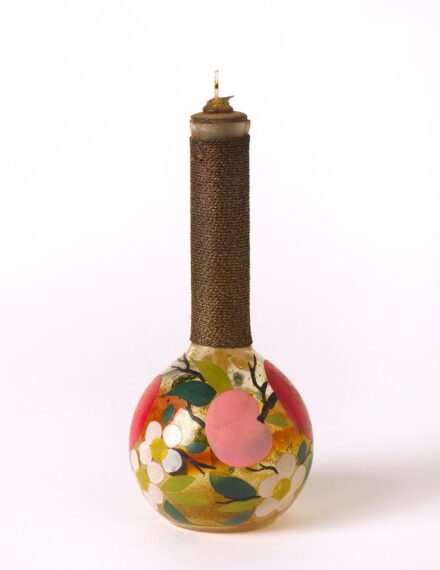
Les Parfums de Rosine, Borgia perfume bottle, 1920–25, painted glass, paper, metal. Palais Galliera, acquired by the City of Paris, 2004.847.1
The Parisian fashion house of Paul Poiret introduced Les Parfums de Rosine’s Hahna, l’étrange fleur (Hahna, The Strange Flower) in 1928. He became one of the very first designers to not only launch a signature fragrance line but also to control the entire production by opening his own factory. He oversaw everything from synthetic scent creation to the design of custom glass bottles (flacons) and detailed branded packaging.
Poiret drew inspiration for the perfumes from his travels, the theater, and his love of the decorative arts. Hahna, l’étrange fleur reflects the Roaring Twenties fascination with Orientalism (the Western practice of viewing and describing Eastern and Middle Eastern cultures in a stereotyped way, often emphasizing what was considered exotic), mythology, and floral scents. He introduced it alongside other Rosine perfumes like Nuit de Chine (China Night), Aladin (Alladin), and Le Fruit Défendu (Forbidden Fruit).
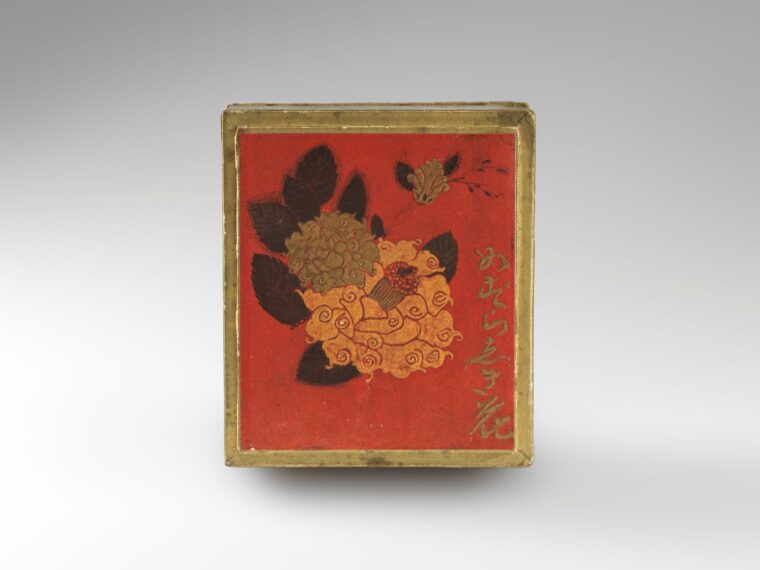
Les Parfums de Rosine, Hahna l’Étrange Fleur (Hahna, The Strange
Flower) perfume bottle and its box, 1928, metal, glass, paper, cardboard.
Palais Galliera, acquired by the City of Paris, 2004.845.1.1–4
Activity: Discuss and Create
30–60 minutes
If time allows, read the text before discussing.
Paul Poiret used illustrations, photographs, film, logos, and perfume to promote his fashion house. How do fashion brands
today use social media, influencers, videos, and other products to build their image and attract customers?
Poiret expanded his brand beyond clothing by creating a perfume line. What examples can you think of today where a company or celebrity sells products beyond their original business, and why do you think this strategy is successful?
Imagine you are an influencer (or maybe you already are!). What would be your brand? Sketch some ideas of products you might use to promote yourself and your brand. You could even create a mood board!
Magazines
As World War I ended, fashion publications began to focus on forward-looking design trends. Commentaries provide insight into the radical departure from corsets and the move towards designs that celebrated freedom of movement with looser, more practical silhouettes, shorter ankle hemlines, and sportswear.
A small group of well-known magazines addressed this transition to fashions that came to define the Roaring Twenties. American Vogue magazine celebrated the return of Parisian couture after the war. Harper’s Bazaar showcased Art Deco influences and the early concepts of practical, day-to-day fashion for the modern woman. The Delineator reached a broad audience of women who made their own clothes by promoting sewing patterns for looser day dresses and practical apparel for entering the workforce. La Gazette du Bon Ton, a French fashion publication, promoted fuller skirts with raised hemlines as both practical and patriotic in 1919.
Trends highlighted in magazines included the “Camargo” silhouette, a new, slightly fitted waistline that sat higher and led the eye down to the ankles; simplified headwear including small, round velvet and fur hats; and shorter sleeve designs like the “butterfly” or “wing sleeve.” The trend toward comfortable, gender-neutral sportswear—middy blouses, knickers, gym clothes—also attracted attention.
Sylviac, the writer of the article Sur le costume tailleur (On the Tailored Suit) in the February 1914 issue of Gazette du Bon Ton (see below for full text), was not a fashion journalist but a well-known stage and film actress. This commentary reveals Sylviac’s disdainful but also humorous opinions. She suggests that women want the modern image of the tailored suit but reject its simple and strict style in favor of whatever suits their body type and personal sensibility.
Activity: Read and Discuss, 45 minutes
Read the commentary by Sylviac below. A well-known stage and film actress in the early 1900s, Sylviac’s writing was published in the February 1914 issue of Gazette du Bon Ton.
Respond to a few of the discussion prompts that follow in small groups or as a class.
On the Tailored Suit, by Sylviac
It is evident that the woman’s tailored suit represents our era; in the distant future, when the woman of the Third Republic is portrayed, she will be dressed in a strict jacket and a serge skirt, for not only do the dress and hairstyle lend themselves to the material needs of those who wear them, but they also reflect their state of mind. The pious ladies of the Middle Ages hid their hair under headdresses, the courtesans of the eighteenth century had their bodices deeply cut; our contemporaries, with their progressive ideas, wanting to be the equals of men, dress exactly like them, for a skirt that is too narrow now looks nothing more than trousers that are too wide. Yet the tailored skirt didn’t initially show such boldness. Timid at first, it was long, wide, retaining in its awkward fullness something of the constraints of the past, but it has become quite practical since the feminist movement has intensified: as [the movement] has expanded, [the skirt] has contracted. Since women’s admission to restaurants and the liberal professions, the short, fitted, practical tailored suit is the one they most readily wear, during the day of course, at the hours of male activity.
But no matter how much they want to be men, they will always remain women; it’s not some good old-fashioned Mr. de La Palisse [proverbial expounder of naïve truths] who, on this occasion, is spreading this well-known truth, but their favorite suit that reveals it. In reality, the women’s suit should follow the men’s; strict and severe, it should, like its counterpart, vary very little, but try asking women for such consistency, especially in matters of fashion! Isn’t this where their whim reigns supreme? So much so that our contemporaries have only one idea: to keep the suit while altering it, and to wear it while not wearing it. They play with it as with a familiar theme; the woman’s suit has variations, currently so many that it is hardly recognizable anymore. Considered severe, boring, and in poor taste when overly masculine, it began by embellishing itself with subtle details. On its clean lines, buttons added whimsical touches, lighter silks brightened the rigid lines of the stitching, and these timid attempts at emancipation having met with great success, the focus shifted from detail to the whole, which changed little by little. Masculine clothing was interpreted in a feminine manner: hunters, sailors, hussars, and students lent their jackets, their large collars, their frogging [ornamental braided closures], but then, as this field was necessarily limited and people thus dressed looked a bit like they had stepped out of a magazine, it quickly grew tiresome, and the focus shifted entirely to pure fantasy. Moreover, nothing could better distinguish the tailor of yesteryear from that of today than [a suit’s] method of construction. Formerly it was made by men; now that it is made by women, the tailors only retain the basic division, with a suit defined simply as [being] any two-part garment: a skirt that is always short, and a jacket, bolero, or smock that can be lengthened or shortened according to the physique and whim of the wearer. The tall, the majestic, are condemned to the long basque [peplum], to dark colors, to discreet embellishments; but the short, the tiny, the stubby, those for whom current fashion seems predetermined, more than make up for it. Their whimsy borders on eccentricity, but they don’t forget that in these times of aesthetics, clothing must serve to correct the faults of Mother Nature, so those who, endowed with legs that are too short, wish to lengthen them, almost always stick to the bolero; those who have the opposite desire favor the belt placed as low as possible; the hips that are too thin are adorned with the Persian jacket whose pleated basque is trimmed with furs; the overly generous breasts are concealed under wide oriental sleeves. All colors, all styles, all eras are found and blend into the tailored suit. Even the classic Amazon has changed incredibly, and the ghost of [equestrienne and circus performer] Mademoiselle [Elvira] Guerra would rear up in surprise at the sight of the Cowgirl you see here galloping down a path in the Bois de Boulogne. There remains no good reason why we shouldn’t meet her there one of these mornings. Ladies, you’ll laugh at her at first, then a little later you’ll say, “But why not?” and you’ll end up copying her exactly. It’s the story of all fashions, and there’s none more picturesque and amusing than this one.
Discussion Questions
What do you think the author is saying about women of her era?
What connections is she making between modern women and what they want from their clothing? How does clothing today reflect people’s values or personalities? What does your clothing tell other people about you?
What connections does the author make between the change in women’s fashion and the expansion of women’s rights? What are some examples of clothing trends today that relate to social changes?
The author expresses her opinion that women of her time wanted to dress more like men in tailored suits but also wanted to be more creative and comfortable and express themselves through their suits. How do fashion choices today allow people to show who they are? How do fashion choices blur the lines of gender identity?
The Roaring Twenties (1920–1929)
Haute couture changed greatly during the 1920s. Dresses became straighter, waistlines disappeared, and, for the first time in Western fashion history, women’s legs were shown, especially in evening dresses with hemlines above the knee. Gabrielle Chanel, widely known in the United States as Coco Chanel, helped make fashion more flexible and comfortable by using jersey fabric, a machine-made knit that had been used only for sportswear and undergarments before.
Almost 100 fashion houses took part in the 1925 International Exhibition of Decorative Arts in Paris. Many of the dresses exhibited had very simple shapes—some were made from just two pieces of fabric, a front panel and a back. Master artisans showcased their work through embroidery, beads, sequins, and appliqués.
Even as colonial empires gradually dissolved, Parisian fashion designers continued to take inspiration from non-European cultures, using images, symbols, and patterns like Asian dragons, palmettes, and Egyptian hieroglyphs detached from their original meanings or cultural traditions.
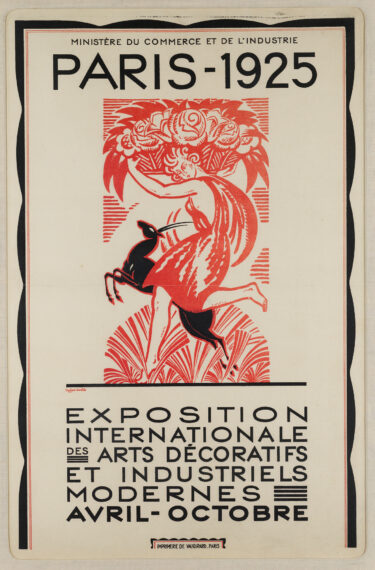
Robert Bonfils (French, 1886–1971), Paris–1925: Exposition internationale des arts décoratifs et industriels modernes, Avril–Octobre (Paris–1925: International Exhibition of Modern Decorative and Industrial Arts, April–October), 1925, color lithograph from a woodblock. The Modernism Collection, gift of Norwest Bank Minnesota, P.98.33.43
Look, Read, and Discuss
30–45 minutes
As you look at and read about the creations in this section, use these questions to reflect on the content.
European fashion designers in the 1920s borrowed images and styles from other cultures. Where do you see cultural influences in fashion, music, art, or social media today? How can people respectfully appreciate cultures different from their own?
Look closely at the dress by the Callot Soeurs and read about how they were inspired by Asian design and imagery. Do you think this dress is an example of cultural appreciation or cultural appropriation? Share your reasoning.
Gabrielle “Coco” Chanel’s designs were praised for being comfortable and practical, even though some people thought they were
too simple. What is most important to you in your style choices— comfort or appearance?
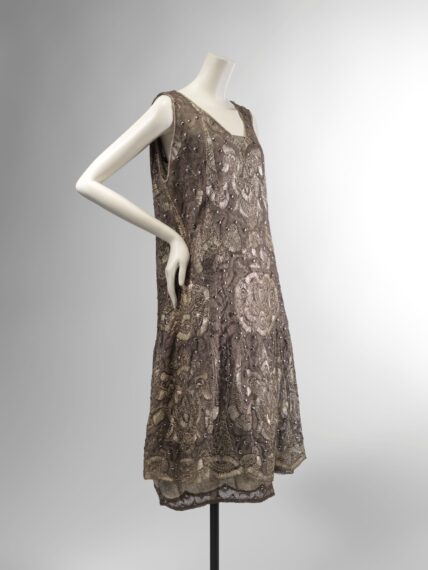
Attributed to Gabrielle Chanel, French, 1883–1971. Evening dress and slip, c. 1924. Silk tulle embroidered with metallic thread, plastic cabochons (polished gemstones), lamé. Palais Galliera, gift of Countess Renaud de la Frégeolière. 1967.42.6A–B
Gabrielle Chanel revolutionized women’s fashion during World War I by creating clothing that was more comfortable and easier to wear. Her soft jersey suits introduced a relaxed style and helped replace the corset. In 1921, her Chanel No. 5 perfume became a worldwide success, and throughout the 1920s her designs continued to simplify women’s wardrobes while remaining elegant and fashionable. This evening gown shows Chanel’s attention to detail and her belief that clothing could be both beautiful and comfortable. The dress was donated to the Palais Galliera without a designer label, but it has since been identified as a Chanel design.
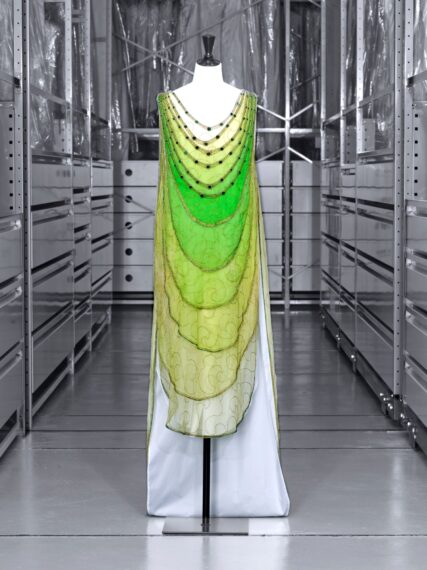
Madeleine Vionnet (French, 1876–1975), evening dress, 1922, silk
chiffon embroidered by Lesage, metallic threads, beads, micro-tubes,
faceted round rhinestones. Palais Galliera, gift of François Lesage, inv. 1992.19.1
This evening dress by Madeleine Vionnet reflects the designer’s unique style and serves as a visual signature of her fashion house. Its flowing shape and inspiration from ancient Greek clothing connect directly to the fashion house logo, created in 1919 by the Italian artist Thayaht, showing a woman wearing a Greek peplos atop a classical column and raising her arms inside a circle. This image appeared on the fashion house’s labels, advertisements, invoices, and perfume bottles until the company closed in 1939.
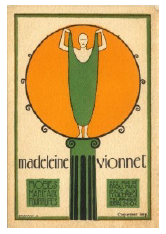
Thayaht (Ernesto Michahelles, Italian, 1893–1959), logo for House of Madeleine Vionnet, 1919
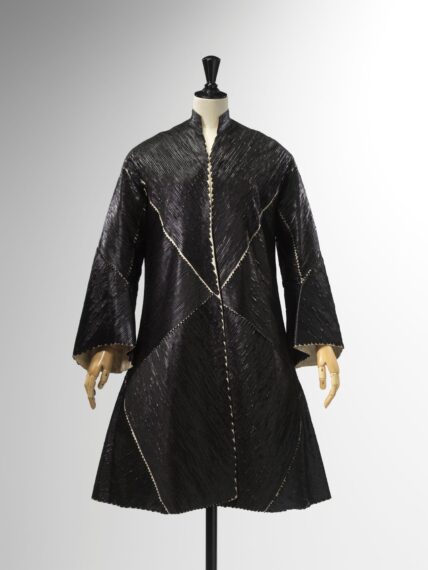
Jeanne Lanvin (French, 1867–1946), “Rarahu” day coat, Spring/Summer 1928, wild silk, waxed laces. Palais Galliera, gift of Mme Marchais, 1984.177.7This evening coat reflects Jeanne Lanvin’s careful consideration of ornamentation—her signature style. The geometry of the coat’s 21 black laces, arranged in angular spirals, gives the garment a powerful character that is further emphasized by its waxed finish, reminiscent of leather. For Lanvin, the motif, whether embroidered, painted, or printed, was just as important as the shape and structure of the clothing.
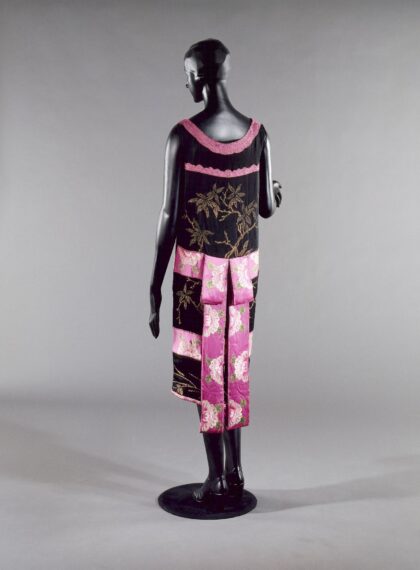
Callot Soeurs (French; Marie [1857–1927], Marthe [1859–1920], Régina [1861–1945], and Joséphine Callot [1866–1897]), “Oeil de lotus” (lotus eye) evening dress, Spring/Summer 1924, silk satin embroidered with silk and metallic thread. Palais Galliera, gift of Elina Labourdette, 1984.58.3
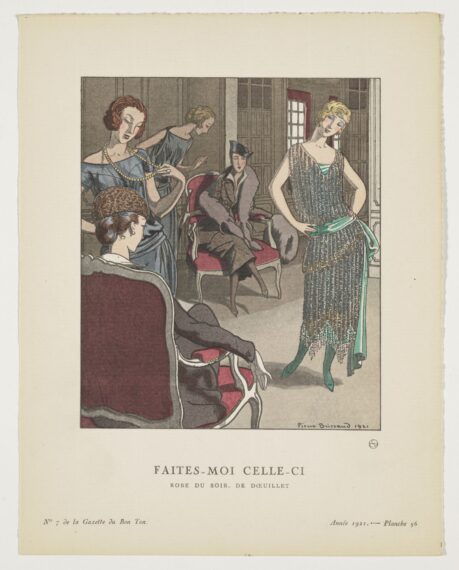
Pierre Brissaud (French, 1885–1964), “Faites-moi celle ci,” Robe du soir de Doeuillet (“Make Me This One,” Evening Gown by Doeuillet), Gazette du Bon Ton (Gazette of Good Taste), September 1921. Minneapolis Institute of Art, The Minnich Collection, The Ethel Morrison Van Derlip Fund, 1966 P.22,253
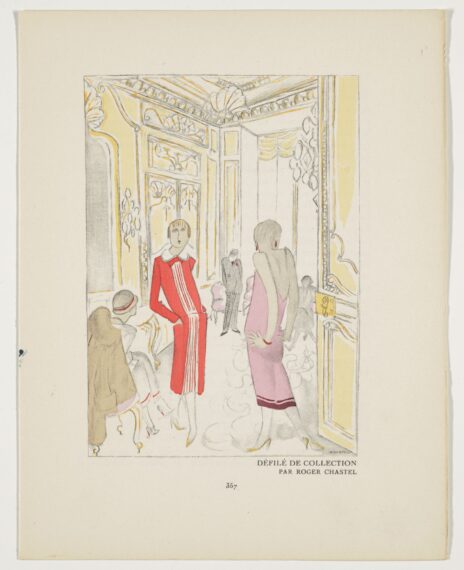
Roger Chastel (French, 1897–1981), Défilé de collection (Collection Fashion Show), Gazette du Bon Ton (Gazette of Good Taste), May 1924. Minneapolis Institute of Art, The Minnich Collection, The Ethel Morrison Van Derlip Fund 1966, P.22.275
Activity: Look, Discuss, and Create
15–30 minutes
Take a close look at each of these fashion drawings. What do you think each one is saying about women and fashion at the time?
What do you see that makes you interpret each in this way?
Sketch a picture of fashionable people today wearing current clothing—what details would you include? Think about your models, clothing, background, and accessories.
Couture in the Age of Crisis (1930–1939)
In the late 1920s, dresses gradually became longer again. This change reflected growing economic and cultural problems in Europe and the United States, especially after the 1927 Berlin stock market crash and the 1929 Wall Street crash. Fashion shifted away from decoration and focused more on shape and structure. Short dresses with dropped waists were replaced by longer, simpler, and more serious styles. A new popular evening dress, called the sheath dress, fit closely to the body. The style used a special technique called bias cut, which made the fabric fall smoothly along the body.
At the same time, new artificial and synthetic fabrics allowed designers to experiment in new ways. Creativity and innovation grew, especially with couturiers like Elsa Schiaparelli, who was inspired by the Surrealist art movement. She created unusual designs like the Shoe Hat and the Lobster Dress, sometimes working with famous artists.
In the second half of the 1930s, Neoclassicism became popular in French art, design, and fashion. This style showed up in dresses that were draped to look like clothing from ancient Greece and Rome. At the same time, a more romantic style also appeared. Evening gowns had wider skirts, similar to the large crinoline dresses of the mid-1800s.
The summer fashions of 1939, just before France declared war on Germany, were extremely elegant and detailed. However, by early fall 1939, many fashion houses, including those of Gabrielle Chanel and Madeleine Vionnet, had to close. Chanel planned to close permanently but reopened after the war, while Vionnet retired in 1940.
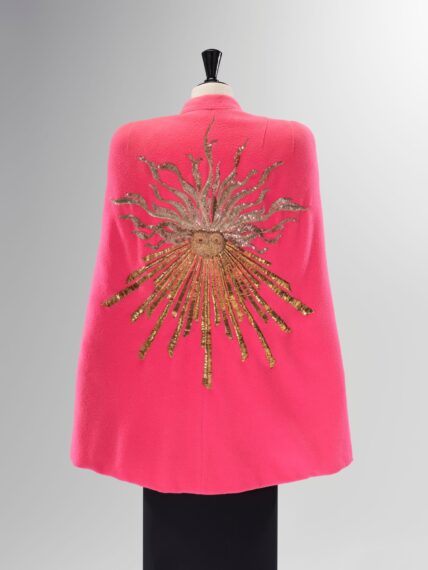
Elsa Schiaparelli (French, born Italy, 1890–1973), “Phoebus” evening
cape, worn by Daisy Fellowes (French, 1890–1962), Autumn/Winter
1938–39, woolen ratine embroidered by Lesage with sequins and
gold thread. Palais Galliera, gift of Countess Emmeline de Castéja,
1963.20.8
Elsa Schiaparelli worked with many artists connected to the Dada and Surrealist movements. One of the most important people behind her success was master embroiderer François Lesage. The two worked closely together and trusted each other’s creative ideas. For this cape, Lesage created the bright sun design, which was inspired by the style of artist and illustrator Christian Bérard. The cape’s bold color and its name, “shocking pink,” are both trademark Schiaparelli creations.
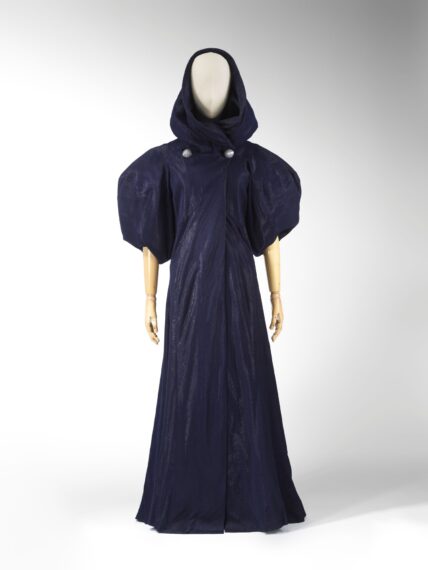
Madeleine Vionnet (French, 1876–1975), evening coat, Autumn/Winter 1934–35, rhodoïd twill, acrylic buttons. Palais Galliera, gift of the Fondation Josée et René de Chambrun, 2007.8.24
In the early 1930s, the growing chemical industry influenced haute couture to start using artificial (cellulose-based) materials such as rayon and acetate, followed by sythentic (petroleum-derived) fabrics such as nylon late in the decade. Paris fashion houses saw these new materials as signs of modern progress and temporarily moved away from natural fabrics such as silk and cotton. This coat was woven from spun Rhodoïd, a transparent plastic acetate film. Its cone-shaped buttons, designed to look like frost, are made from acrylic.
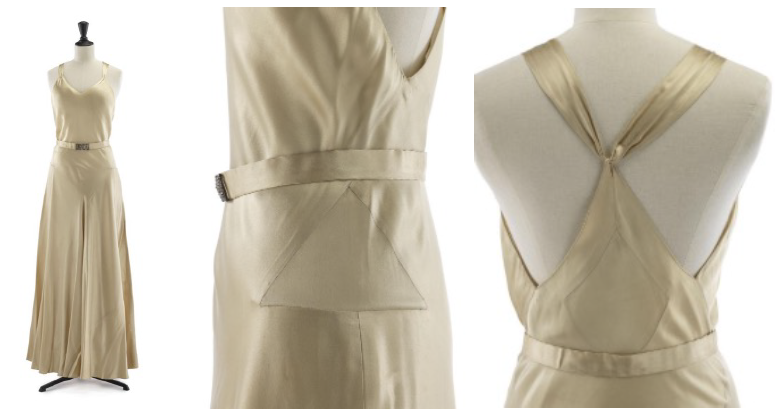
Madeleine Vionnet (French, 1876–1975), evening dress and belt, Spring/Summer 1931, silk satin, metal buckle with crystal rhinestones. Palais Galliera, gift of Mrs. Rippert, 1966.7.3A–B
The satin evening gown became the iconic garment of the 1930s femme fatale, worn by stars like Jean Harlow, Rita Hayworth, and Bette Davis. First appearing around 1929, the style quickly became popular. Its smooth, sculpted shape was made possible by the bias-cut technique, which cuts fabric diagonally instead of straight along the grain. This method allowed the dress to follow the body’s curves while still draping beautifully and allowing easy movement.
Fashion designer Madeleine Vionnet is considered the master of the bias cut, and evening gowns like this one became iconic. The shiny satin fabric reflects light in a way that highlights the hips and waist. One unique feature of this dress is the diamond-shaped panel on the lower back.
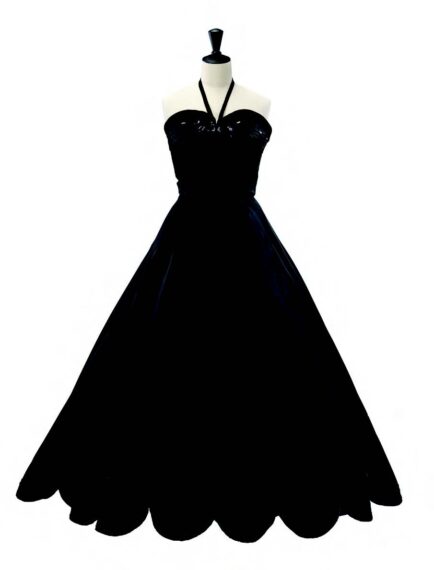
Robert Piguet (Swiss, 1898–1953). “Impératrice” (Empress) evening
gown, Spring/Summer 1939. Silk faille embroidered with sequins, silk
velvet. Palais Galliera, gift of Mme Gingembre, 1967.64.1A
In the late 1930s, a romantic style trend became popular in fashion, possibly as a response to growing international tensions. Full skirts replaced the sheath dresses that had defined much of the decade. Designer Robert Piguet helped lead this trend with history-inspired designs like this one. Working with Christian Dior, he created dresses with larger volumes than those seen earlier in the decade. The exposed shoulders were inspired by Second Empire fashions, while the full skirts reflected the renewed popularity of the waltz.
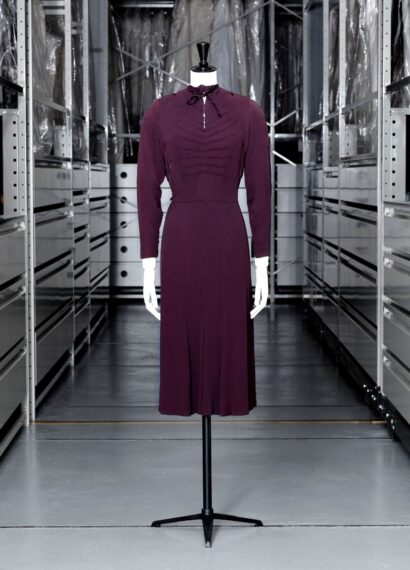
Martial & Armand (French; Martial Lelong [1861–1933] and Armand Lelong [1868–1935]), city dress, c. 1932, rayon satin crepe. Palais Galliera, gift of Jacqueline Dumont, 1969.69.2
Activity: Look, Write, and Discuss
30–45 minutes
Look closely at the very diverse examples of haute couture from the 1930s. No single style dominated. Instead, fashion designers were drawing inspiration from a wide range of sources and experimenting with new techniques and materials, while meeting the demands for day and evening styles.
Write a few words to describe each of these creations. Then, look at the words you wrote to see which, if any, appeared in more than one list.
Overall, how would you describe 1930s fashion trends based on the words you chose?
Next, select five to seven words from your lists to inspire a contemporary design of your own creation. Create a sketch of your design. What influences, if any, did you draw from the 1930s styles? What other ideas inspired your design?
Take a look around your community. What fashion trends do you observe? What do you believe are the inspirations or motivations for these trends?
Couture Under the German Occupation (1940–1944)
In June 1940, the German army invaded France, starting a period of occupation during which Parisian haute couture struggled to survive. The German-controlled French government placed strict limits on clothing production and rationed fabric. They even set rules for how much fabric could be used in each garment, leading to shorter hemlines, which turned out to be practical for walking and biking—common activities when gasoline was hard to find.
Because materials were limited, designers had to be creative. Instead of silk, they used synthetic fabrics like rayon or simpler, less expensive materials such as straw. They added features like quilting to keep people warm and included practical details like visible pockets, which had usually been hidden before. Dress shapes also changed, often featuring wide shoulders and narrow waists, creating a triangle shape.
Haute couture remained important both culturally and economically, which is why German authorities tried to control it. At one point, there was even a plan to move fashion houses to Berlin to weaken Paris’s prestige and influence. During the occupation, designers responded in different ways: Some worked with the German regime, some tried to stay neutral, and others resisted or left the country. The Nazis shut down fashion houses that did not follow their rules, leading some designers to cooperate with them just to keep their businesses open.
Activity: Read, Look, Discuss and Dig Deeper
45 minutes
Read the introduction to this section on the impacts of World War II and the Nazi occupation of France as well as the entries on the individual creations. What factors seemed to have the greatest impact on the fashions of the time? What were some of these impacts? How did they change the look of women’s fashions at this time?
Many people and industries in the United States today are experiencing economic hardship. How is the economy impacting individuals today? How does this impact you? Your community? The world? What impact, if any, do you speculate the economy is having on haute couture today? Explain your reasoning. Research the state of different fashion houses to find out more.
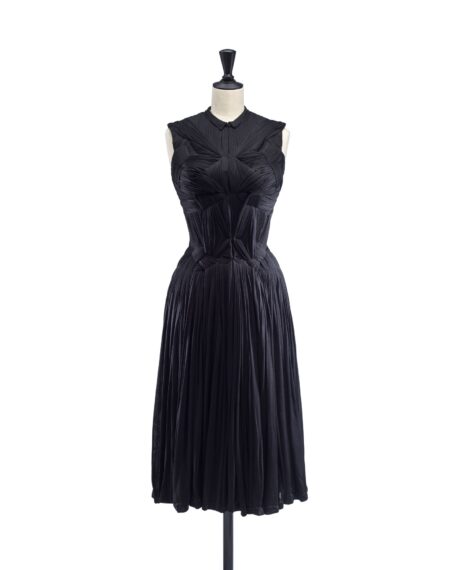
Grès (Germaine Émilie Krebs, French, 1903–1993), dinner dress, Autumn/Winter 1942–43, viscose jersey by Rodier. Palais Galliera, gift of Mme Labourdette, 1977.37.15
Madame Grès opened a new fashion house under her own name in 1942, during World War II. Wanting to remind people of the designs that had made her famous a decade earlier, she returned to the use of antique-style draping. She also created a special type of pleat, now known as the Grès pleat.
Madame Grès admired classical sculpture and approached dressmaking as a form of sculpture. She preferred draping fabric rather than cutting it into shapes. In this dress, the jersey fabric panels begin at the hem, twist and weave together through the bodice, and end on the opposite side of the skirt. Because of its complex and flowing design, creating a single dress took an entire month of work.
As one might imagine, Madame Grès’s designs also required large amounts of fabric. During the German occupation of France, fabric was heavily rationed, making it difficult to obtain. As a result, she was forced to close her fashion house in 1944.
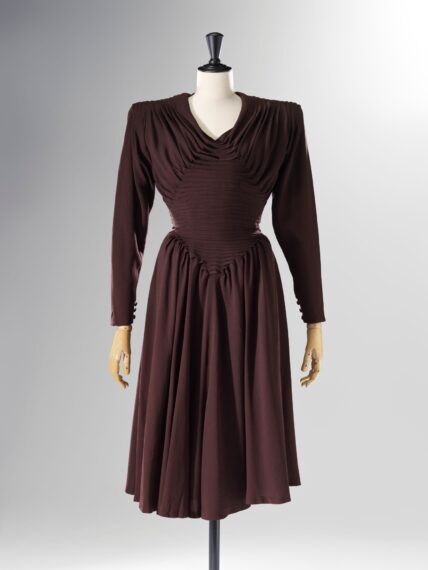
Jeanne Lanvin (French, 1867–1946), “Marché noir” (black market) day dress, Spring/Summer 1944, crepe made of artificial fibers. Palais Galliera, gift of Madeleine Corbillon, 1986.197.4
For her summer 1942 collection, Jeanne Lanvin named her designs after everyday activities that many Parisian women experienced during wartime shortages. Examples included “I’m standing in line,” “I’m replacing the central heating,” and “I’m taking a vélo taxi (bicycle taxi).”
Two years later, in the months before the Allied landings in Normandy in June 1944, Lanvin chose more hopeful names for her designs, such as “Une femme libre” (a free woman) and “Ami comme avant” (friends as always). She also used names that reflected the ongoing difficulties fashion designers faced in finding materials, such as the name she gave this dress, “Marché noir” (black market).
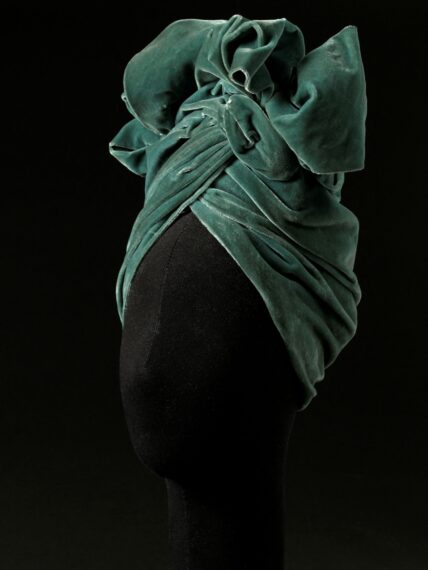
Madame Charlotte, turban, 1943, silk velvet. Palais Galliera, gift of Mme Gomel, 1957.22.2
During the wartime occupation of France, fabric was heavily rationed, so hats and other head coverings became important ways for people to show their style. Turbans were especially popular during this time. Some were made at home from leftover fabric scraps, while others like this turban were created by Parisian milliners.
Turbans were practical because they helped keep one’s head warm in winter, were quick and easy to put on, and were lightweight. They also helped people deal with other wartime challenges including hiding hair that had not been washed or styled. They were also popular among the growing number of cyclists, especially in Paris, where car use was heavily restricted and fuel was rationed.
A New Golden Age (1947–1957)
After World War II, couture houses initiated many new efforts to reestablish Paris as the center of fashion design, including working closely with photographers to restore the glamorous image of Paris.
In February 1947, Christian Dior brought lobal attention back to Paris with his first collection that introduced a new silhouette that left behind the austerity of wartime designs. The waists were tightly cinched, and longer skirts used large amounts of fabric in a luxurious way. The square shoulders of the early 1940s were replaced with a more natural shape. This style, which Harper’s Bazaar called the “New Look,” set fashion trends for the next decade.
Dior’s designs received both praise and criticism around the world. In the United States, many women’s groups, activists, and ready-to-wear designers saw the return of corseted waists and long skirts as a step backward for women’s freedom. However, haute couture designers saw the style as a welcomed return to luxury. Gabrielle Chanel, noticing the success of new, mostly male designers and their styles, which she considered too heavy and restrictive, reopened her fashion house in 1954.
In general, after the war, clothing again became more complex, as wardrobes expanded in variety and with increasing attention to the style, cut, and decoration of each garment.
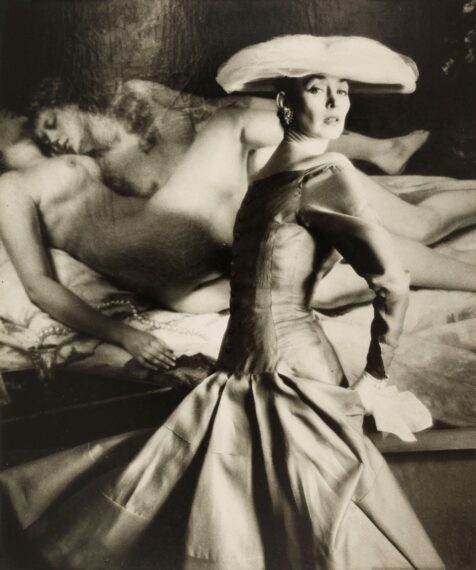
Henry Clarke (American, 1918–1996), Jacques Heim evening dress in front of Gustave Courbet’s painting Le Sommeil at the Petit Palais, published in Vogue, French edition, April 1955
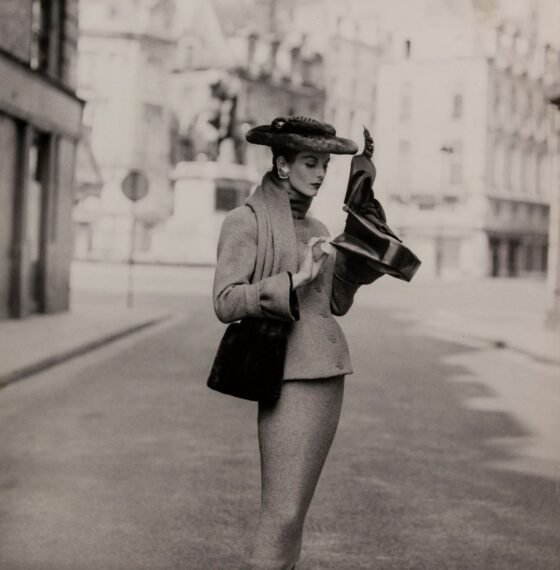
Anne Saint-Marie in a Jacques Fath suit, rue Croix des Petits Champs, published in
Vogue, French edition, September 1955
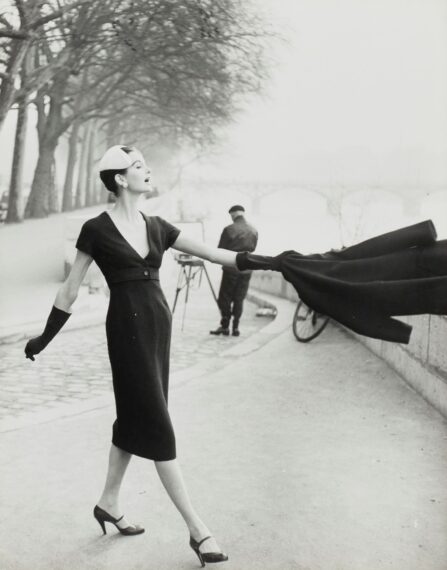
Christian Dior V-neck dress, in front of the Pont des Arts, published in Vogue, French edition, March 1955
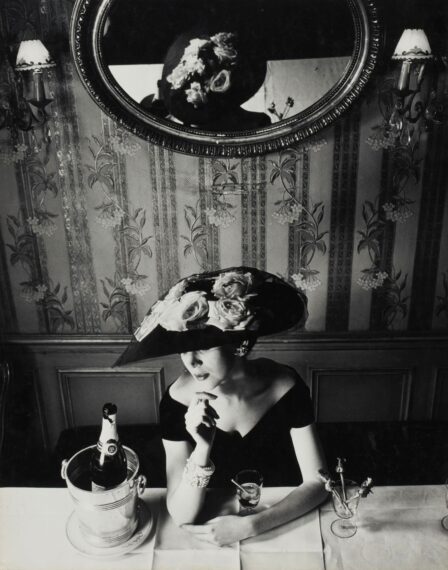
Christian Dior hat, in Lapérouse restaurant, published in Vogue, American and English editions, April 1956
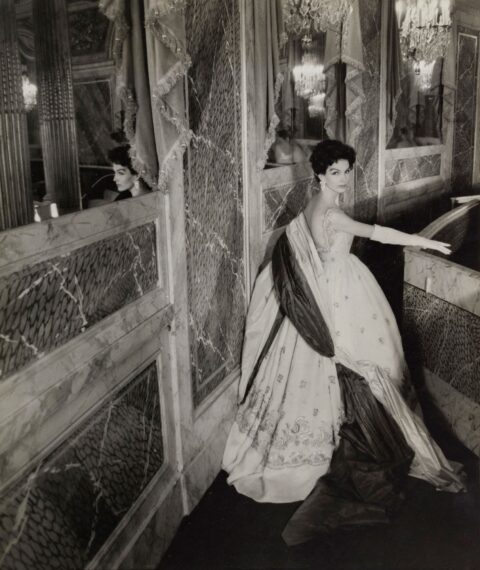
Joanna McCormick in a Balmain evening gown, at the Théâtre Gabriel in Versailles, published in Vogue, French edition, April 1957
Henry Clarke discovered fashion photography in New York while working as a prop assistant in the Vogue photo studios. In 1949, he chose Paris—the center of the fashion world—to begin his professional career. For more than 20 years, he worked for all three editions of Vogue: French, American, and British. His photographs from the 1950s often show models in famous Paris locations, such as luxury hotels, high-end restaurants, museums, and the opera.
Activity Look, Discuss, and Create
30–60 minutes
Look closely at Henry Clarke’s fashion photos from the 1950s. What do they all have in common? What sets each one apart as unique?
Using magazines or a digital device, find some contemporary fashion photographs that appeal to you. What about each photo do you like?
Now, compare one or two of your photographs with one or two of Henry Clarke’s photos from the 1950s. What, if anything, do they have in common? What makes the new photographs uniquely modern?
Now, it’s your turn to create a fashion photograph (or drawing if you don’t have access to a camera). What contemporary fashions will you show? Who will be your models? In what setting will you stage your fashion photographs? What’s your thought process behind your photographs? What are your inspirations?
Compare your photographs with others’ photos. What do they have in common? What makes them different? What trends might someone looking at your photographs identify?
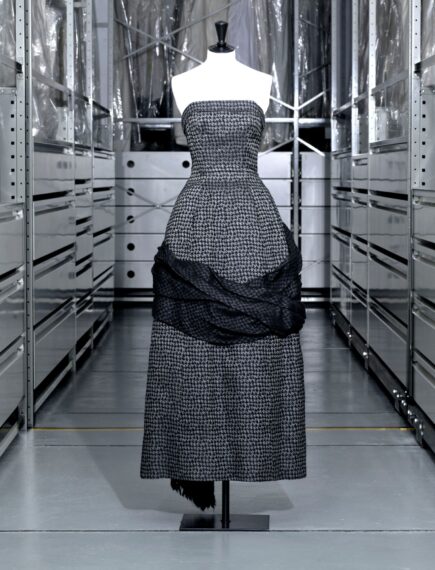
Christian Dior (French, 1905–1957), “Mazurka” dinner dress, Autumn/Winter 1953–54, from the “Vivante” (alive) line, houndstooth wool and silk by Abraham. Palais Galliera, gift of the Marquise de la Valette, 1989.44.3A
Christian Dior, the leading fashion designer of the 1950s, shaped the era with a style that carefully balanced simple shapes with carefully controlled use of materials. This mix is shown in his “Mazurka” gown, which features a domed (coupole) skirt. A mazurka is a traditional Polish folk dance, but Dior’s inspiration is more likely to be Chopin’s popular piano pieces that were inspired by the dances.
The strapless dress is made of long vertical panels that run from the bodice to the hem. This technique harkens back to Charles Frederick Worth’s designs in the late 1800s and helps create a smooth, flowing shape. The dress uses houndstooth fabric, one of Dior’s favorite patterns. The same fabric is turned and reused on the skirt to form a scarf detail, illustrating how Dior creatively reused materials usually meant for daytime clothing to make a dramatic evening dress.
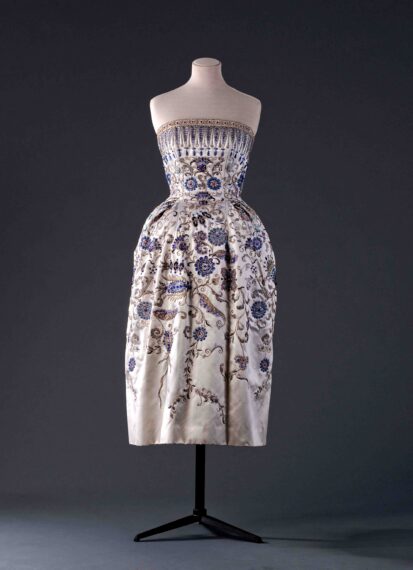
Christian Dior (French, 1905–1957), “Palmyre” (Palmyra) evening gown from the Profile Line collection, worn by Wallis, Duchess of Windsor (American, 1896–1986), Autumn/Winter 1952–53, celanese satin (acetate) embroidered with rayon thread, lamé, laminette (elastic stabilizer strip), glass beads, sequins, faux pearls, rhinestones. Palais Galliera, gift of Wallis Simpson, Duchess of Windsor, 1971.45.1
Edward VIII, the Prince of Wales, abdicated his position as the British King in 1936 because Constitutional rules prevented him from keeping the crown if he married the woman he loved, Wallis Simpson, because she was divorced. They married in 1937 and became the Duke and Duchess of Windsor. After World War II, they settled in France.
The duchess, a well-known social figure, represented Parisian elegance and became one of Christian Dior’s most loyal clients. In 1952, she asked Dior to design an evening gown for her. This gown is decorated with beads and crystals in different shades of blue and with decorative patterns inspired by 18th-century (1700s) scrollwork.
The Renewal and Decline of Couture (1958–1975)
By the mid-to-late 1950s, designers like Gabrielle Chanel and Cristóbal Balenciaga began to move away from the popular styles of the time. Chanel created elegant clothing that was light and comfortable, allowing women to move freely, including her famous wool tweed suit. Balenciaga also changed fashion in a bold way by removing the waistline again and introducing loose styles like “shirt dresses” and “sack dresses,” which followed the shape of the body without being tight.
Balenciaga’s students and followers also became successful with styles that brought back the 1920s idea of freeing the female body. In the mid-1960s, clothes like trapeze dresses, miniskirts, jumpsuits, shorts, and trousers became popular and gave women much more freedom of movement than ever before.
During the 1960s, ready-to-wear fashion also became more popular, especially in the United States, and began to
challenge haute couture. Ready-to-wear appealed to a growing consumer culture, offering trendy clothing in modern stores that appealed to younger people who wanted fast and affordable fashion.
At the same time, fewer women were becoming top designers, a trend that started after World War II. This may have been partly due to sexism in the industry and because some women were less interested in what seemed like a fading art form. In 1966, retired designer Elsa Schiaparelli told Women’s Wear Daily that she felt sorry for modern couturiers, saying they were “on the edge of a precipice.”
Between 1939 and 1967, the number of fashion houses dropped sharply. In May 1968, Balenciaga, feeling out of touch with modern trends and unwilling to switch to ready-to-wear, closed his business. By 1969, only 17 couture houses remained.
In response to this decline, people in the 1960s began to focus more on preserving the history of haute couture. In 1965, the Musée de la Mode in Paris asked fashion houses and their clients to save examples of their designs. In 1968, Azzedine Alaïa started collecting clothing, including dresses from Balenciaga’s archives. In the mid-1970s, the fashion house of Yves Saint Laurent began carefully saving its designs, both to preserve history and to inspire new ideas. In 1983, the Metropolitan Museum of Art held a major exhibition of Yves Saint Laurent’s work, one of the first large museum shows focused on a single designer.
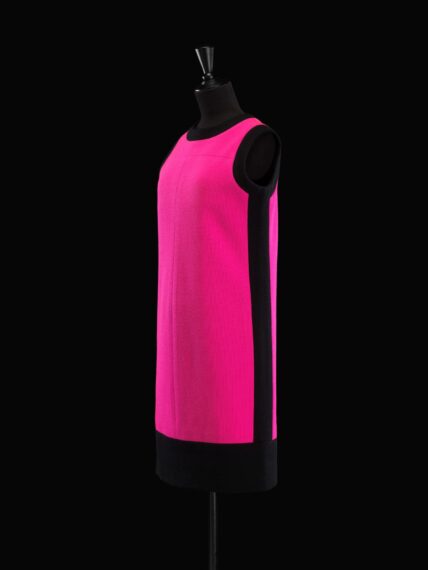
Yves Saint Laurent (French, born Algeria, 1936–2008), cocktail dress from the Mondrian collection, worn by Juliette Gréco (French, 1927–2020), Autumn/Winter 1965–66, “Paris-Midi” wool jersey from Racine. Palais Galliera, gift of Julie-Amour Rossini, 2021.27.8
After World War II, French singer and actress Juliette Gréco influenced fashion with a style that reflected her free-spirited personality. Though known for wearing black clothing on stage, in her everyday life she often chose brighter, bolder colors. This dress from her wardrobe is part of a group created as a tribute to the modern artist Piet Mondrian. The dress, made from thick wool jersey (“Paris-Midi”), takes inspiration from Mondrian’s well-known geometric art style, using bold blocks and lines. Although Mondrian never used pink in his paintings, the dress reflects the balance of shapes and structure that is characteristic of his work.
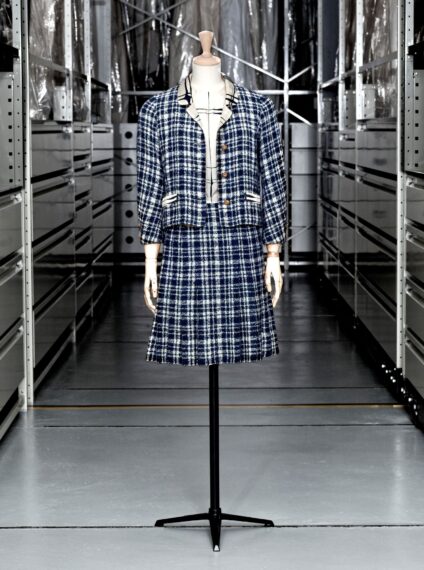
Gabrielle Chanel (French, 1883–1971), suit consisting of a jacket, blouse, and skirt, Spring/Summer 1964, wool tweed, printed silk twill, gilded metal. Palais Galliera, gift of the Société de l’Histoire du Costume, 1975.33.3A–C
Gabrielle Chanel returned to haute couture in 1954 after retiring in 1939. Her return was controversial, as she worked with both sides during the Nazi occupation of France.
Throughout her career, Chanel was inspired by Scottish fabrics and by wool materials usually used in menswear. She reworked their signature patterns, such as tartan, checks, and houndstooth, and used their two-tone designs to create bold, graphic linings for her suits. The suit style she developed in the 1950s became a defining look in the 1960s and was widely featured in fashion magazines. On the inside of the jacket, there is a practical and elegant detail: a small gold chain sewn into the hem. This helps the jacket fall back into the correct shape and drape smoothly with every movement.
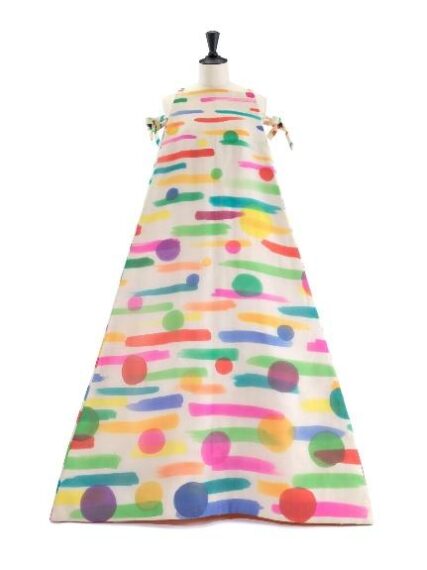
Marc Vaughan (Abdel Karim Ben Choubane, Algerian, 1932–2009). Evening dress, Spring/Summer 1974. Hand-painted organza by Maison Hurel, canvas by Ludwig Abraham & Co. Seiden. Palais Galliera, gift of Arlette Baudart-Vaughan, 2023.43.5
Originally from Algeria, Abdel Karim Ben Choubane moved to Paris in 1954 to study fashion before launching his own fashion house in 1957. During a time of strong anti-North African sentiment in France, he faced hostility and chose to adopt the name “Marc Vaughan.” He presented his first haute couture collection in the spring/summer of 1966. That collection, called “Opus,” was inspired by the geometric shape of the cube. This later cone-shaped evening gown is hand-painted with multicolored circles and lines. Its design reflects a later stage in the fashion world’s interest in optical patterns and visual effects.
Activity: Look, Analyze, Discuss, and Create
30–45 minutes
Look closely at these three creations. What five adjectives would you use to describe each outfit? What do they have in common? How do they differ? Take a look around your neighborhood, school, or shopping areas. Also look at fashion trends in magazines and on social media. What connections might you make between these 1960s and ’70s styles and the styles you see today? What fashion trends from today do you think will still be influencing fashion in 50 years? Why do you think so?
Sketch an idea for a fashion creation that could be trending in 2075.
Renaissances (1987–2019)
In 1987, haute couture got new energy when Christian Lacroix opened his own fashion house, one of the few created at the end of the 20th century. His bold and colorful designs inspired by the bright colors of Provence, traditional clothing from Arles, and even bullfighter costumes, brought attention back to haute couture. His creations often
featured strong reds and purples with black, and they included detailed embroidery and beads.
In the 1990s, haute couture began to attract more designers again. Its creative freedom and distance from mass production appealed to many, even as ready-to-wear fashion remained dominant. In 1997, several well-known ready-to-wear designers began working in haute couture. Jean Paul Gaultier and Thierry Mugler both introduced their first couture collections despite having once criticized haute couture. They embraced its traditions and used it to experiment with dramatic and theatrical designs that were often not practical for everyday life. That same year, Alexander McQueen presented his work for Givenchy, creating major excitement in the fashion world.
By the early 2000s, haute couture was no longer just about preserving traditional craftsmanship in Paris, but also
largely about promoting fashion brands. The rules of haute couture became more flexible, allowing more designers to take part. In 2001, Tunisian designer Azzedine Alaïa presented his own couture collection featuring sensual, form-fitting designs. In 2005, Martin Margiela introduced his “artisanal” line, which reused old clothing and materials to create new designs. During the first two decades of the current century, designers intentionally sought ways to make couture relevant.
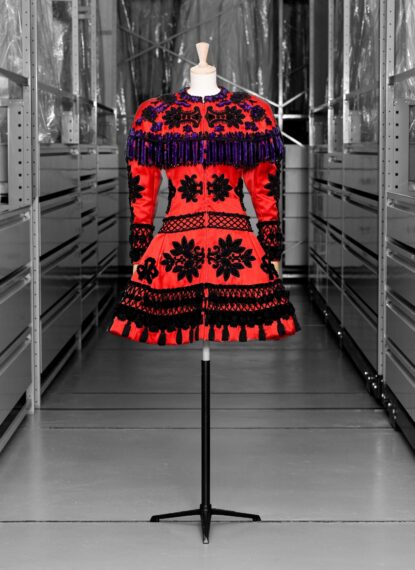
Christian Lacroix (French, b. 1951), “Faena” coat dress, Autumn/Winter 1987–88, silk satin embroidered by Lesage, passementerie (decorative trim), chenille, jet, tassels, bows, netting. Palais Galliera, gift of Christian Lacroix, 1988.134.1
For his first haute couture collection, Christian Lacroix was inspired by the heritage of his hometown of Arles in southern France. He drew on the bright colors of Provence, the traditional clothing of Arlesian women—such as caracos, kerchiefs, and flounced skirts—and the costumes of bullfighters.
His designs combined vivid reds and purples with deep blacks, and they were richly decorated with embroidery, trimmings, and beads. The collection was named “Faena,” referring to the final set of movements in a bullfight, when the matador guides the bull using a muleta (a small red cloth) and a sword.
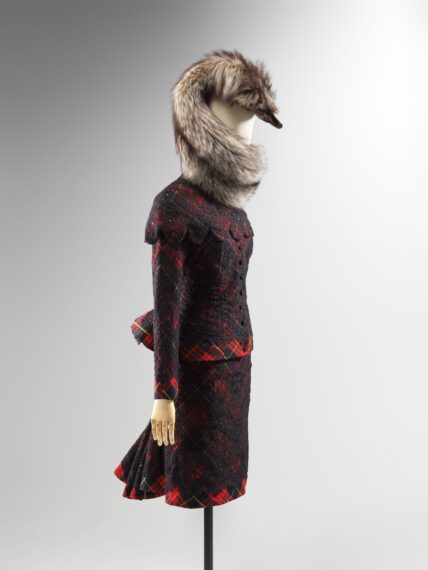
Givenchy by Alexander McQueen (British, 1969–2010), suit consisting of a jacket, collar, and skirt, from the Eclect-Dissect collection, Autumn/Winter 1997–98, wool twill McQueen tartan, lace, sequins, jet-like beads, satin piping. Palais Galliera, acquired by the City of Paris, 2014.1.1.1–3. The headdress is a reconstruction made from a fox fur stole, Palais Galliera, 2005.19.6At just 27 years old, Alexander McQueen became the artistic director of Givenchy, one of the most iconic names in classic haute couture. His second collection, which includes this suit, shows the controversial British designer’s great skill in tailoring and in working with fabric cut on the bias. The McQueen clan’s Scottish tartan—a red and black checkered wool with yellow piping—expresses the designer’s independence and personal identity. Other pieces in the same collection had a darker tone and used materials like black leather, red feathers, and resin vulture skulls. These works were influenced by a Gothic aesthetic, drawing inspiration from Mary Shelley’s Frankenstein and Robert Wiene’s film The Cabinet of Dr. Caligari.
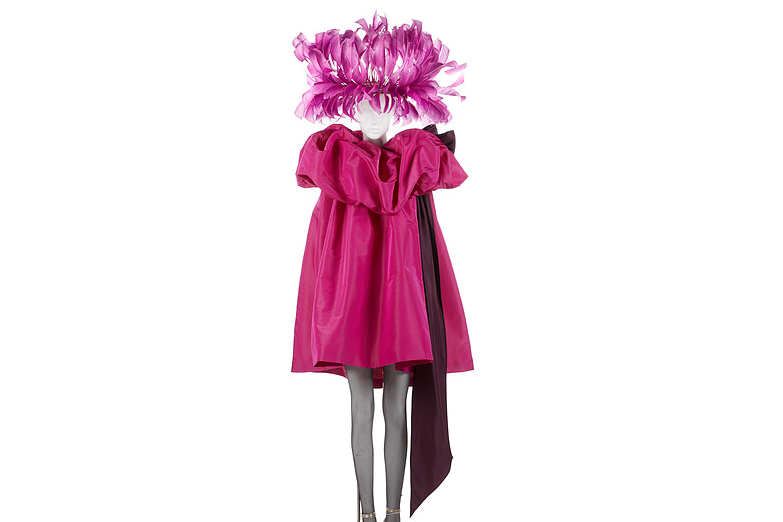
Valentino by Pierpaolo Piccioli (Italian, b. 1967), “Sylvia R.” dress and sandals, Headpiece by Philip Treacy (British, b. 1967), Spring–Summer 2018. Dress: silk faille, silk organza. Headpiece: goose feathers on a metal frame. Sandals: leather, brass, suede. Palais Galliera, inv.2019.26.1–5, gift of Valentino–Vogue Paris Foundation 2018
In 2008, Pierpaolo Piccioli and Maria Grazia Chiuri became the artistic directors of Valentino, a fashion house founded in Rome in 1959. In only a few collections, they transformed Valentino into one of the most highly anticipated haute couture brands in Paris. Chiuri left the company in 2016, but Piccioli continued their style while improving its shapes and color choices. In this collection, Piccioli uses color with the careful balance seen in early Renaissance Italian paintings. He combines fuchsia and black currant to create a striking look. The collection also honors the seamstresses who work in Valentino’s ateliers. This design is called “Sylvia R.” in honor of one of them.
Activity: Look, Analyze, and Imagine
30–45 minutes
These three designs speak to the wide range of styles designers introduced from the late 1980s into the first two decades of the 21st century. Each design includes a strong element of storytelling. Look closely at the designs and read the short passage about each. How does each designer incorporate storytelling?
Now, think about a character, story, or cultural experience around which you would like to create a fashion design or even a design collection. What design elements and principles will you incorporate to connect your designs to your inspiration? What will you name your design or collection?
Couture in the 2020s
Today, haute couture still attracts many famous designers, even if sometimes for just one special collection.
One of the main features of haute couture is its ability to create dramatic and memorable shows. In 2023, Thom Browne made his couture debut at the Palais Garnier, where guests sat on the stage and the audience seats were filled
with identical cutout figures wearing his uniform designs. In January 2024, Maison Margiela held a show under a bridge in Paris on a rainy night. The setting was dark and foggy, inspired by the photography of Brassaï (1899–1984). Models looked like broken dolls and wore highly detailed, artistic designs. Photos and videos of the show quickly spread around the world on social media.
This kind of theatrical style is also seen in events like the Met Gala, where celebrities wear custom couture outfits on the red carpet. These looks are carefully chosen and seen by millions of fans online.
Although men have worked in haute couture since the late 1800s, they only started becoming regular clients in the early 2000s. When Balenciaga relaunched its couture line in 2021 under designer Demna, many male models were included. Designers today are also challenging traditional ideas about gender in fashion. For example, Thom Browne combines masculine and feminine styles in bold and creative ways. The emotionality of his creations drew Jordan Roth, a Tony Award–winning Broadway producer and style icon, to collaborate with Browne as a muse and runway model.
Activity: Read, Look, Discuss, and Create
60–120 minutes
Read the introduction and individual entries in this section. Although these two examples don’t begin to illustrate the wide range of haute couture during this decade, what Big Ideas do they represent?
If you have engaged with earlier content in this guide, what trends from long ago do these two fashions bring to mind?
The Met Gala is highly controversial because it’s an open display of extreme wealth and opulence and has even drawn comparisons to the Hunger Games books and movies because it highlights the contrast between the lifestyles of ultrawealthy celebrities and the struggles of average people. What do you think about the Met Gala? Create a video, written commentary, or other response explaining how you feel about the Met Gala. What images will you use? What will your message be?
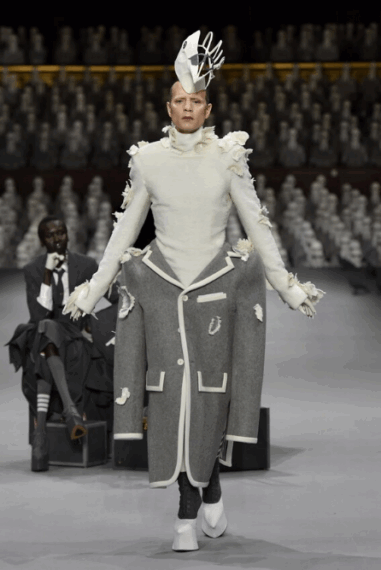
Thom Browne (American, b. 1965), Look 54, worn by Jordan Roth, b. 1975), Autumn/Winter 2023–24, Dress: silk, silk thread feathers appliqué in embroidered overlapping matte sequins; Skirt: felted cashmere; Corset: silk double duchesse; Boots: calf nubuck, metal. Loan from Thom Browne, New York
Jordan Roth was attracted to Thom Browne’s artistic imagination and deeply meaningful designs. He was particularly drawn to Browne’s poignant exploration of tailoring that often started with the concept of the suit. In an interview published in the May 4, 2022, issue of Vogue, Roth explained, “So much of what Thom does starts from the idea of the suit, which is a charged form for me. The suit is the uniform of masculinity: terrain that I have, at times, bounded away from. Thom takes that form and deconstructs it, explodes it. He evolves it in a way that articulates my relationship with it.” This idea is clearly illustrated in Look 54, worn by Roth in Thom Browne’s debut exhibition at the Palais Garnier, to which attendees were asked to “wear their best grey.”
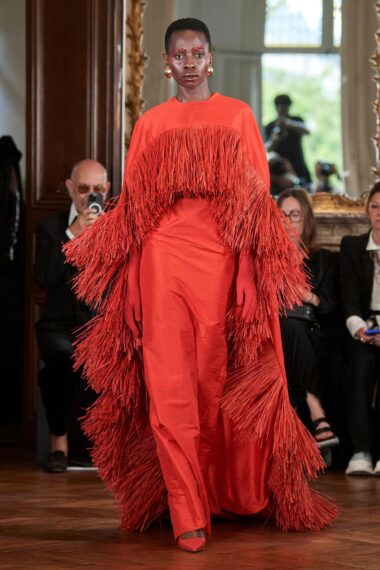
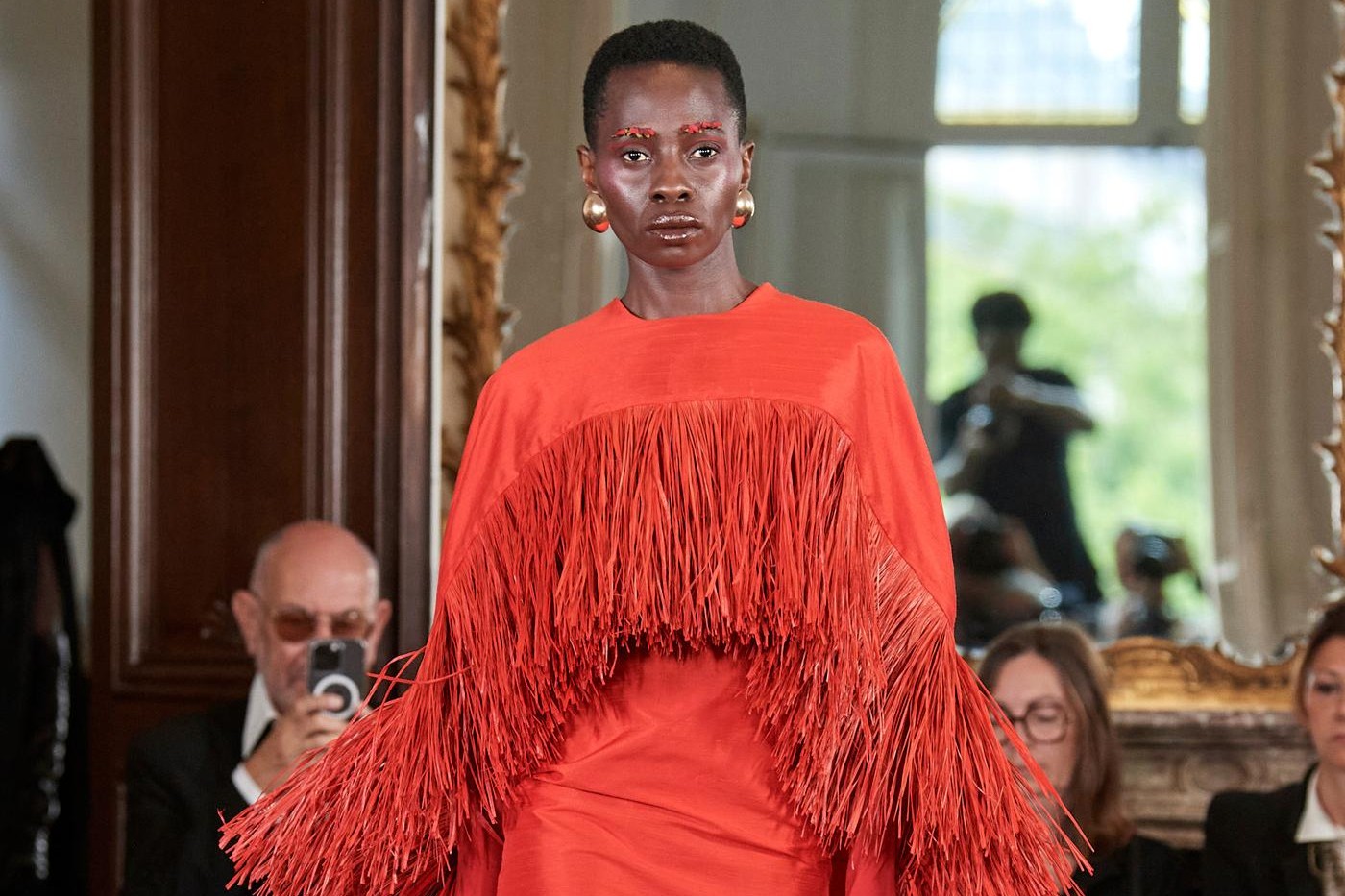
Imane Ayissi (Cameroonian, b. 1969), ensemble consisting of a sheath dress, cape, gloves, pumps, and earrings, from the Mguilguidigueu-Mteun collection, Autumn/Winter 2023–24. Shantung silk, dyed Madagascar raffia, stretch silk jersey, leather, patent plastic, PVC, gilded metal. Palais Galliera, acquired by the City of Paris, 2026.E.20.1
Imane Ayissi first trained as a dancer with the National Ballet of Cameroon. Later, while working as a model in Paris, he became inspired by major fashion designers, especially Yves Saint Laurent. He showed his first ready-to-wear collections in 1992. In 2020, he became the first Black designer from sub-Saharan Africa to present during haute couture fashion week.
His work brings together traditional haute couture techniques and rich African textile traditions. These include Faso Dan Fani fabric from Burkina Faso, kente cloth from Ghana, and raffia from Madagascar. This collection is titled “Mguilguidigueu-Mteun,” which means “line” and “circle” in Kóló, a language spoken in southern Cameroon. Ayissi also focuses on eco-friendly design, using natural materials such as raffia fibers and silk taffeta. His work blends influences from both Cameroonian and French culture.
Elements and Principles of Fashion Design
An understanding of four basic visual elements—line, color, texture, and shape (form)—and five basic principles—
proportion and scale, balance, rhythm, and emphasis—is essential for fashion designers to create clothing and accessories that stand out.
Use this resource to learn about these design elements and principles, which will help guide your appreciation of the fashions here and in the special exhibition “Paris Couture.” With each fashion you look at, see how many of the elements and principles you can find! It’ll also be fun to look at your own clothing to see which elements are most important.
Note: The inspiration for this section comes from a lesson created by the Museum at Fashion Institute of Technology in New York City.
Design Elements
The basic tools for creating art, including fashion. A designer thinks about the impact of these design elements when creating.
Color
Color is often the first element to which people respond when looking at clothing and accessories. Color adds mood and emotion to design.
Color has three parts:
• Hue is the name of the color: for example, this cape is pink.
• Value is how light or dark the color is.
• Intensity is how bright or dull the color is.
Line
In fashion design, line refers to the direction our eyes are drawn by construction details like seams, openings, pleats, topstitching, and trims. In general, straight lines suggest crispness—in very tailored garments, for example, curved lines create more flowing effects.
Shape
Shape, often referred to as silhouette in fashion design, describes the outline of the whole garment. Silhouette can refer to the way the garment itself fits or relates to the body structure.
Texture
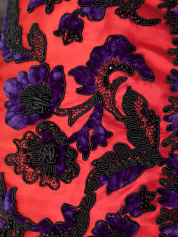
Texture is the surface of a garment—what it feels like or might feel like to touch. Surface interest can be created in many ways, including the weave of the fabric or through embellishments.
Design Principles
A designer combines these principles when creating:
Balance
Balance is the visual weight in design. Think about an imaginary line running through the front of a garment—are both sides the same (symmetrical)? Or are they different (asymmetrical)? How does the designer create visual balance or impact?
Symmetrical or formal balance uses two identical features (like sleeves, pockets, or cuffs) of the same size.
Asymmetrical balance relies on the sides of the garment being different from each other yet still balanced.
Proportion and Scale
Proportion is the interrelationship between the different parts of a design. For example, the various elements of the design are scaled in size to fit together in a pleasing way.
Emphasis
Emphasis intentionally draws attention to some aspect of a garment. The other parts of the garment support the message created by the focal point. Designers rely on a wide range of elements and principles to create emphasis, including color accents, special shapes or details, the way lines interact, contrasts in textures, or how details are put
together.
Rhythm
Rhythm is the way designers move viewers’ eyes from one part of the design to another. Movement of the eye can be achieved through the repetition of colors, patterns, or textures.
Activity: Create!
30–45 minutes
Now that you’ve learned about the featured elements and principles, it is your turn to think like a fashion designer. Sketch or collage your own original design featuring some of your favorite elements and principles! Be creative—think about what will make your design unique.