
Lakota Winter Count
Lesson Objective
Students will look at a Lakota Winter Count and learn the purpose and meaning behind the images.
Students will discuss events that happened this school year and why it’s important and notable to record those events.
Introduction
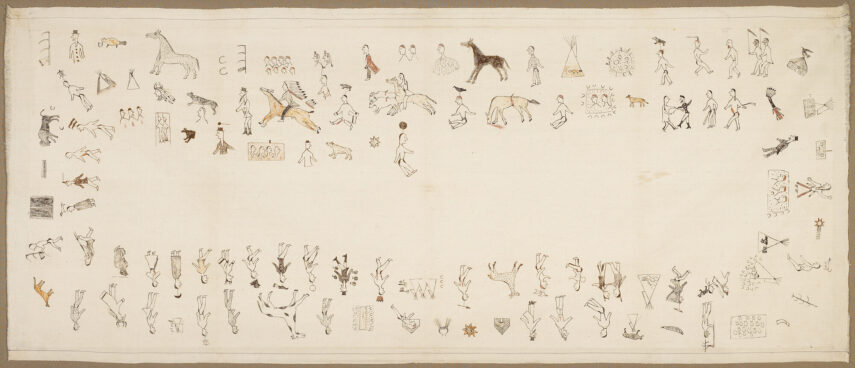
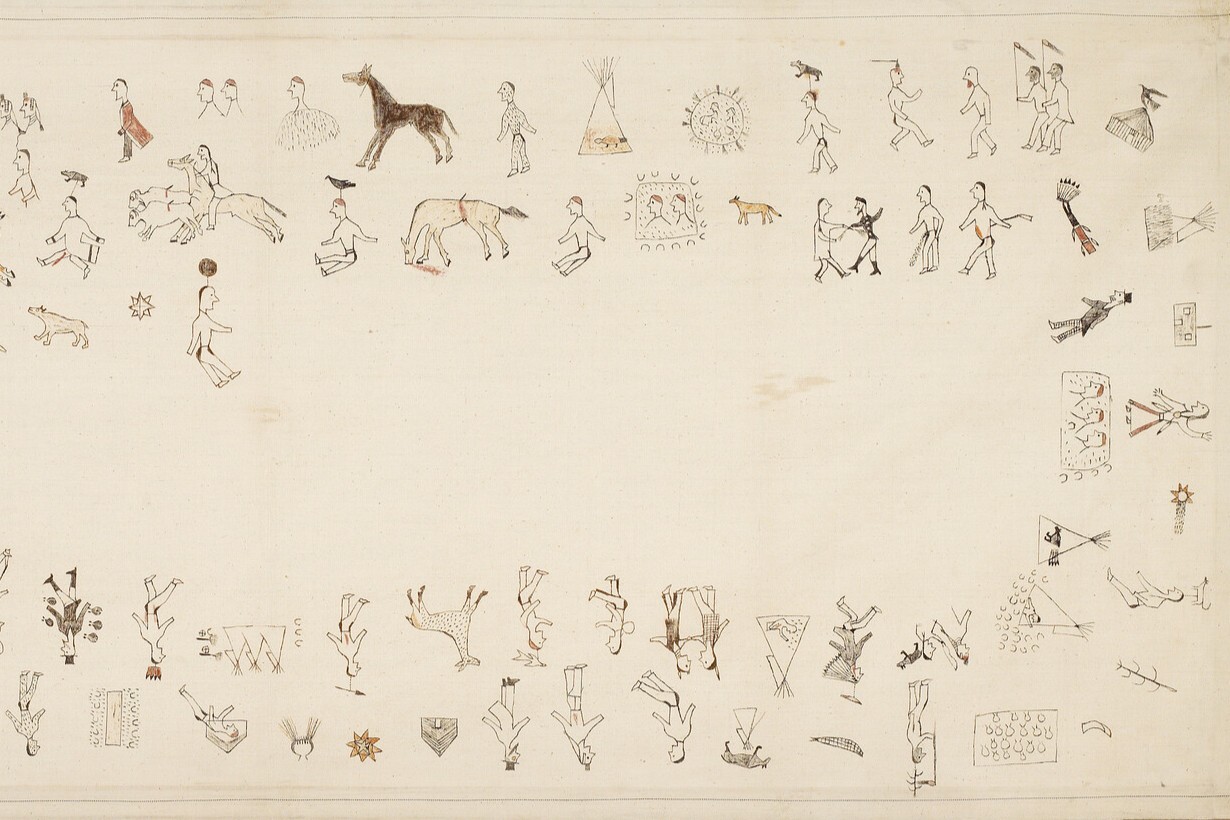
Lakȟóta artist, United States (Great Plains); attributed to Long Soldier, Designer, Húnkpapȟa Lakȟóta. Winter Count, 20th century. Pigment on canvas. Gift of the Weiser Family Foundation. 2002.163
Like many other Plains Indians, the Lakota created winter counts to record significant events that happened during each year. These pictographic calendars (calendars that use images to represent an event) serve as important reminders to the Lakota of their history and their ancestors. A typical winter count spanned more than 100 years.
Traditionally, older prominent men in a Lakota tiyospaye [tee-yo-shpah-yay] held the role of the winter count keeper. It was vital that these men be excellent artists and storytellers, as keepers were responsible for not only drawing the depictions, but also for relaying to the people the community’s history as depicted on the winter count. The keeper, along with the community elders, decided on the most memorable event of the year, and an image representing that event was added to the winter count.
Warm-Up Questions
- • The winter count uses pictures to tell important stories about Lakota history. Each small picture, or pictograph, represents an event for each year. Why do you think it’s important to record and remember history?
- • What important event has happened in your community this year? What symbol would you use to represent an event?
Background
Depending on the grade level, this information can be used for reading and research in a whole group, partner, or individual setting.
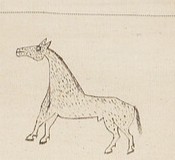
Lakȟóta artist, United States (Great Plains); attributed to Long Soldier, Designer, Húnkpapȟa Lakȟóta. Winter Count (detail of horse), 20th century. Pigment on canvas. Gift of the Weiser Family Foundation. 2002.163
Pictures Track Time
The Lakota felt the importance of keeping track of history and found ways to mark the passage of time. A year began with the first snowfall of one winter and ended with the first snowfall of the next winter. At the end of a year, elders chose an unusual event to represent the whole year. The horse near the top left of this canvas, for example, stands for 1801–02, the year this group of Lakota got their first horse. People spoke about that year as the time people had no horses.
Traditionally, older prominent men in a Lakota tiyospaye [tee-yo-shpah-yay] held the role of the winter count keeper. He added a picture to the calendar for each year that passed and was also expected to remember the details of all the years included on the calendar, in the proper order. The winter count images jogged his memory when he retold the stories of his people’s history on special occasions.
During the dark days of winter, the winter count keeper would show the winter count to children and tell the stories of each pictograph, giving the children a sense of their people’s history. Within Lakota society, the role of Winter Count Keeper was passed from father to son. Some daughters also kept winter counts, though this occurred rarely. When a new keeper took over, a new copy of the winter count was created. There are more than 150 Lakota winter counts that exist today.

Sam Kills Two, also known as Beads, working on his winter count. 1800s, Image courtesy of National Anthropological Archives, Smithsonian Institution (03494000).
Sam Kills Two, a Lakȟóta winter count keeper, displays a winter count drawn on an animal hide.
A Record of Events
The images on a winter count might refer to natural occurrences, such as meteor showers, unusual weather, or outbreaks of disease. They also might stand for events such as battles, encounters with European Americans, or the death of a leader. Certain years are marked by events important to Lakota groups all across the Great Plains.
Scholars can figure out what year an image refers to by matching up the count with known events. A dramatic meteor shower in 1833, for example, appears on every Lakota winter count for that year. Counting from that symbol, we can tell that this calendar shows the years 1798 to 1904. (The years spiral inward, starting at the top left corner and ending near the center.)
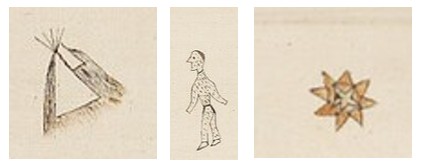
Winter count, 20th century, Lakȟóta, pigment on canvas (detail). Left: The winter of 1818–19, known as the sand-blowing year, is pictured as a tipi with brush piled around it as a windbreak. Center: A smallpox epidemic killed about 10,000 people on the Great Plains in three weeks during 1837–38. On this winter count, a man covered with spots is used to note smallpox outbreaks in three different years. Right: 1833–34: This single red star represents the “year of falling stars,” also known as the Leonid meteor shower. It appears in all of the Lakota winter counts, as well as those of other tribes. Its appearance is a clue for scholars seeking to date winter counts. People all over North America witnessed the Leonid meteor shower.
Ideas More Important than Pictures
The first winter counts were drawn on animal skins. As the keeper ran out of room or the hide wore out, he copied the pictures onto another surface, often a muslin cloth like canvas or, in the late 1800s, a paper ledger book.
Another reason for copying a winter count was the retirement of a keeper. The span of time covered by winter counts, often 100 years or more, was longer than one person could record. The first task of a new keeper (usually a son or nephew of the retiring keeper) was to make his own copy, to learn the count’s symbols and stories. Then, as each new year passed, he added a new picture to his copy of the count.
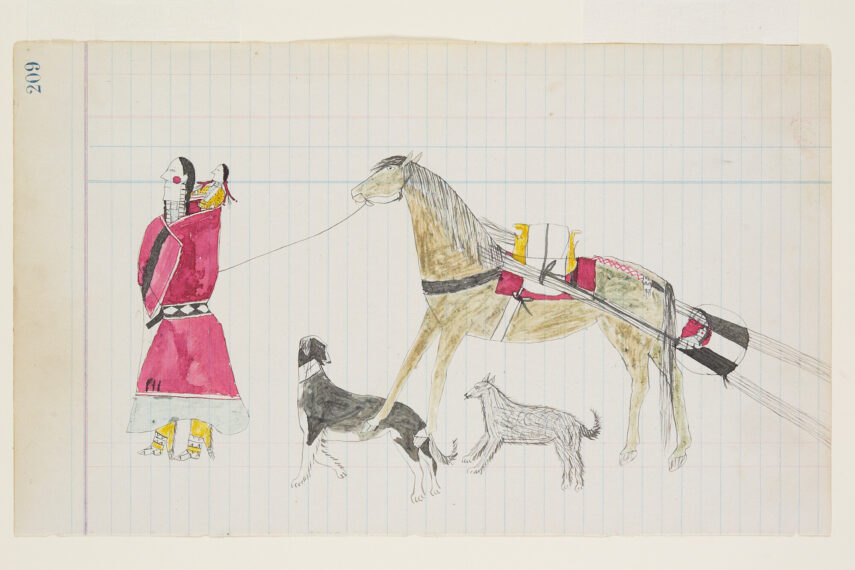
Roan Eagle, American, Lakota (Oglala Teton Sioux), born 1863. Untitled (Woman with Two Dogs and Two Children Moving Camp), c. 1890. Ink, watercolor, and graphite on ledger paper. The Putnam Dana McMillan Fund. 90.107
Activity
Materials
- • Paper or notebook
- • Pencils or colored pencils
Guided Practice
Look closely at the winter count. As a class, share what you see. What more can you find?
The winter count uses pictures to tell important stories about Lakota history. Each small picture, or pictograph, represents an event for each year. Why do you think it is important to record and remember history?
Whole group/small group/individual prompt: What important event has happened in your community this year? What symbol would you use to represent an event?
Instructions
Take a moment to write down one or a couple of important events that happened to you, your family, school community, or city. Write three to five sentences explaining why these events were significant to you and others. Why would this be notable to mark and remember? If you assigned a symbol or drawing to this significant event, what would it be? Why? Draw it below your sentences.
Something to think about: Do you think others would be able to understand what your symbol signified? Is it something that would only be understood by storytelling? Does this change how you look at it? Would you make any changes to your drawing? Why or why not?
Reflection
After completing this activity, think about the question from the beginning: Why do you think it’ important to record and remember history? What’s an event that you don’t want to forget about this year? If you have time, keep a record of notable events in your school year. At the end of the year, come together as a class and share with each other through art or writing.
Additional Learning Activities
Memory Aid
Skills: Art and communication
The images on winter counts helped Lakota historians recall the details of past events. Choose a topic you’re studying in history and draw a sequence of images to help you remember the course of events. Reflect on the following questions when you complete your sequence of images:
- How is this different from drawing a single moment in time?
- Do you think your images must be realistic to work as memory aids?
- Could other people make sense of your images if they already know the story you are telling? What if they know nothing about it?
Oral History
Skills: Research and communication
Interview an older friend or relative about a historical event they lived through. Then read a description of that event in a reference book. How do the accounts compare? What does the oral history offer that the reference book doesn’t? What does the reference book offer that the oral history doesn’t?
Minnesota State Standards
Social Studies
3.4.18.1: Identify various ways that different cultures have expressed concepts of time and space.
Visual Arts
5.0.4.7.1–5.9.4.7.1 Respond: Analyze and construct interpretations of artistic work.
5.0.5.9.1–5.5.5.9.1 Connect: Integrate knowledge and personal experiences while responding to, creating, and presenting artistic work.