
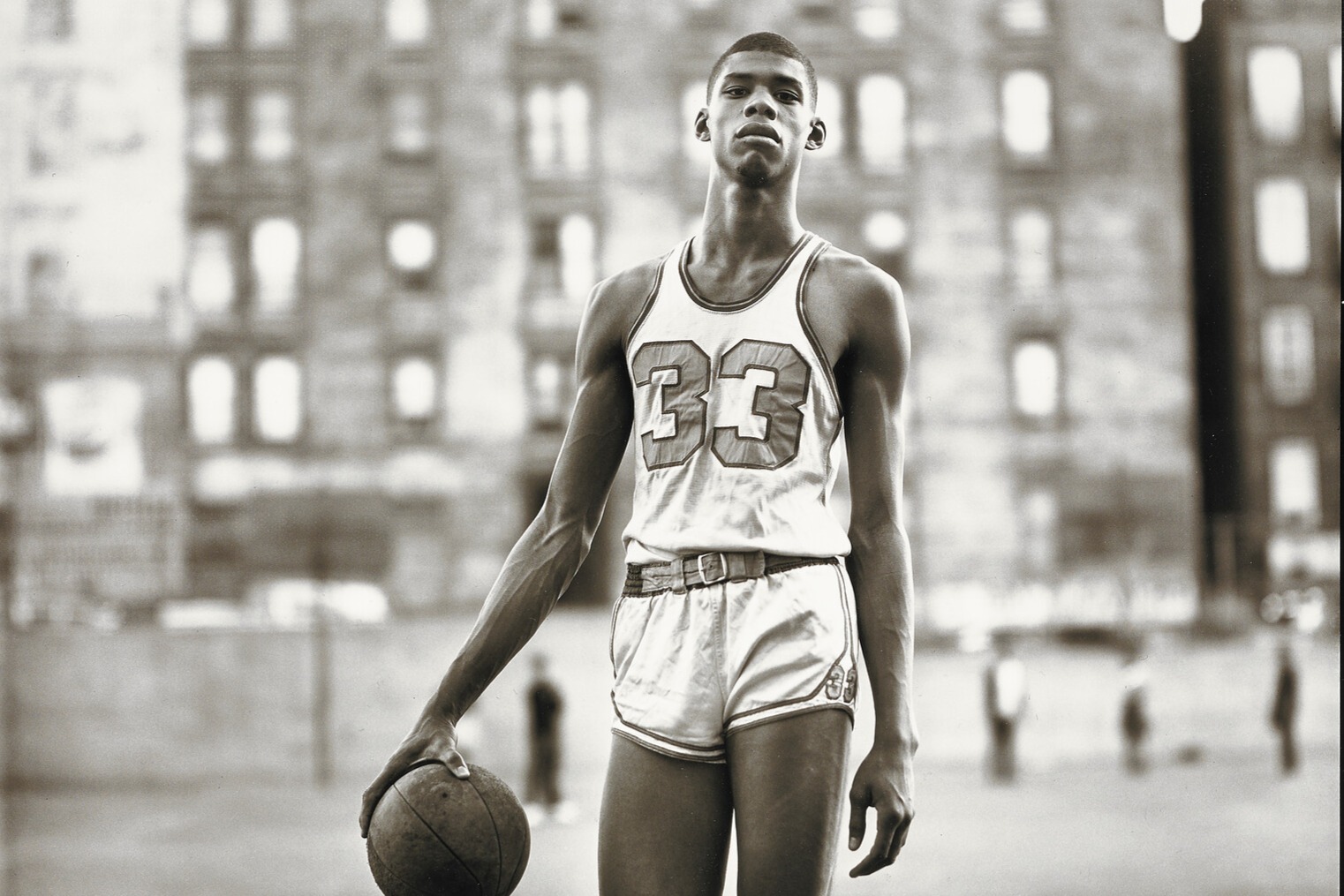
Lew Alcindor, Basketball Player, 61st Street and Amsterdam Avenue, New York, May 2, 1963
Lesson Objective
Students will look at Richard Avedon’s black-and-white photograph of Lew Alcindor and practice close looking. In a group setting, students will discuss what they see and the activities they like to do. This is an opportunity for students to reflect on moments where they feel strong and powerful, or perhaps a place where they have a strong community of friends through writing and art.
Introduction
Richard Avedon’s black-and-white photograph shows Lew Alcindor, a high school basketball star, as self-confident and physically powerful. Alcindor, who later changed his name to Kareem Abdul-Jabbar, went on to become the National Basketball Association’s leading scorer and winner of six championships.
This photograph embodies the stories of two superstars—artist and athlete—in their own professions. It also addresses an era that embraced the civil rights movement, fashion photography, and the idea of sports star as superhero.
Warm-Up Questions
Take a moment to look at the photograph. Discuss what you see.
- • What else do you notice about it?
- • How does it make you feel? What do you see that makes you say that?
- • What do you wonder about as you look at this photograph?
Background
Richard Avedon
Both Richard Avedon, the photographer, and Lew Alcindor, better known as Kareem Abdul-Jabbar, were superstars in their chosen professions. Both also dedicated themselves to the cause of civil rights.
Richard Avedon was one of the world’s most famous fashion and art photographers from the late 1940s into the 21st century. During the early 1960s, he traveled through the southern United States, photographing participants in the civil rights movement. He took pictures of African American leaders such as Malcolm X and movement opponents like George Wallace, governor of Alabama, for a book called Nothing Personal. This was in collaboration with James Baldwin, the novelist, playwright, poet, and civil rights activist.
Avedon’s photographs often present political or ethical positions. And, despite opposition from others in the fashion business, Avedon chose and photographed the first nonwhite model, China Machado, to appear in a fashion magazine. He later championed Donyale Lewis as the first Black super model.
Lew Alcindor
Lew Alcindor finished his high school career with 79 wins and only two losses. An A-student, he also studied Black history and learned about his own family’s African heritage. In 1971, Alcindor converted to Islam and changed his name to Kareem Abdul-Jabbar.
By the time he retired from professional basketball in 1989, Abdul-Jabbar was the NBA’s leading scorer and winner of six championships. His accomplishments on the court are legendary.
Abdul-Jabbar is also an educator and best-selling author. He’s written many books about Black history, including On the Shoulder of Giants: My Journey Through the Harlem Renaissance, co-authored with Raymond Obstfeld, and Brothers in Arms: The Epic Story of the 761st Tank Battalion, WWII’s Forgotten Heroes, with Anthony Walton.
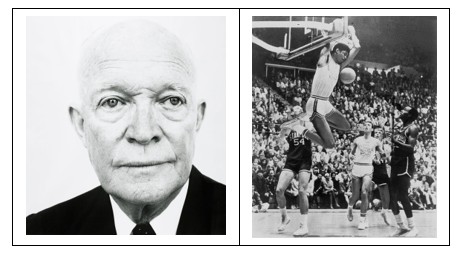
Left: Richard Avedon (United States, 1923–2004). Dwight David Eisenhower, President of the United States, 1965, gelatin silver print (printed 1970). The Christina N. and Swan J. Turnblad Memorial Fund. ©The Richard Avedon Foundation. Right: Library of Congress Prints and Photographs Division. New York World-Telegram and the Sun Newspaper Photograph Collection.
Fashion Forward
Pictures tell stories. Photographers, including Avedon, make many choices in order to present their subjects as they want viewers to see them. Avedon recalled that as a boy, his family planned all of their snapshots; they dressed up, posed in front of expensive cars and other people’s homes, and even borrowed dogs to present the family as it wanted to be seen. They role-played for the photographs.

Richard Avedon (United States, 1923–2004). Lew Alcindor, basketball player, 61st Street and Amsterdam Avenue, New York, May 2, 1963 (detail), 1963 (printed 1990). Gelatin silver print. The Alfred and Ingrid Lenz Harrison Purchase Fund and gift of the Richard Avedon Foundation, 2011.15, Photograph by Richard Avedon ©The Richard Avedon Foundation.
Let’s Think About It!
- • What words would you use to describe Lew Alcindor?
- • What do you see in the picture that brings those words to mind?
- • Does the knowledge that the photograph was taken by a famous fashion photographer change how you describe it? If so, in what ways?
Avedon posed the young Alcindor on a basketball court in an urban environment. The photograph’s title locates the scene at 61st Street and Amsterdam Avenue in New York, then the address to Alcindor’s high school, Power Memorial Academy. Though photographed in 1963, the picture first appeared in a fashion magazine filled with other photos by Avedon in 1965. In what ways is Avedon’s picture of Alcindor like images of fashion models?
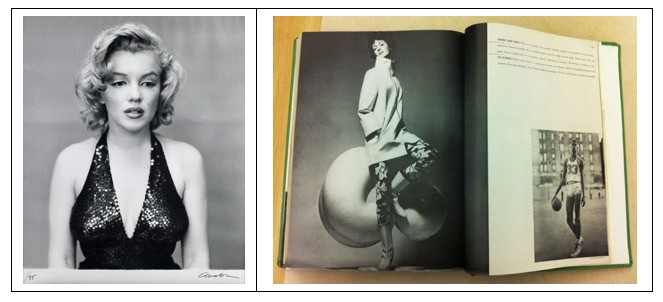
Left: Richard Avedon (United States, 1923–2004). Actress, May 6, 1957. Gelatin silver print (printed 1970). The Christina N. and Swan J. Turnblad Memorial Fund. © 2008 The Richard Avedon Foundation. Right: Avedon’s photograph of Lew Alcindor appeared in this spread in the April 1965 issue of Harper’s Bazaar.
Sports Superstar
Since ancient times, artists have represented athletes as extraordinary. The pose of this ancient spear thrower was innovative in its day for showing the body at rest and in motion at the same time. Many photographers of the 20th and 21st centuries have captured the drama of sports and created iconic images of sports superstars.
Let’s Discuss It!
Think about the various places you see sports images every day. In your opinion, what makes a sports image a work of art or not a work of art? Explain your opinion.
Avedon made artistic choices to emphasize that Alcindor was not an ordinary high school student. He positioned his camera well below the tall, athletic Alcindor to emphasize his height. By posing Alcindor palming the basketball (a difficult feat for most people), and with his right knee bent and his right arm extended, Avedon showed off the extraordinary length and muscularity of the young man’s arms and legs. Alcindor is self-confident. He dominates the court. He appears almost super-human.
Strike a Pose!
How does it feel to stand like him?
The photograph first appeared in print nearly two years later, in the April 1965 “What’s Happening” issue of the fashion and style magazine Harper’s Bazaar. The entire issue featured photographs by Avedon; Alcindor was pictured and heralded as “what’s about to happen in basketball.”
In fact, however, he was already “happening.” In his senior year, Alcindor averaged 33 points per game and led his team to win the New York City Catholic High School championship.
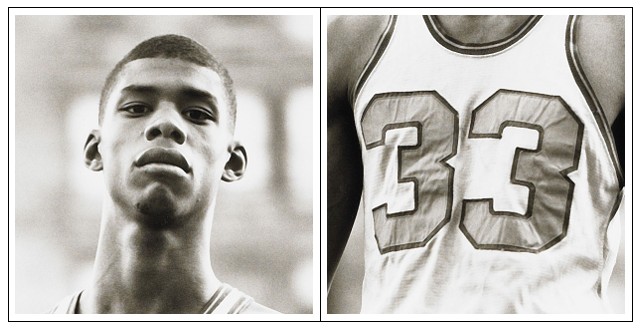
Left: This detail of Alcindor’s expression reveals his self-confidence. During his sophomore year when the photo was taken, he averaged 19 points per game, leading Power Memorial’s team to 27 straight victories. He was also an A-student. Right: Lew Alcindor, better known today as Kareem Abdul-Jabbar, kept the number 33 throughout his career.
Activity
Materials
- • Paper
- • Pencil
- • Marker, colored pencil, etc.
- Magazine clippings (optional.)
Guided Practice
As a class or in partners, discuss what activities you like to do. They might be activities where you have fun, you feel strong and powerful, or perhaps a place where you have a strong community of friends. No matter the activity, take the time to share what it is and why you selected it.
Instructions
- 1. Brainstorm and decide the place and/or activity where you have fun, feel strong and powerful, or have a strong community of friends.
- 2. Write two or three sentences about what you chose and why.
- 3. On the same paper as your sentences (or use a separate sheet), draw the activity where you feel strong and powerful using markers, colored pencils, etc.
- 4. Add at least three important details to your drawing. Think of the photograph of Alcindor. We see his jersey, a basketball, and the location near his school. What’s your setting? Who’s in the scene? What other details help the viewer learn more about you?
Reflection
Share your drawing and two or three sentences with a partner, small group, or class. Why do you suppose it’s important to celebrate each other’s strengths?
Additional Learning Activities
Sports Mia | Research
Search Mia’s website to find artworks related to sports or your favorite activity. Simply type your search word (e.g,. football, baseball, tennis) into the search box!
Learn About a Local Photographer | Research and Close Looking
Explore photographer Wing Young Huie’s website to learn how many of his photography projects document the socioeconomic and cultural realities of American society, much of it centered on the urban cores of his home state of Minnesota.
The Harlem Renaissance | Research, Writing, and Creating
Kareem Abdul-Jabbar created a documentary On the Shoulders of Giants: The Story of the Greatest Basketball Team You Never Heard Of, which tells the story of the Harlem Rens team. Research the Harlem Renaissance of the 1920s and 1930s. In small groups, develop an outline and storyboards for a documentary about an individual or group of people (e.g., writers, artists, athletes) who were part of the Harlem Renaissance.
Minnesota State Standards
Social Studies
5.5.24.1 Analyze anti-colonial and anti-racist resistance movements of culturally, racially, and ethnically diverse people throughout the world.
6.5.24.3 Identify how the arts have been a part of strategies, activities, and/or engagement for social and political change.
7.5.24.1 Examine the goals and actions of community groups, organizations, and other freedom movements that fought against injustices (i.e., local, national, and global).
Visual Arts
5.0.4.7.1–5.9.4.7.1 Respond: Analyze and construct interpretations of artistic work.
5.0.5.9.1–5.5.5.9.1 Connect: Integrate knowledge and personal experiences while responding to, creating, and presenting artistic work.