
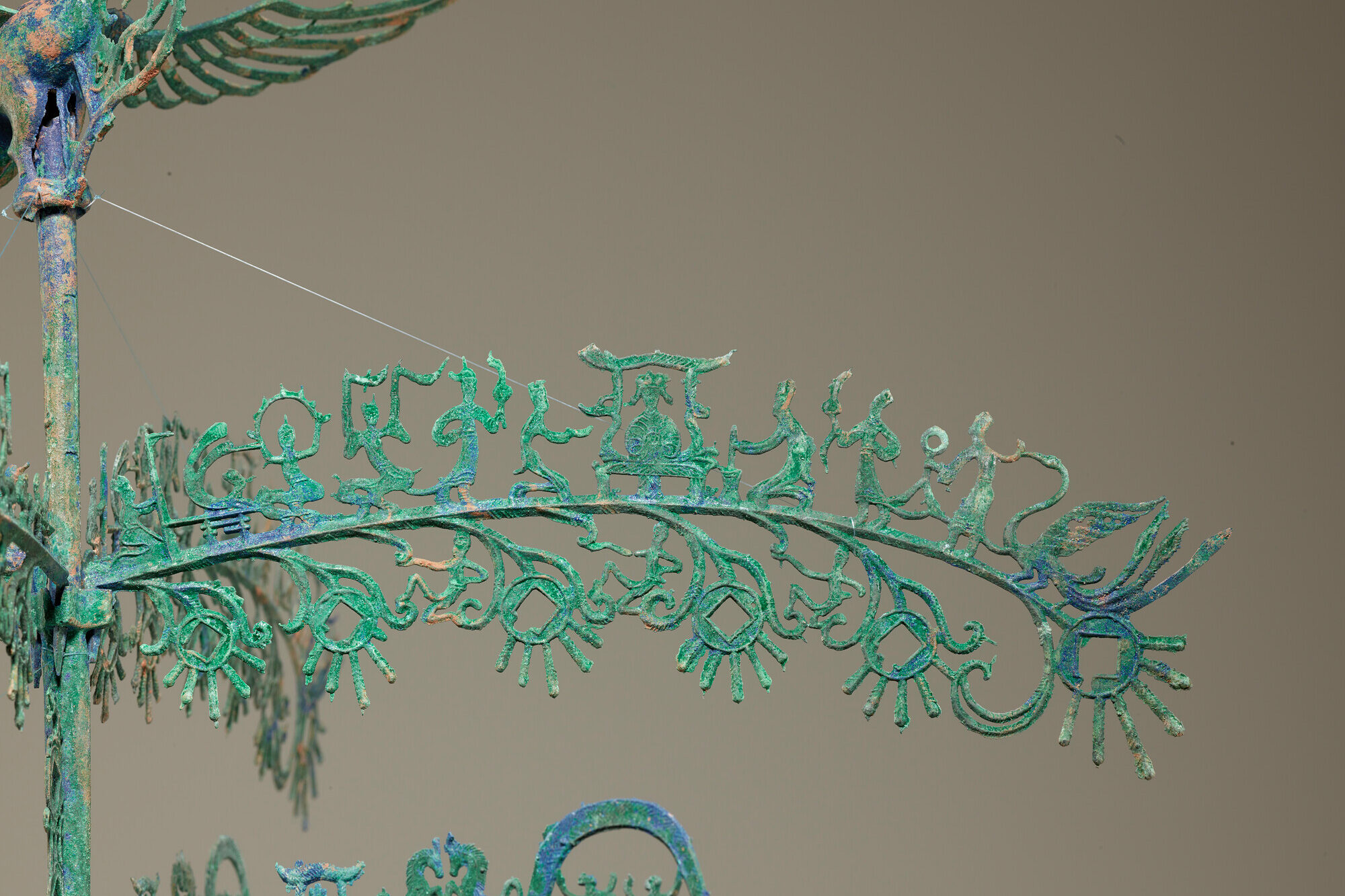
Money Tree

China, Money Tree, Bronze and green glazed earthenware, Eastern Han dynasty, 1st–2nd century. Gift of Ruth and Bruce Dayton.
Lesson Objective
Students will look at the Money Tree and related Chinese artworks and symbols of the Sichuan province from 2,000 years ago. These objects will help them learn about Chinese rituals, especially burial rituals. They’ll reflect on the meaning behind the symbols used to transition from life to death and how these rituals can aid the acceptance of someone’s passing and apply it to their own experiences.
If you wish to replace or add creative writing, compare and contrast activities, and/or historical research to your lesson, scroll down to the Learning Extensions.
Introduction
The Money Tree is filled with details of people, animals, and coins, which provide clues into the spiritual beliefs and practices of people in China’s Sichuan province dating back nearly 2,000 years. The abundance of coins and the types of figures included tell us it was associated with the ideas of paradise, long life, and enduring wealth. The idea was that the tree, decorated with wealth, would sustain its owner in the afterlife.
Warm-Up Question
Take a moment to look at the artwork:
- What do you see? What more can you find? Does this look like a real tree?
- How does this object make you feel? What do you see that makes you say that?
- What questions do you have after looking at the object?
Background
Money trees were produced for burial in tombs during a brief period in China’s history, now called the eastern Han dynasty (25-220 CE). At this time, a cult focused on the idea of an afterlife in paradise was very popular in Sichuan province in southwest China. There, money trees were highly prized tomb objects believed to grant wishes for eternal life and prosperity to the tomb’s occupant.
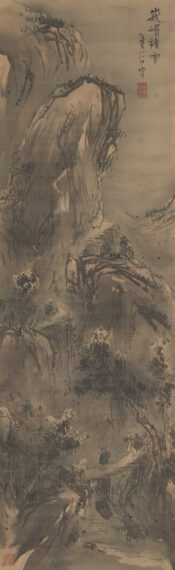
Yokoi Kinkoku, Road to Shu, 19th century, Hanging scroll, ink and light color on silk. Gift of the Clark Center for Japanese Art & Culture; formerly acquired by the Center with the kind assistance of Carol Brooks and Prof. James Cahill in honor of George Schlenker. The road to Shu, the old name of Sichuan Province, was famous for its precarious passages along sheer cliffs.
What Is a Money Tree?
The term “money tree” comes from modern scholars because of the coin designs throughout the tree’s branches. Supported by a glazed pottery base, the tree trunk and branches are made from bronze. Literature of the time suggests that money trees were inspired by folktales about money growing on trees. The coins resemble Han dynasty coins found in archaeological excavations.
Most tombs incorporated all aspects of luxe lifestyle, including sculptures of servants, guards, farmhands, musicians, and jugglers. The money tree represents a renewable, sustainable, never-ending source of prosperity and sustenance, while also symbolizing rebirth and eternal life. Furthermore, placing a money tree in a tomb likely had spiritual significance for Han dynasty citizens.
The tree’s verticality represents the soul’s journey from the earthly to the spirit world. At the time, coins were thought to emit supernatural light, guiding and helping sustain the deceased’s journey to the immortal world. The imaginary animals composing the tree base likely served as vehicles to the afterlife. Sculptures of dancers in performance dress were often included in Han tombs as a source of entertainment for the occupant.
Elements of a Money Tree
Taoism and Hsi Wang-mu (Xiwangmu)
Look at the top center of each branch for a figure seated beneath a canopy. This is Hsi Wang-mu (pronounced shee-wong-moo), a deity in Taoism (pronounced dow-ism) known as the Queen Mother of the West. Atop the lower branches, she’s seated in a shrine and is being entertained by flying horses on both sides and performers below.
On the higher branches, spiritual attendants (xian) make offerings to her. In each depiction, she wears a customary flowing robe and a headpiece (sheng). To one side, the rabbit of the moon works his mortar and pestle to make the elixir (potion) for long life. On her other side is the east toad, with another symbol of long life, a special fungus. Behind the rabbit, spiritual attendants make offerings. Behind them is a fancy bird whose tail merges into a coin with rays of light.
During much of the Han dynasty, Hsi Wang-Mu was worshipped as the ruler of mythical Mt. Kunlun and holder of the secret to longevity. In some portrayals, she possesses an elixir that, when consumed, guarantees immortality. People of all social statuses, from commoners to royalty, worshipped her. Particularly in Szechuan province, she augured good fortune, thus explaining her central placement on the money tree.
At the end of the Han dynasty (c. 220), Taoism became an established religion in China. Taoism focuses on nature, the quest for longevity, spiritual cultivation, and the “Tao” as the source of all things. Taoism incorporated much older philosophy and deities, including Hsi Wang-mu, into its system of beliefs. In time, Taoism and Buddhism overlapped in China, and Hsi Wang-mu was depicted alongside the Buddha and other enlightened figures of Buddhism.
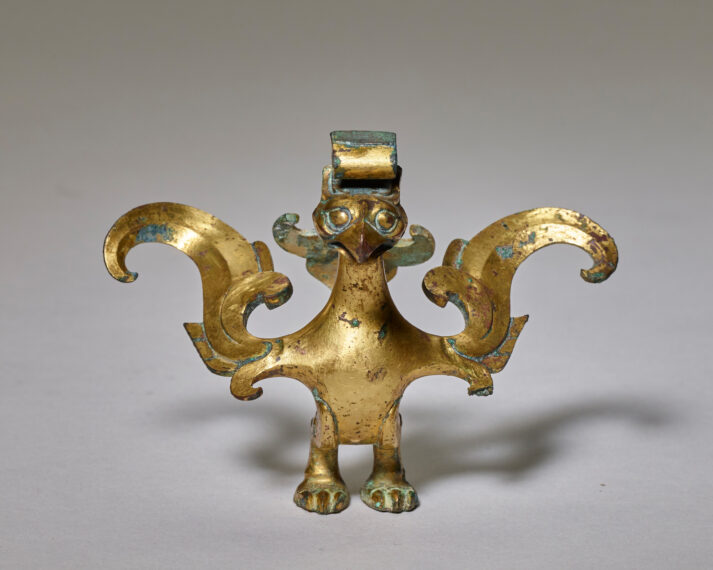
China. Phoenix, Western Han dynasty, 2nd–1st century BCE, gilt bronze, Gift of Ruth and Bruce Dayton.
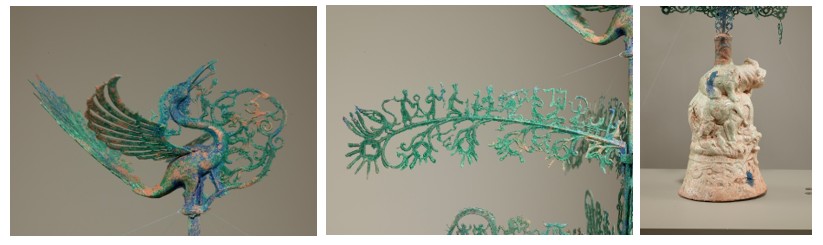
Left: Money Tree, detail of phoenix (left), branches (center), and base (right).
Phoenix
The phoenix-like bird up top majestically stretches toward the sky. While the exact interpretation of the birds on money trees is not known, scholars believe they could be birds of good omen, the bird that brings the sun to the world each morning, the red bird of the south, or even the phoenix, widely associated with immortality.
Branches
The figural decorations on the lower five sets of branches are largely like one another. As visible in the lowermost branches here, Hsi Wang-mu is again at center, bracketed by pairs of prancing horses atop coins. Below the horses are scenes of people leading livestock. At the end of each branch, figures move above a vertical row of three coins, the top one with light rays. More coins with rays decorate the innermost part of these branches.
Base
The ceramic mountain-like base of the sculpture, which supports the tree, shows a stack of imaginary animals. On top is a horned toad-like animal. It stands on what appears to be a fantastic winged bovine beast with horns. Animals on these bases are typically associated with good fortune or serve as guardians or vehicles to the afterlife.
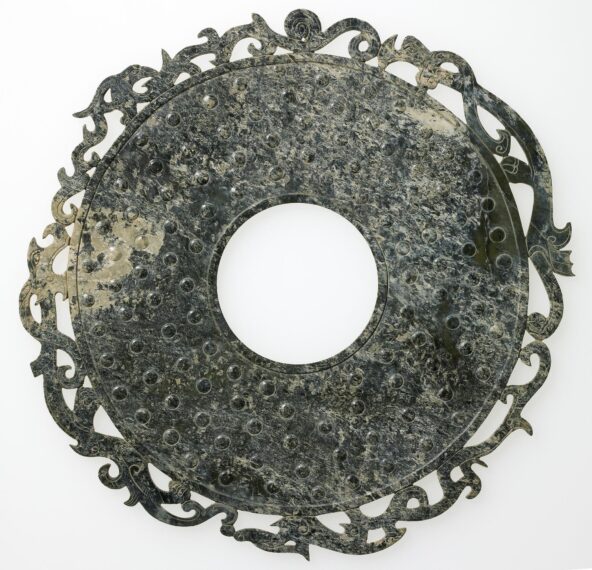
China. Bi disc, 1st century CE. Gray-green mottled nephrite (jade). Bequest of Alfred F. Pillsbury. Originating in the Hongshan culture of the Neolithic period, around 4000 to 3000 BCE, the bi disk is emblematic of heaven. The bi disks from the later Han dynasty tend to be more elaborate.
At the lower part of the base, you can see round disks attached by ribbons. These may well be jade circles with holes in the middle called bi (pronounced bee) disks. Jade trees were believed to grow on mythical Mt. Kunlun. The disks, resembling coins, serve to strengthen the tree’s associations with long life and wealth.
Present Day Money Trees
Money trees, though in a very different form, continue to be popular today with some families during the Chinese New Year. They are made of pine or cypress branches arranged inside a clay pot filled with rice grains. Symbols of long life as well as paper garlands of silver and gold coins decorate the branches.
Art Activity: Pop-Up Gratitude Tree
Materials
- Blank sheets of paper
- Colored sheets of paper
- Scissors
- Glue or glue sticks
- Drawing materials: pencils, markers, paint
Guided Practice
Look closely again at the Money Tree, left to right and top to bottom. Think about what you’ve learned about the elements present and their meaning. Think about what the Money Tree represents. Reflect on the idea of wealth and what is valuable in the afterlife, and create a Gratitude Tree.
Instructions
Spend some time reflecting on the things that are important to you, the things that represent “wealth.” Make a list of the items you’ wouldn’t want to part with. It can be anything, not just material goods.
Create your Gratitude Tree by cutting a green sheet of paper into squares of different sizes. Then cut the squares in half to create rectangles (you’ll be able to create two Gratitude Trees). The rectangles should follow an order from smallest to largest.
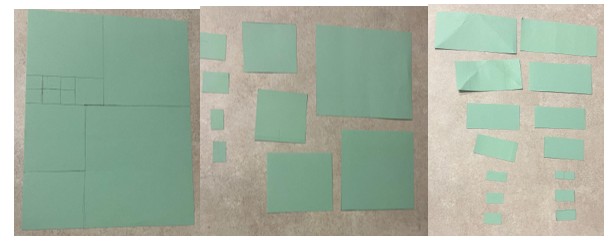
Fold the two top corners of each rectangle inward, creating what looks like a triangular point. Repeat with all rectangles.
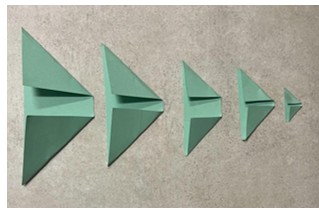
Organize the squares vertically on a blank sheet of white paper, starting with the smallest at the top with the point facing upward and descending down to the larger folded squares, creating the body of the tree.
Once your tree takes shape, glue the folded green squares on the blank paper.
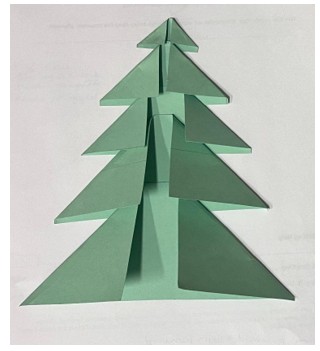
Now turn it into your ideal Gratitude Tree by adding the list of things that are important to you and that you’re grateful for. Draw or cut and paste from colored paper the symbols onto the flaps of the tree.
Activity Reflection
Talk to a classmate or friend about their Gratitude Tree and have them explain the symbols they chose and why. Then you do the same and reflect on how everyone has a different meaning of wealth. Reflect as a class on the meaning of “wealth.”
Money trees are still valued today, even though they originated a long time ago. Think about the traditions or beliefs you’ve learned from your ancestors or community. What does your family do to commemorate events?
Reflection
Whole group activity: Each student writes what they are grateful for on a piece of paper. Then this paper can be folded and hung in the classroom to serve as the class’s gratitude tree. This could be a lesson in what students find important in their life and what is valuable to them—family, friendships, community, etc.
Learning Extensions
Research and Discussion
Watch Chinese Bronzes: Ancient Methods Meet Modern Technology to learn more about Mia’s research related to the bronze collection. Divide the class into four groups (can be assigned for homework) and have your students research one of the four methods mentioned in the video: ink rubbings, line drawing, CT scanning, and 360-degree imagery.
Then have an in-class discussion or debate where students argue why they believe their method is most effective. There are no right answers. The idea is to have students work on their communication skills.
Research and Writing
The phoenix is a mythological bird that’s been used in art across cultures and time periods. Research the many examples of the phoenix in art around the world. Use the following guiding questions:
- How do different cultures use the phoenix in art?
- What similarities and differences do you find between cultures?
Compile your research and write an essay or create a presentation for your classmates.
Minnesota State Standards
Social Studies: History
K.4.19.1 Identify how different families and communities celebrate or commemorate events and engage in respectful conversation about traditions within an individual’s family/community and those of other families/communities.
Social Studies: Ethnic Studies
K.5.23.1 Create a personal representation of themselves, including their family and/or ancestors. Discuss the choices made, describing what is special and important, including strengths and assets.
Reading
4.1.9.1 Collect information from a variety of sources in different formats on a topic of personal interest or academic focus.
Visual Arts
5.0.4.7.1 – 5.9.4.7.1 Respond: Analyze and construct interpretations of artistic work.
5.0.5.9.1-5.5.5.9.1 Connect: Integrate knowledge and personal experiences while responding to, creating, and presenting artistic work.
Writing
4.2.5.1 Write to inform or explain, organizing and presenting ideas clearly, using precise, domain-specific vocabulary and a variety of text structures, and including an introduction and conclusion, building on skills from previous years.
4.2.7.2 Plan and conduct independent research using sources to build understanding of topic; evaluate perspective, credibility, and relevance of information, avoiding plagiarism, and share findings in writing.