
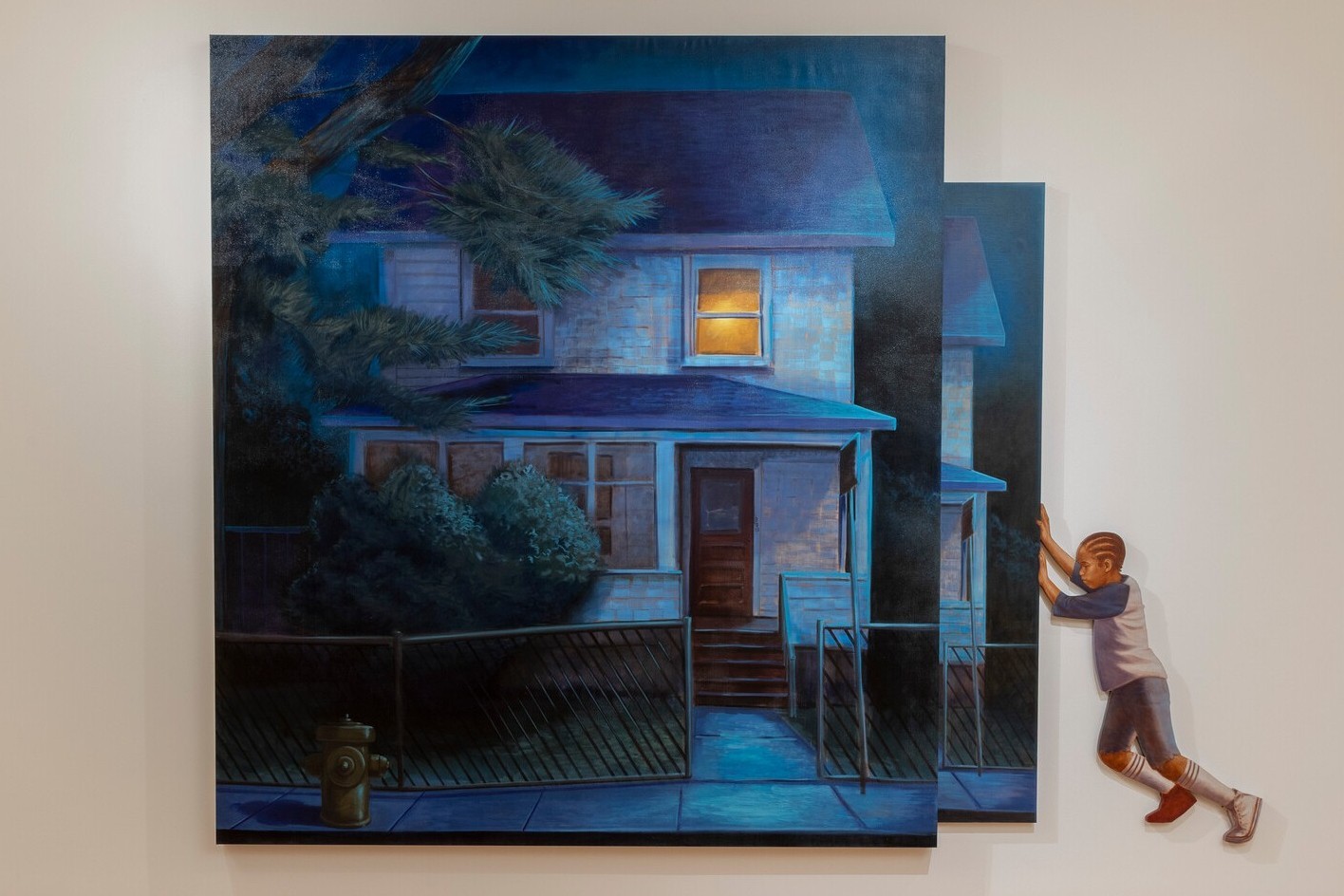
Titus Kaphar on Painting the Personal
By Tim Gihring
October 9, 2026—Titus Kaphar created Exhibiting Forgiveness to teach his children some history—his own history. Ultimately, he not only wrote and directed the semi-autobiographical film, which premiered at the Sundance Film Festival in 2024, he made 15 paintings that appeared in it. Nine of the works are now on view at Mia through January 3, 2027, revealing the creative process of an acclaimed artist wrestling with his past.
“My kids were getting older and I realized there was so much about my past they didn’t know,” Kaphar says. “So I would wake up at 5 a.m. and write all these narratives of what happened to me.”
The story told in both the film and the paintings is technically fiction: an accomplished artist named Tarrell returns home to interrogate his past, asking his parents to clarify a childhood befogged by time and trauma. But Kaphar, whose art has earned him a MacArthur “Genius” Fellowship and is widely collected, has never been coy about whose story it is.
“It started as a documentary,” he says. “I showed it two times, and then I had to get up in front of a crowd to talk about it. I said, ‘I will never be showing this again.’ I realized I felt way too close to it.”
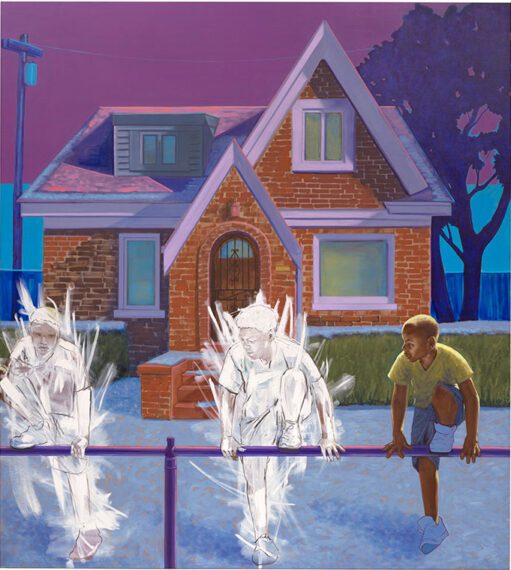
Titus Kaphar (American, born 1976). So Vulnerable, 2023–24. Oil on canvas. Collection of Rad and Hastee Payman.
A Turbulent Start in the Midwest
Kaphar’s mother was 15 when he was born, and his father was 16. The family lived in Kalamazoo, Michigan, though never in one place for long. It was a childhood of drugs and abuse, prison and poverty, which Kaphar walked away from as a teenager.
Eventually he found his way to San Jose State University in California, where he majored in art. At one point, he came across a chapter in an art history textbook about Black figures in Western art: painters, sculptors, subjects of paintings. His professor glossed over it. Frustrated, Kaphar painted his own take on this history—stylized portraits of the artists—which got Kaphar into Yale for graduate school.
In the paintings that followed, he would often return to this idea of historical erasure, of filling in the blanks. An image of Thomas Jefferson being pulled back to reveal a portrait of his enslaved mistress. George Washington with nails in his neck, like those driven by devotees into traditional “power figure” statues in the Congo, prodding the deity within into action.
For Kaphar, history is personal. It is, after all, where his ancestors live, and to know their world is to know them. “I’m trying to hold onto it,” he says, “to stop it from being disappeared.”
This instinct has made Kaphar something of a history painter, if an unlikely one. The tradition of history painting, he notes, is rooted in fiction: artists hired to mythologize events, to advance a narrative.
Kaphar is wary of the temptation. In June 2020, shortly after the murder of George Floyd, he was asked by TIME magazine to contribute a cover image. He declined, worried the magazine wanted to “whitewash” the crime and its incendiary aftermath. Then he reconsidered. He offered a painting of a mother holding an absent child—a son lost to police brutality. A son, he says, who could have been him.
“Even though there’s all this historical stuff going on in the work,” he says of his paintings, “I promise you there is nothing I’m doing that doesn’t have a personal connection.”
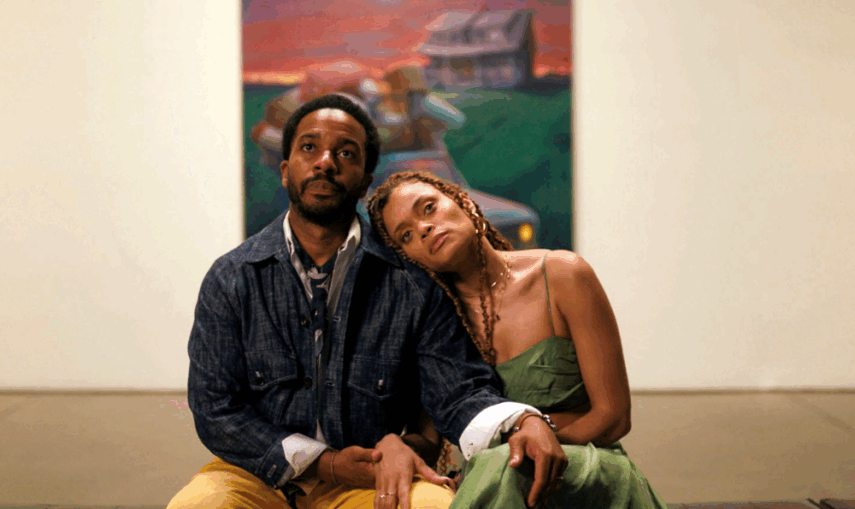
André Holland (as Tarrell) and Andra Day (as his wife, Aisha) in the film “Exhibiting Forgiveness.”
The Road to Forgiveness
Kaphar began composing his own history, in some ways, as soon as he left home at 14. He had a story in his head of what had happened to him, and he began rehearsing what he would say to his father if he ever ran into him.
About 15 years ago, he went to visit his grandmother and found his father on the porch. They hadn’t spoken in more than 20 years. Kaphar had a camera and asked his father, “You want to talk? Great. I’m going to film you because there’s a lot you have to account for.”
His father surprised him. “He was honest, open, remorseful,” recalls Kaphar, who had hoped the conversation would be a kind of “gotcha” moment. “It threw me off to the point where I just didn’t understand what I was doing.” He put the interview on a hard drive and walked away from the idea of ever doing something with it.
Soon after, however, he was searching for his father’s name, Jerome, in an online database of mugshots, and it struck him how many Black men with the same name had been imprisoned. He began painting portraits of these prisoners in the ancient Byzantine style—close-ups against a background of gold leaf—but with tar covering part of their faces, depending on how much time they had served. The Jerome Project, which debuted in 2015, marked a turning point both in his career and his understanding of his parents.
This led to a choice: forgiveness or reconciliation. At Mia, the labels for the paintings in “Exhibiting Forgiveness” include dialogue from the film, revealing Kaphar’s inner conflict. The painting He Was a Good Man recalls a heated conversation about whether his father is ultimately “a good man,” despite his abusive past. His mother suggests forgiveness: “If you forgive him, maybe it could be how it first was. He gave me you.”
Ultimately, the project clarified the way forward. “Forgiveness is about you, so you don’t have to carry these things, so you can let go,” he says. “Reconciliation is about coming back together with someone, and sometimes that can’t happen.”
Still, the process has proved cathartic, not just for him but for people who have seen the film and reached out. “I was very uncomfortable with it all until people started telling me, ‘I appreciate your honesty.’ Or ‘That was my father, too.’ For me, it’s another moment where I recalibrate and say that’s why we make what we make.”
How to Experience “Exhibiting Forgiveness”
Nine of the paintings created by Kaphar for the film Exhibiting Forgiveness are on view in the Bell Family Decorative Arts Court at Mia through January 3, 2027. The exhibition is free.
The film will be shown on October 18 and November 12, 2026, in the museum’s Pillsbury Auditorium, on the second floor just below the exhibition.