

Art in a Time of Turmoil
By Tim Gihring
March 2, 2026—Repression, freedom, totalitarianism. In just a few decades in the early 20th century, Germany careened between several political extremes. The resulting turbulence fueled two global wars, bringing out the best and worst of human nature and changing the entire world.
The special exhibition “Modern Art and Politics in Germany 1910–1945: Masterworks from the Neue Nationalgalerie, Berlin,” on view at Mia from March 7 through July 19, 2026, shows how artists responded. Here, Tom Rassieur, Mia’s John E. Andrus III Curator of Prints and Drawings, explores the themes of the show and the ongoing vitality of art in times of change.
The exhibition begins in the early 1900s, as the German art scene is embracing the experimental. Where is that impulse coming from?
It’s a tension. You’ve got this social conservatism guided by Kaiser Wilhelm, the leader of Germany, which is all about propriety—pretty stiff. Then Friedrich Nietzsche, the philosopher, comes along and says you can tear this all down and build a new society.
This invitation to self-invent gives rise to Expressionism, artists like the Brücke group who are rebelling against their families. Getting away from corsets and parlors, going out into nature. Some are nudists, some are vegetarians. They’re interested in folk art, working with their hands. The art dealers, who were often Jewish, are bringing art from elsewhere to Germany, and German artists are seeing this and traveling themselves. The kaiser conservatives think it’s anti-German; they don’t even want Impressionist paintings in German galleries.
After World War I, this tension between freethinkers and the establishment comes to a head. What’s the creative result of this collision?
World War I brings this to a head because Germany’s youth are being sent into the meat grinder. In November 1917, sailors in the German navy mutiny—a rebellion that turns into a revolution, ultimately causing the kaiser to abdicate. The Weimar Republic that follows has a lot of liberal elements. You have the Bauhaus artists trying to create art that is very rational, completely relatable to everyday people. You have the New Objectivity movement working to create a new utopia.
The establishment sees this as a great danger. So you have this collision course between artists emboldened by the liberal environment meeting an authoritarian power in the rise of Hitler. And because Hitler is this failed artist who wants to control everything, he’s not going to tolerate art that doesn’t live up to his ideas of heroism and nostalgia for a pure German culture.
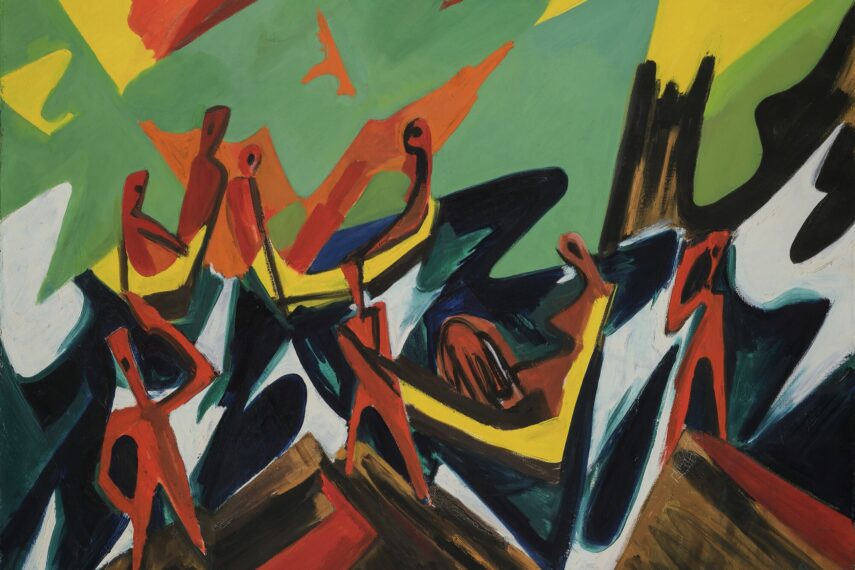
Ernst Wilhelm Nay, German, 1902–1968. Fishermen in the Surf, 1937. Oil on canvas. EL2026.2.69. © Neue Nationalgalerie, Stiftung Preußischer Kulturbesitz, Berlin
Abstract art in general becomes a target of the Nazis. Why is that?
It doesn’t fit with the academic tradition—the grand German tradition—that the establishment values. It’s seen as an import, largely from France, Germany’s archenemy. Also, it’s too open to interpretation for someone like Hitler, who wants to control what you think.
The Nazis famously stage an exhibition of what they call “degenerate” art in 1937, calling attention to what they find unacceptable. What’s the effect of that show?
The effect is mixed. It has its tar-and-feathering effect, waving an official flag of hatred that justifies the confiscations of art that are going on. It gives people something to latch onto. But others go to the show and really like the art.
And because it’s held at the same time as a show of rather dull art that Hitler does like, many people go to both and come away loving the comparative vibrancy of the “degenerate” art. In the long term, it becomes a badge of honor to have been in that show.
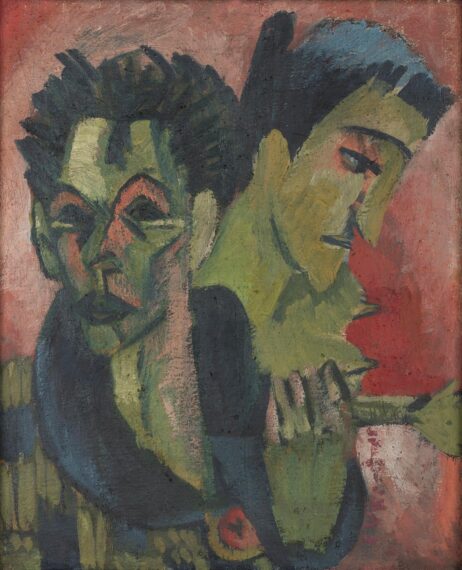
Ernest Ludwig Kirchner (German, 1880–1938), Self-Portrait with a Girl, 1914–15, oil on canvas. Acquired by the State of Berlin, 1949, B 4
What becomes of the “degenerate” artists? How do they navigate being enemies of the state?
Many leave—for the United States, Russia, France. The prominent exiles in our exhibition are Wassily Kandinsky, George Grosz, and Max Beckmann. And some of their art is very propagandistic in service to the Resistance, like Grosz’s 1926 painting of a military figure with a warhorse rising out of his head and a politician whose head is literally a steaming pile of poop. Then there are the internal exiles, people who stay in Germany and either work innocuously or secretly or not all—which is its own form of resistance.
It’s perhaps surprising that the only one who martyrs himself is Ernst Kirchner. Shortly after he finds out that he’s been declared a degenerate artist, he takes his own life—shooting himself twice in the chest.
Some artists in the show, like Emil Nolde, embrace Nazi ideology but are still castigated for their art. What happens to these artists?
Nolde is an antisemite who feels he’s being pushed around by Jewish artists, and so he is an early sympathizer with Nazism. He thinks his art will be safe, but he is a modernist. And even the way his art looks matters to the Nazis—it doesn’t have the clarity and ideal forms that Hitler wants.
So he loses his job, and in 1937, more than a thousand of his works are confiscated from museums and galleries. He ends up making what he calls his “non-paintings”—small watercolors that he paints in secret. His story underscores that ideological alignment with the regime offered no protection, and his suffering does not mitigate the beliefs he held.
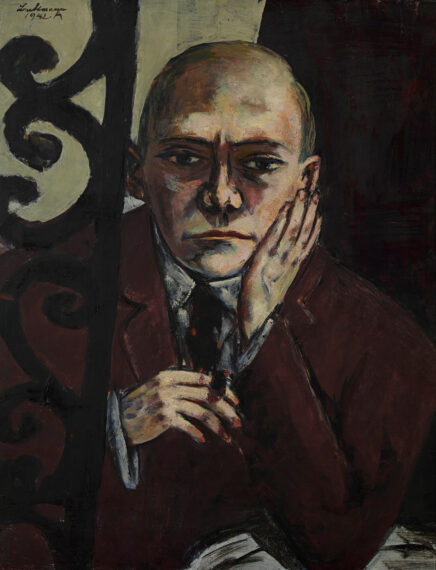
Max Beckmann (German, 1884–1950), Self-Portrait at a Bar, 1942, oil on canvas. EL2026.2.66. © Neue Nationalgalerie, Stiftung Preußischer Kulturbesitz, Berlin
This exhibition first opened in Germany last spring, but there are plenty of ways that Minnesotans might connect it to their own lives. What do you want visitors to think about as they move through the galleries?
I want them to think about the vitality of art in times of political turmoil—how creative these artists were and how easily threatened other people were by them. How art was used to drive divisions between people.
In a way, the stuff that the Nazis did in terms of art was a prefiguration of what they eventually did to Jewish people. You see them trying out the denigration of one aspect of society, and the physical destruction of it, before moving on to others. Art, like any other language, can work for good or bad. It can be powerful or innocuous. How you use it and how you respond to it really matters.
See More at Mia
“Modern Art and Politics in Germany 1910–1945” is on view at Mia through July 19, 2026. Tickets are available to see the exhibition. And the catalogue for the exhibition is available in the Store at Mia.