
Artists at Work
By Tara Kaushik
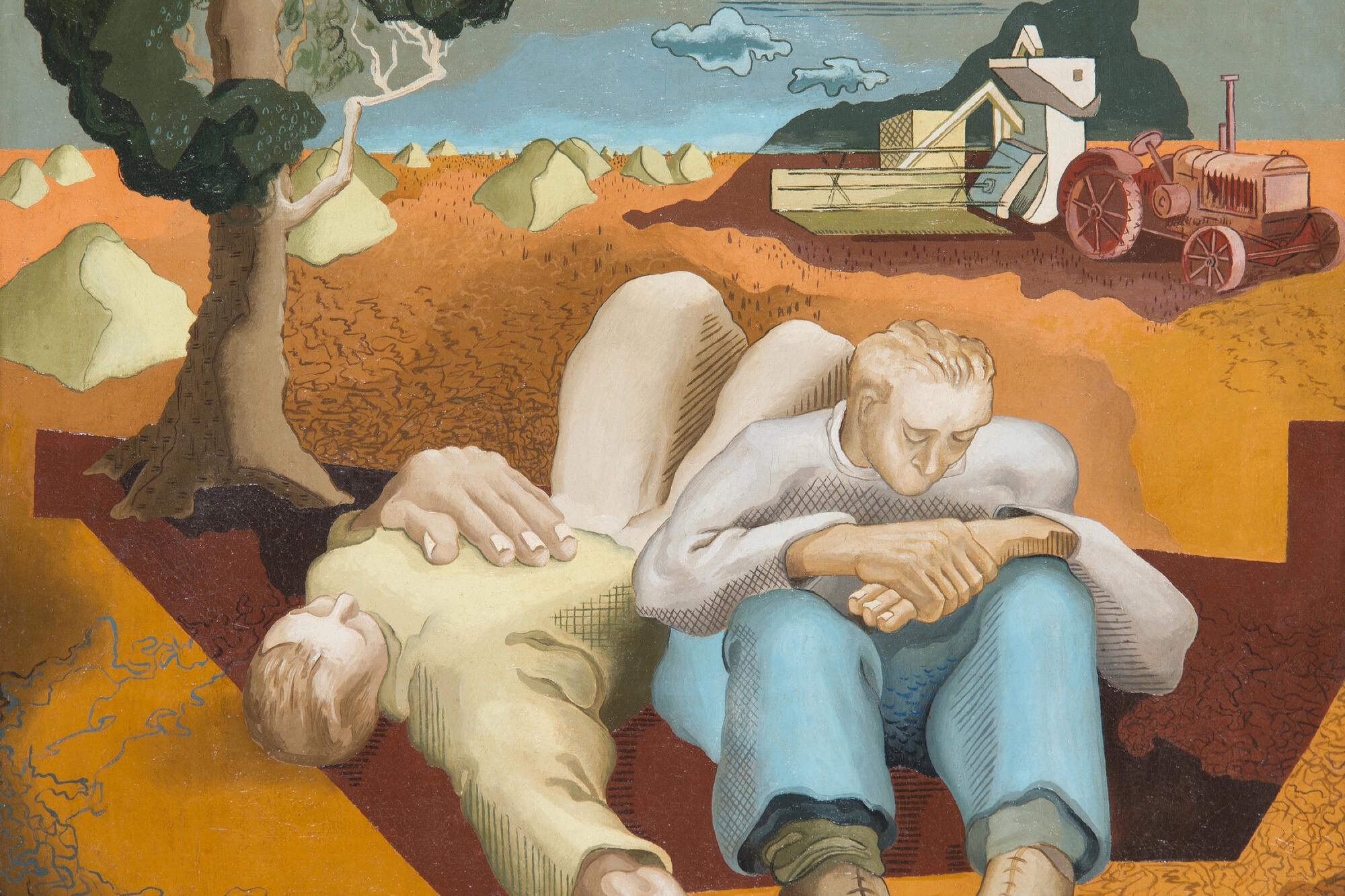
May 4, 2026—Many of the artists in “Built to Last: The Shogren Meyer Collection of American Art” received as little recognition for their artistry in their time as they did for their day jobs—working for the government, as commercial illustrators, or, in the case of artists like Jack Steele, in the very industries whose shadow their art depicted.
Led by a shared interest in the history of the Great Depression, Dan Shogren and Susan Meyer collect art centered around American industry. Their collection includes works by some of the most significant American artists of the early 20th century—Walker Evans, Dorothea Lange, Ben Shahn, to name a few—but Dan and Susan take pride in elevating the careers of artists whose creativity has been all too often overlooked.
“Built to Last” brings together paintings and photographs from the Shogren-Meyer collection, spanning the late 1920s through the early 1940s—a period marked by economic hardship, social unrest, and the dominance of industrial manufacturing.
Here, Spencer Wigmore, Mia’s Patrick and Aimee Butler Associate Curator of American Paintings, explores the context and themes that shape the show.
How did this exhibition come together?
Dan Shogren and Susan Meyer are long-standing supporters of Mia who have an impressive collection of American painting and photography. As I was getting to know their collection, what stood out to me was the way it captured the varied meanings of work during the early 20th century, particularly during the Great Depression. Scenes of industry were a visual form in which artists contested and reimagined the place of work within American culture during a time of serious political and cultural turmoil.
In organizing the show, I wanted to capture that spectrum of emotional responses to the theme of industry, as well as the different contexts in which artists worked, whether it was commercial advertising, federally funded art programs, or self-taught artists documenting their own communities. So the structure of this show is loosely arranged to differing responses to industrial life, ranging from celebratory to critical.
And what were some of those different responses?
For one, there are paintings and photographs that celebrate the monumentality of this new industrial landscape, often within the context of corporate advertising commissions, such as for Life or Fortune Magazine, which employed some of the best-known artist-illustrators and photographers of the era. In these images, heavy industry becomes a symbol of American progress and economic strength.
But alongside these more optimistic portrayals of industrial life, there are also images that offer a more cautious, even uneasy assessment, particularly within the context of the Great Depression. Some of my favorite works in the show are cityscapes that address the sometimes overwhelming presence of heavy industry within certain communities—scenes of oppressive clouds of smoke and smog, of steel mills encroaching on neighborhoods and churches, but also, at the same time, of the possibility of work during an era of widespread unemployment and economic hardship.
And rounding out that story, which ranges from optimistic to ominous, I wanted to include examples of works by artists who were themselves committed labor activists and who portrayed labor causes in their own art, such as Lewis Rubenstein and Sarah Berman Beach. These offer a unique and rich perspective on the Depression Era, and they show the stakes of this type of art as a form of cultural democracy.
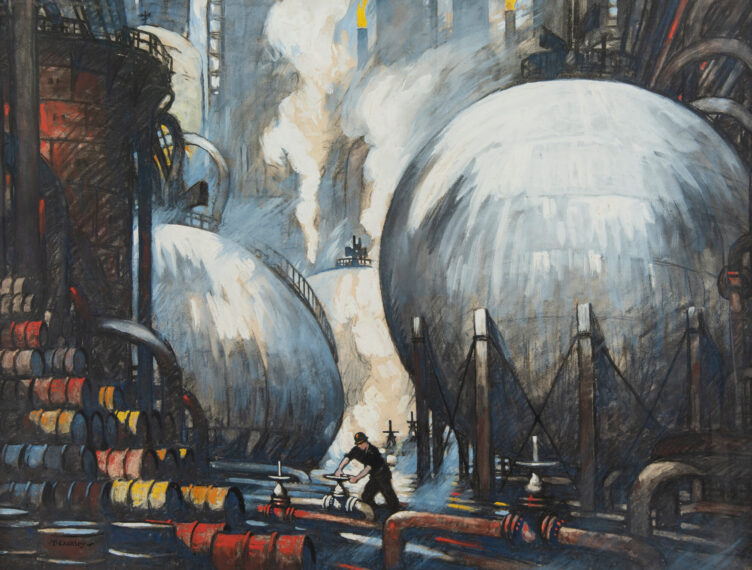
Thorton Oakley, American, 1881–1953. The Wonderland of Oil, c. 1942. Oil on canvas. The Shogren-Meyer Collection. EL2026.5.24
There are some really beautiful images of things that don’t immediately spring to mind as beautiful, like dams or oil and steel factories.
Many of the artists in this exhibition were creating work while navigating the pressures and expectations of an employer, whether an advertising agency, an illustrated magazine, or a federally funded art program. Each of these opportunities came with a certain set of expectations about how to portray industrial life in the U.S.
The thing I find really rich about this type of work is that artists didn’t just blankly follow the mandates they were given. They asserted their creative agency in various ways to challenge or push back against some of those expectations. It’s not easy to reduce this imagery to a straightforward reading or point of view. There’s always something deeper going on.
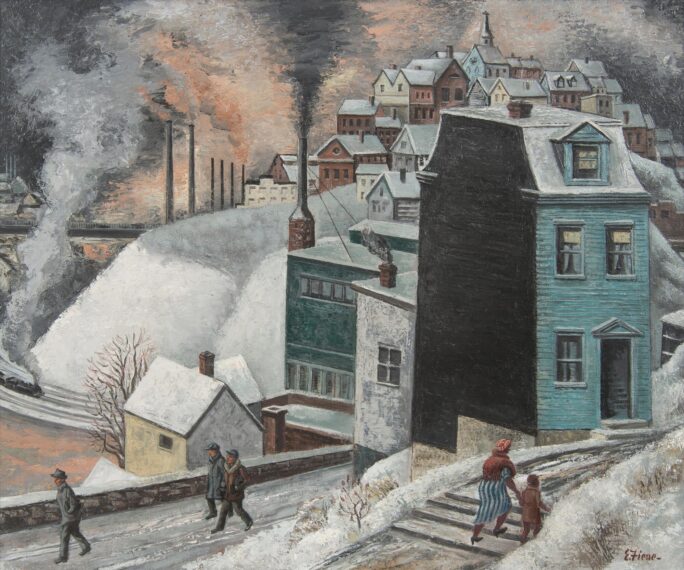
Ernest Fiene (American, 1894–1965), Milltown in Winter, 1935–1937, oil on canvas. EL2026.5.30. The Shogren-Meyer Collection
What are you hoping stays with visitors after they’ve left the gallery?
At its core, this is a story about art and democracy. These were artists who were making art for a mass audience, for viewers who weren’t necessarily museumgoers. And they were using their art to engage some of the most pressing issues of their time, often with the financial lifeline of federal and state-funded art programs. The stakes were high, and my hope is that visitors can gain a new appreciation of the depth of artistic production during this time, as well as the quality of work produced by artists who are not as well known, and who have perhaps been sidelined within the art historical narrative.
About the Exhibition
“Built to Last: The Shogren-Meyer Collection of American Art” is on view through June 14, 2026, in the Cargill Gallery (G103).