
Bare Bones: Skeletons in Japanese Art
By Laura Silver
October 8, 2026—Skeletons dance, arm wrestle, make music, smoke pipes, play games, and even take part in a courtesan procession. In Japanese art, the dead can be surprisingly lively—and sometimes downright funny.
“Bare Bones: Skeletons in Japanese Art,” on view at Mia October 24, 2026, through January 3, 2027, puts these unexpected characters center stage, bringing together 23 spooky artworks from Mia’s collection. The exhibition includes scrolls, prints, sculpture, textiles, and netsuke that show skeletons and skulls of all kinds, dating from the 1830s to 2018, in lifelike, humorous settings.
Just in time for Halloween, it offers a playful look at figures we usually think of as terrifying. The highlight of the exhibition is a recently acquired pair of six-panel folding screens by Takeuchi Ryūa (Kokunimasa) that shows skeletons at play and as a courtesan in a procession.
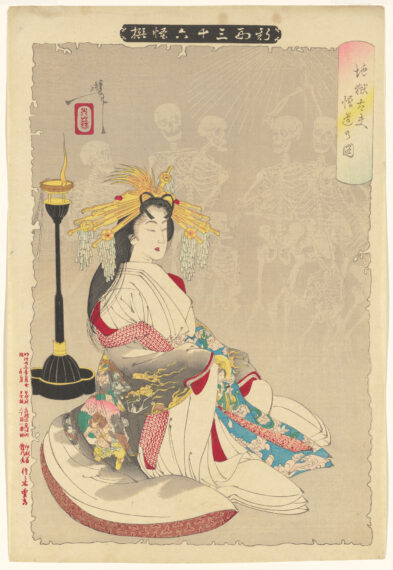
Tsukioka Yoshitoshi (Japanese, 1839–1892) Picture of the Hell Courtesan’s Enlightenment, from the series Collection of Thirty-Six Ghosts in New Style, February 1890, woodblock print; ink and color on paper. The Mary Griggs Burke Endowment Fund established by the Mary Livingston Griggs and Mary Griggs Burke Foundation, gifts of various donors, by exchange, and gift of Edmond Freis in memory of his parents, Rose and Leon Freis, 2017.106.235
The Buddhist Tradition of Impermanence and Death
The skeletons’ lively antics have deeper roots. Demons, ghosts, and other supernatural beings appear early in Japanese art, often alluding to the central Buddhist idea that life is fleeting. Much like the memento mori (an ancient Latin phrase that translates to “remember you must die”) of Western art, these works tell us that death is always present beneath the surface of beauty, pleasure, and worldly life.
One early literary example is the story of the Hell Courtesan. According to legend, a courtesan named Jigoku (literally, “hell”) was said to have been a close companion of Ikkyū (1394–1481), the eccentric Zen priest and poet. Known for finding virtue amid vice, Ikkyū criticized the hypocrisy of fellow monks. He also enjoyed worldly pleasures and claimed to have spent 10 years frequenting brothels.
In Skeletons, his prose and poetry text from 1457, Ikkyū reflected on the illusion of the world, writing: “Remember that under the skin you fondle lie the bones, waiting to reveal themselves.” Jigoku ultimately becomes Ikkyū’s disciple and achieves enlightenment. The story became enormously popular in the Edo period (1603–1868) and Meiji era (1868–1912), and is seen in Tsukioka Yoshitoshi’s Picture of the Hell Courtesan’s Enlightenment from 1890.
Skeletons: They’re Just Like Us!
Literal skeletons, however, didn’t become a staple of Japanese art until the late 18th and 19th centuries, possibly in connection with Japanese exposure to European scientific and anatomical knowledge. A pivotal moment was the translation of a Dutch medical text, in 1774, by three Japanese physicians. Its diagrams and drawings (copperplate etchings) were faithfully copied as woodblock prints.
The publication in Japan of the Kaitai shinsho (“New Text on Anatomy”) sparked a massive intellectual craze. It gave artists a new visual resource for the actual structure of the human skeleton. Soon skeletons became wonderfully adaptable characters in popular art—spectacular, theatrical, frightening. And entertaining.
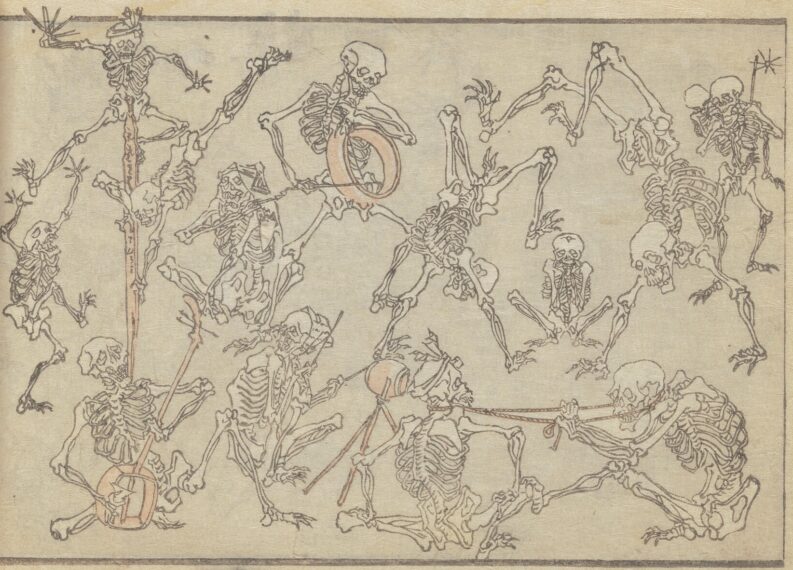
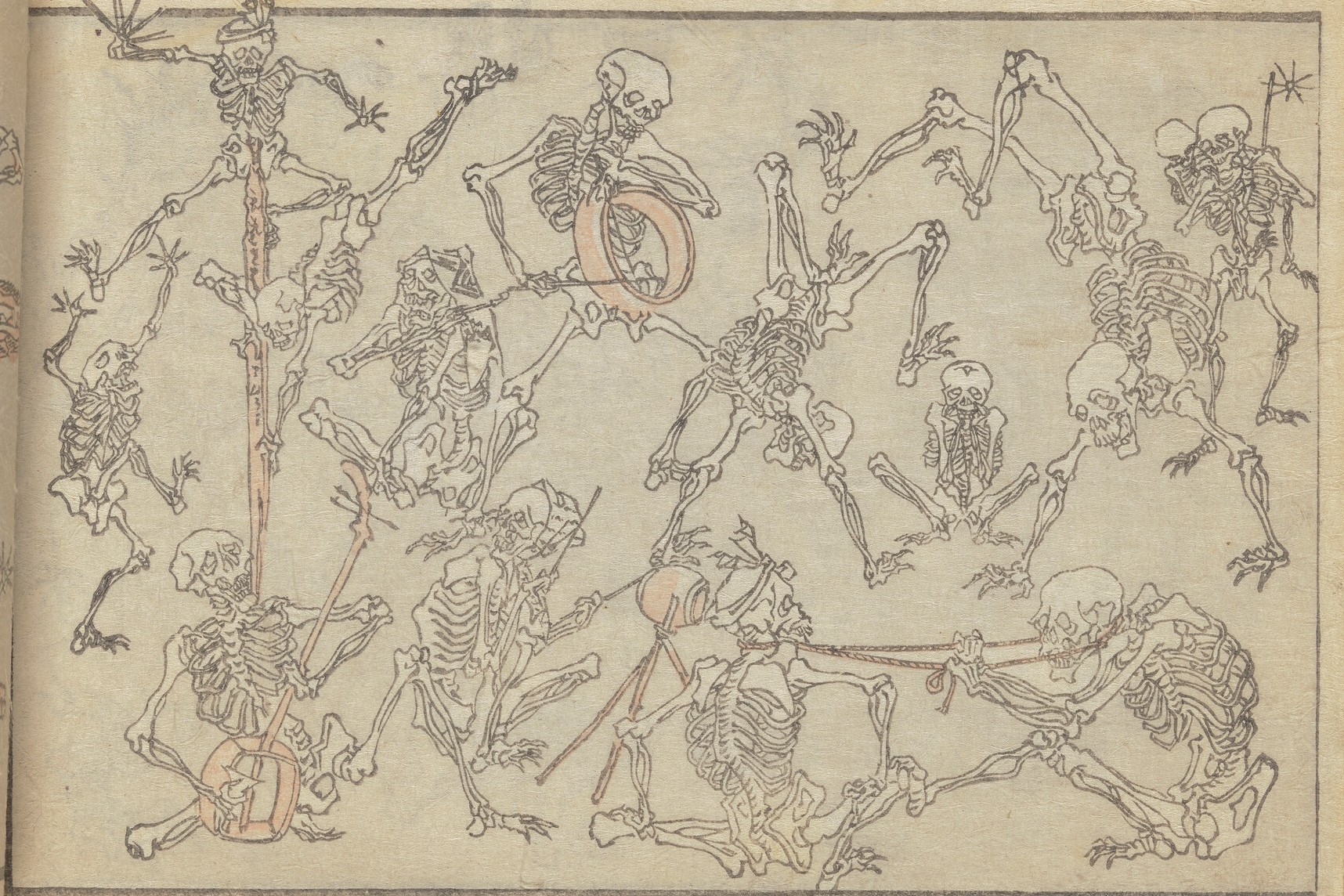
Kawanabe Kyōsai (Japanese, 1831–1889), Kyōsai’s Idle Drawings (detail), 1881, woodblock printed book; ink and color on paper. The Gary L. Gliem Endowment for Japanese Art, 2025.4
One great example is the work of Kawanabe Kyōsai (1831–1889), whose picture book Kyōsai’s Idle Drawings plays with traditional subjects and transforms the serious into the playful: gods read books or prepare fish for cooking and monsters share an umbrella. One spread depicts 27 skeletons engaged in various activities, including dancing, running, arm wrestling, walking on hands, or making music. Kyōsai captured them as if they were living humans, moving and interacting, mostly in moments of bounteous joy. This is a bit different from the Buddhist idea, “Remember that you will die.”
Kyōsai’s skeletons could be humorous as well as frightening. That ability to move between horror and comedy is a hallmark of his work. His skeletons don’t merely symbolize death. In fact, it sometimes seems like the dead are more vividly alive than the living.
The Buddhist ideals are still there, however. The skeleton strips away social distinctions, clothing, beauty, rank, and individual identity. Everyone, rich or poor, pretty or ugly, ends up as bones. Kyōsai clearly thinks that’s pretty funny.
Skeletons of the Silver Screens
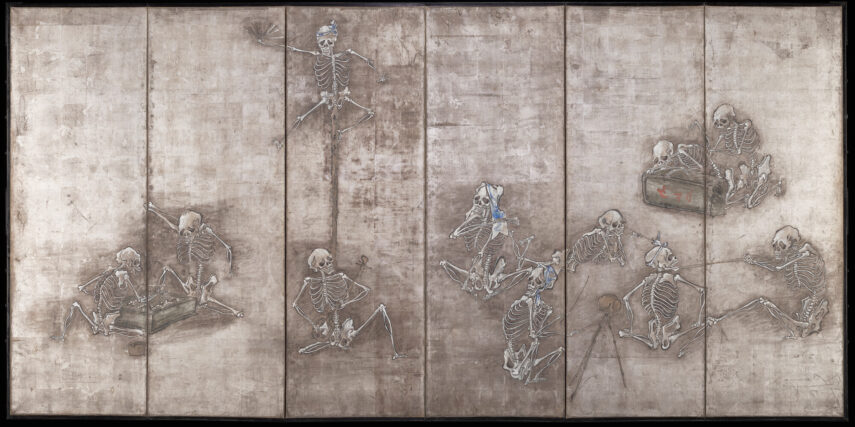
Takeuchi Ryūa (Kokunimasa) (Japanese, born 1873), Skeletons at Play, c. 1900–1920, ink, color, gold pigment, and silver leaf on paper. The Mary Griggs Burke Endowment Fund established by the Mary Livingston Griggs and Mary Griggs Burke Foundation, 2024.66.1
Kyōsai’s skeleton portraits were the basis for one of the two extraordinary folding screens by Takeuchi Ryūa. Ryūa painted the screens, the largest and most important of his career, on silver-leafed paper to emphasize the underworld nature of their subject. The left screen, Skeletons at Play, owes much to Kyōsai. It depicts 11 skeletons in various activities, including one resting its arms on a fallen gravestone, receiving moxibustion (a traditional therapy involving mugwort). Elsewhere, skeletons play tug-of-war, smoke a pipe, dance to the music of a three-stringed shamisen, and are absorbed in a game of go.
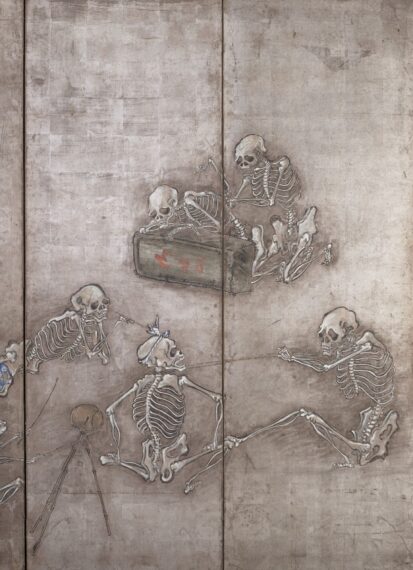
Takeuchi Ryūa (Kokunimasa), Skeletons at Play (detail), c. 1900–1920. The relaxed, pipe-smoking skeleton reclines at far left.
Andreas Marks, curator of “Bare Bones,” and Mia’s Mary Griggs Burke Curator of Japanese and Korean Art and Director of the Clark Center for Japanese Art, has noted that all but one skeleton on the left screen are clearly rendered from Kyōsai’s Idle Drawings. He says, “He added the relaxed, smoking skeleton, and one might speculate whether this skeleton is the artist himself.”
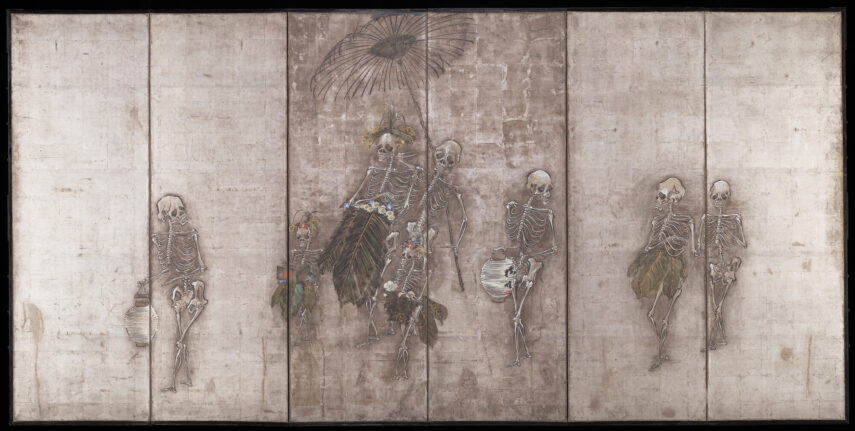
Takeuchi Ryūa (Kokunimasa) (Japanese, born 1873), Skeletons as a Courtesan Procession, c. 1900–1920, ink, color, gold pigment, and silver leaf on paper. The Mary Griggs Burke Endowment Fund established by the Mary Livingston Griggs and Mary Griggs Burke Foundation, 2024.66.2
The right screen, Skeletons as a Courtesan Procession, portrays a courtesan and her attendants, in the skeletal forms they will take after death, symbolizing the fleeting nature of life. The two attendants are dressed in skirts made of green banana leaves gathered in front to mimic a courtesan’s obi sash, their hair adorned with autumn flowers—another symbol of transience. Two male attendants light their path with paper lanterns.
Skeletons—they might represent death and impermanence, but they’re still dancing, drinking, working, flirting, or getting into trouble. Just like everyone else.