
A Portrait of Modernity: Christian Schad’s “Sonja” and the Crisis of the Neue Frau
By Tara Kaushik
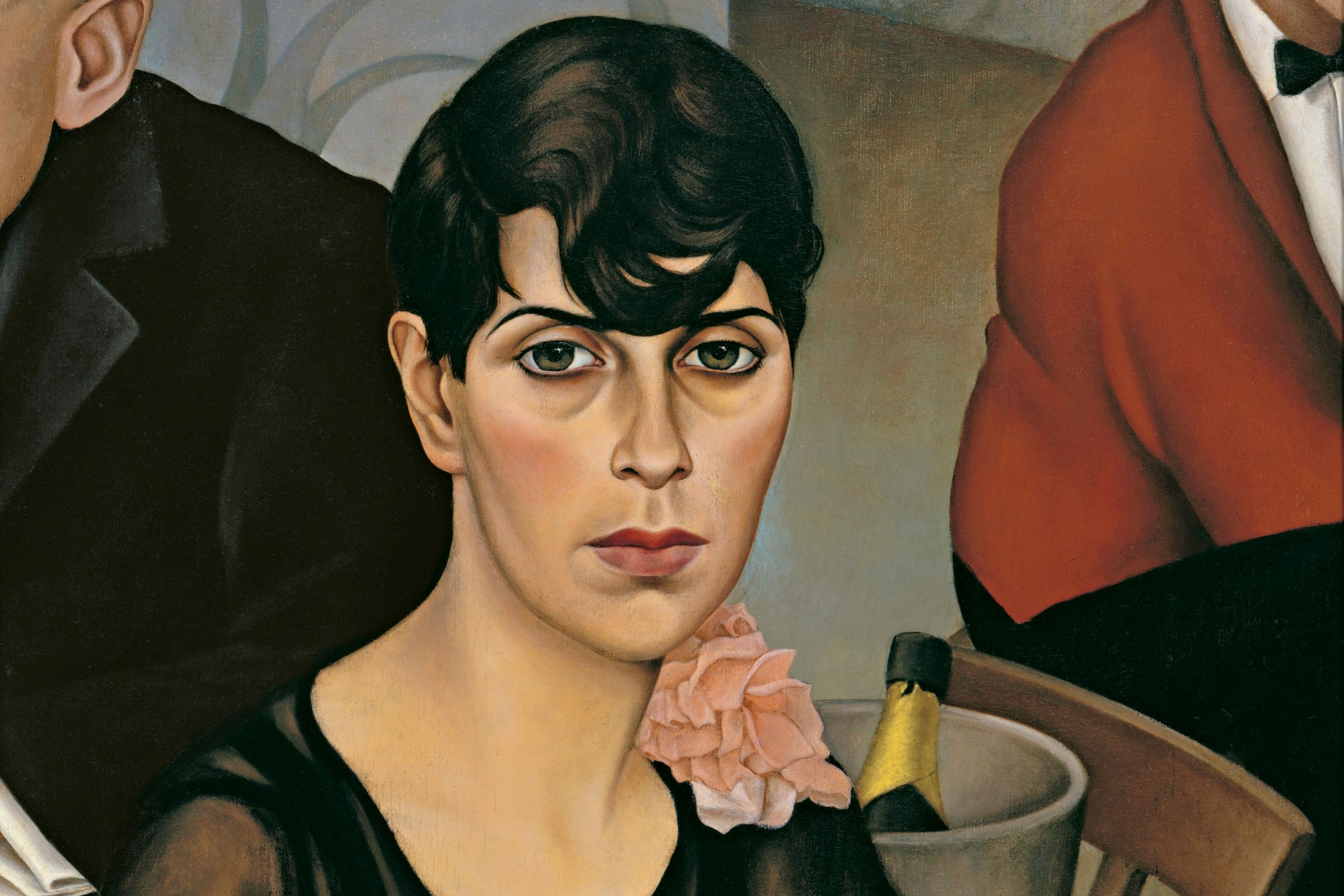
June 18, 2026—The lead image for Mia’s current special exhibition, “Modern Art and Politics in Germany 1910–1945: Masterworks from the Neue Nationalgalerie, Berlin,” is the captivating Sonja, a 1928 painting by Christian Schad. With her bobbed hair, androgynous fashion, and air of self-possession, she is the Neue Frau (new woman)—a walking emblem of the liberal Weimar Republic.
The Neue Frau was the result of widespread shifts in German gender norms during World War I. With men on the frontlines, there had been an influx of women in the workforce, and they’d gained more economic and social autonomy in the process. You could find the Neue Frau working in an office, playing sports, or smoking in a jazz club. She was the antithesis of the traditional German woman, relegated to the domestic sphere. She was a pleasure seeker and the source of a profound cultural crisis.
Liberal sections of German society celebrated the idea of the Neue Frau as a symbol of progressivism and modernity, while more conservative factions saw her emergence as a sign of degeneracy and societal decay. She was also, in many ways, a product of art.
The Cool Detachment of New Objectivity
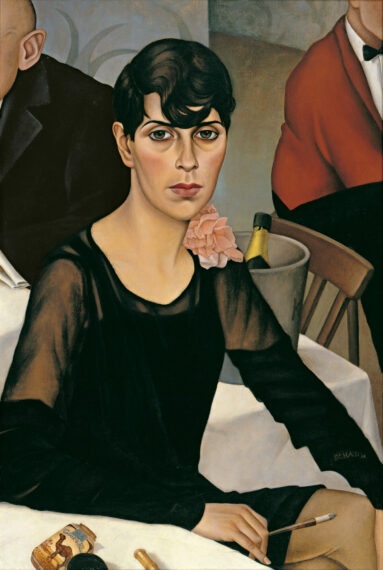
Christian Schad (German, 1894–1982), Sonja, 1928, oil on canvas. © Neue Nationalgalerie, Stiftung Preußischer Kulturbesitz, Berlin.
Neue Nationalgalerie curator Dr. Dieter Scholz calls Sonja “a prototypical depiction of the self-confident, emancipated woman in the Weimar Republic” and “a touchstone of New Objectivity.”
New Objectivity was an artistic movement that emerged in Weimar Germany in the 1920s, a detached, matter-of-fact response to moody, emotion-laden Expressionism. New Objectivity favored realism and practicality, and had no patience for angst and inner turmoil.
A master of the movement, Schad was known for depicting reality with clinical precision. He portrays the distant, melancholic Sonja against the backdrop of a Berlin cafe, with a pianist and a writer partially visible in the background. Clubs and cafes were the nerve center of the Weimar Republic, public spaces where artists and intellectuals could gather to share ideas and socialize. Placing Sonja at the center of one, alone, establishes both her independence and her individuality as well as the isolation and alienation of city life.
Anatomy of a Modern Woman
Every detail of Sonja’s presentation positions her as a Neue Frau. She sports a fashionably short haircut and carries a cigarette holder between her fingers. Casually strewn on the table beside her are a packet of Camel cigarettes, a powder compact, and a lipstick, symbols of urban sophistication.
“Over a silk crepe slip she wears a chiffon gown in the style of Coco Chanel’s ‘little black dress,’” writes Scholz. “Such details as the partial transparency of the material, the hemline that has slipped up over her knee, the silk camellia spreading its petals on her shoulder, and the pointing bottle in the champagne bucket give the picture an erotic flair, which is, however, counteracted by the sitter’s distanced posture and her serious facial expression.”
Indeed, Sonja remains emotionally closed off, her face stoic and difficult to read. This, despite her liberated self-presentation and the casual setting. It suggests the broader ambiguity surrounding the Neue Frau—her freedoms not guaranteed but subject to the shifting social and political currents around her.
The Backlash, Inevitably
To the Nazis, the Neue Frau’s economic freedom, sexual autonomy, and cosmopolitan lifestyle were evidence of moral degeneration. Upon seizing power in 1933, the regime moved swiftly to dismantle her world. Women were expelled from civil service and prestigious professions—the sitter of Sonja was, incidentally, one of them. Her name was Albertine Gimple, and she was let go from her job four months after Hitler was appointed Chancellor.
Economic disenfranchisement was far from the only form of backlash. Conservative physicians pathologized the Neue Frau, diagnosing her with “neurasthenia” and labeling her lifestyle a cause of infertility and national weakness. Nazi propaganda portrayed her as selfish and unwomanly. And so the independent woman was gradually forced back into the private, domestic sphere.
“The Neue Frau was Weimar Germany’s most audacious and vulnerable creation,” says the Explaining History podcast, “embodying both the Republic’s explosive energy and its structural fragility. For a brief historical moment, she proved that female identity could be defined by work, citizenship, and self-determination rather than marriage and motherhood.”
About the Exhibition
“Modern Art and Politics in Germany 1910–1945: Masterworks from the Neue Nationalgalerie, Berlin” is on view in the Target Galleries through July 19, 2026.
This exhibition features more than 70 paintings and sculptures from the collections of the Neue Nationalgalerie (New National Gallery), the distinguished modern art museum of the Berlin State Museums. It traces the German experience in the visual arts over four decades.
In the first half of the 20th century, Germany experienced the last years of the German Empire, World War I and the revolution that followed, the liberal Weimar Republic, the rise of Adolf Hitler and Nazism, World War II, and the Holocaust. Modern art played an important role in the discourse of the period, and politics influenced the arts.
Beginning with the Expressionist reaction and opposition to the conservative artistic regime of Kaiser Wilhelm II, the exhibition moves on to the New Objectivity movement, the modern style of the 1920s. Between the wars, German artists participated in international experiments with abstraction. Painters and sculptors critiqued social currents, but most were silenced under the Nazis. This exhibition concludes with an epilogue that examines the ambiguous aftermath of World War II.