
Print Study Picks: Happy New Year!
By Lori Williamson
January 13, 2026—The flip of the calendar is always a good time to reflect on where we’ve been, on what we hope for in the coming year, and—for the philosophical among us—on the very nature of time itself. Here are a few pieces to use as a starting point for such considerations.
Max Beckmann
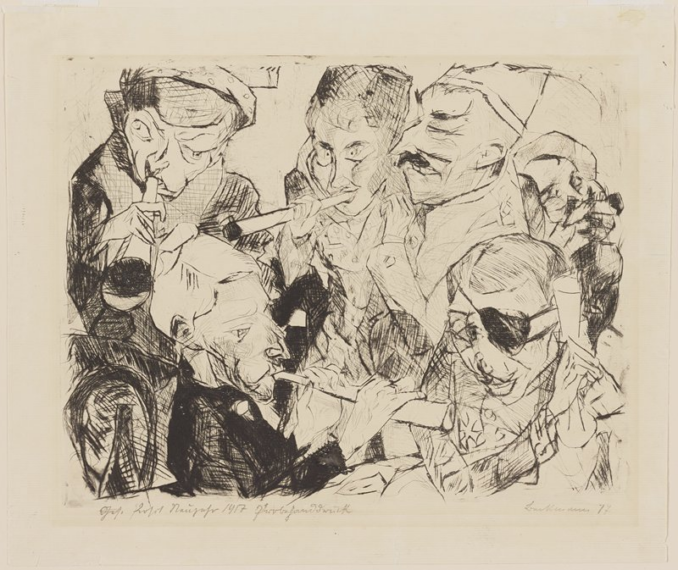
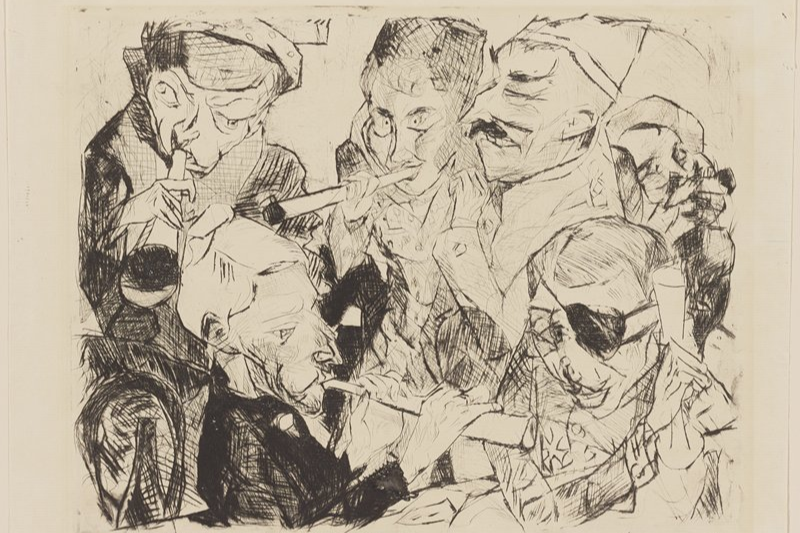
Max Beckmann, Prosit Neujahr (Happy New Year), from the portfolio Gesichter (Faces), 1917 (published 1919), drypoint with additions in black ink. The Richard Lewis Hillstrom Fund, P.94.4
While the attendees of Beckmann’s New Year’s party are blowing whistles, all is not so cheerful in this print. The serious expressions, the figure wearing an eyepatch, and the date of publication all indicate that this is, in fact, a depiction of wounded soldiers marking the new year—likely in a military hospital.
This drypoint image is part of a larger portfolio of 19 plates called Gesichter (Faces) by Beckmann, a German painter, printmaker, and medic during World War I. Beckmann would eventually be declared a degenerate artist by the Nazis and forced to flee Germany. See more of his work in Mia’s upcoming special exhibition “Modern Art and Politics in Germany 1910–1945: Masterworks from the Neue Nationalgalerie, Berlin,” opening March 7, 2026.
Georg Pencz
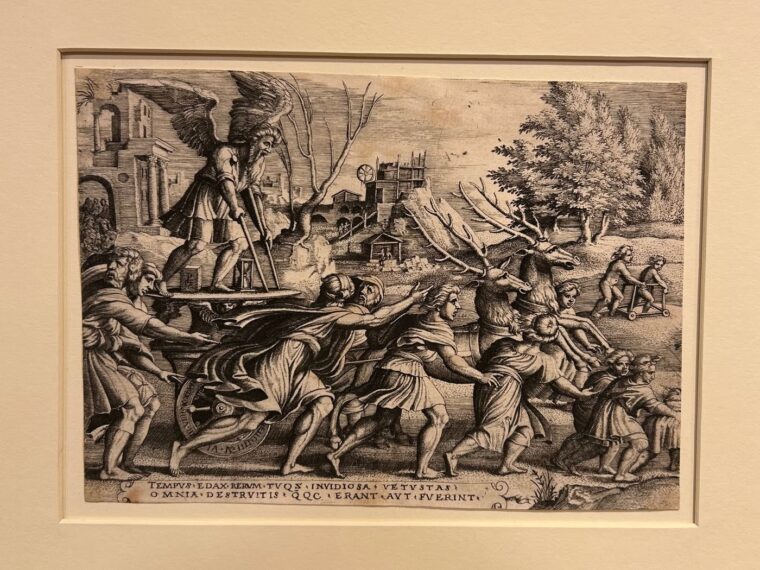
Georg Pencz, The Triumph of Time, c. 1539, engraving. Gift of Herschel V. Jones, P.10,932
This richly detailed engraving draws attention to Time itself. Time is personified here as both man and angel, being pulled on a wagon, barely able to stand but for his crutches. An hourglass at the feet of the figure beckons to an inevitable ending, as even the wheels on the wagon count down the days. The people surrounding the wagon are justifiably concerned—as are the children in the upper right, with the older child trying to help the younger one outrun Time (a feat at which they will be unsuccessful, as will we all.)
Todd Norsten
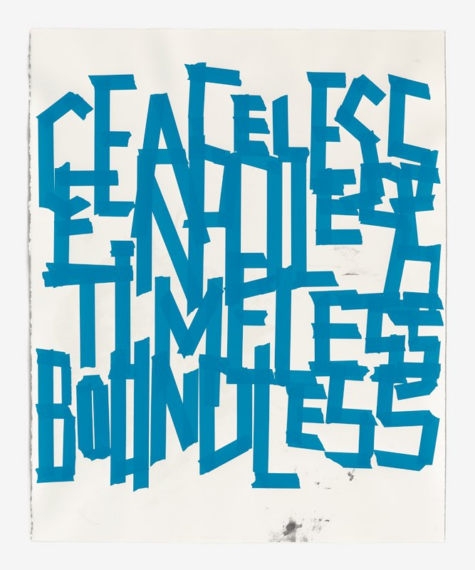
Todd Norsten; Printer: Highpoint Editions, Minneapolis, Ceaseless, Endless, Timeless, Boundless, 2010, screenprint in blue ink, with lithographic additions. Highpoint Editions Archive, The Friends of Bruce B. Dayton Acquisition Fund, and the Christina N. and Swan J. Turnblad Memorial Fund. 2020.85.89
This deceptively simple-looking piece is actually far more complex than it initially appears. It’s among the best-known of artist Todd Norsten’s trompe-l’œil (fool the eye) images of words and messages written with “masking tape.”
Rendering this type of picture as a printed image—including the tactile thickness and texture of blue painter’s tape—required dismantling the image into fragmentary components that were then printed separately in perfect registration, or alignment, a demanding and precise undertaking. Countless layers of ink were needed to complete the visual effects.
Norsten then added lithographic images of hair, dust, and miscellaneous workshop debris to imitate a scuffed and soiled sheet, which he also tore to be irregular in shape—all a sly criticism of the preciousness of so much fine art.
About Lori Williamson, Supervisor of the Herschel V. Jones Print Study Room at Mia
 Lori Williamson creates mini-exhibitions and teaches classes and Print Study Room visitors about the museum’s rich collection of works on paper. She’s the primary caretaker for more than 40,000 prints, 6,000 drawings, and 600 artists’ books, collaborating with curators in American, European, and Global Contemporary Art to make these holdings accessible. Williamson supports scholars through research and inquiry, and advocates for the inclusion of works on paper in exhibitions, social media, and outreach, helping to connect diverse audiences with this dynamic collection.
Interested in seeing something in the Print Study Room? All are welcome by appointment. Email Lori Williamson and copy the Print Study Room to make an appointment.
Meet the other curators in the Department of European Art.