
Print Study Picks: A More Perfect Union
By Lori Williamson
July 22, 2026—This July, the United States marked 250 years of its existence as an independent nation. It’s an opportunity to reflect on the great American experiment, and a reminder that it’s just that—an experiment, ongoing, and a constant work in progress. Looking at, thinking about, talking through, and making art, we see our hopes and fears reflected back to us.
Jaune Quick-to-See Smith
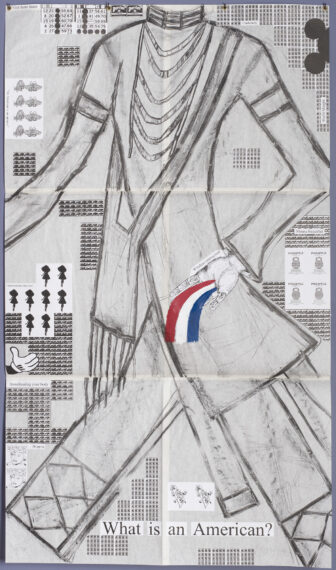
Jaune Quick-to-See Smith (American [Confederated Salish, Kootenai], 1940–2025). What is an American?, 2003, lithograph on six sheets of Japanese Tableau paper joined together, with hand painting in acrylic, chine colle, collage, and metal grommets. The Richard Lewis Hillstrom Fund, 2011.53.3
The hand bleeds red, white, and blue. The location of the wound references the stigmata, a holy symbol in Christianity, and reminds us that colonization brought Christianity, a destabilizing force for Native lifeways. This same blood could also signal the high rate of service of Native people in the U.S. military. What is an American? The artist asks us to ponder this question and what the answer means for our nation’s future.
Teo Nguyen
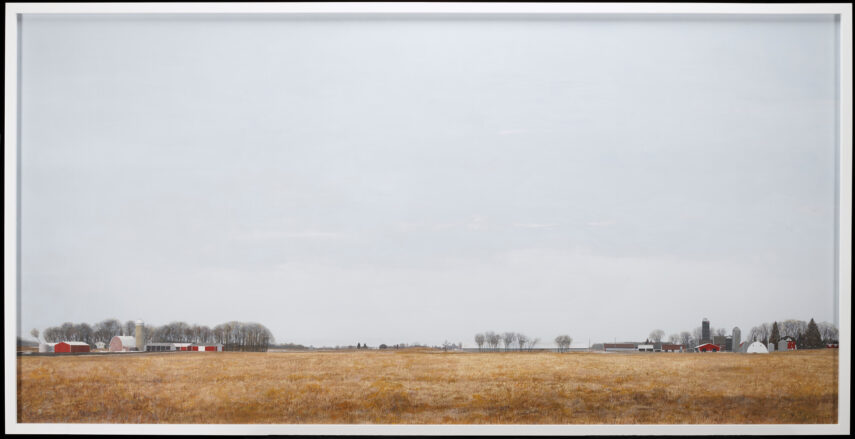
Teo Nguyen (American [born Vietnam], born 1977), Untitled 14, 2017, acrylic paint on vellum paper, mounted on aluminum. Gifts of funds from Mary and Bob Mersky and the Paul and Sheila Steiner Charitable Trust, 2018.39.1
The son of a glass painter and a poet, Nguyen lives and works in Minneapolis and Cam Ranh. His landscapes of the rural upper Midwest capture the vast space, boundless fields, big skies, and chilling isolation of the region, particularly in winter. He enjoys exploring this novel terrain and sees a mesmerizing beauty often overlooked in the land of his adopted home.
“As an immigrant and an artist,” he said, “I have learned to embrace the American spirit of freedom that says if you see a road that interests you, go ahead: venture down it. Even so, I am always a stranger to what I see; always slightly outside, finding in what is ordinary to others something tender and strange.”
Bruce Nauman
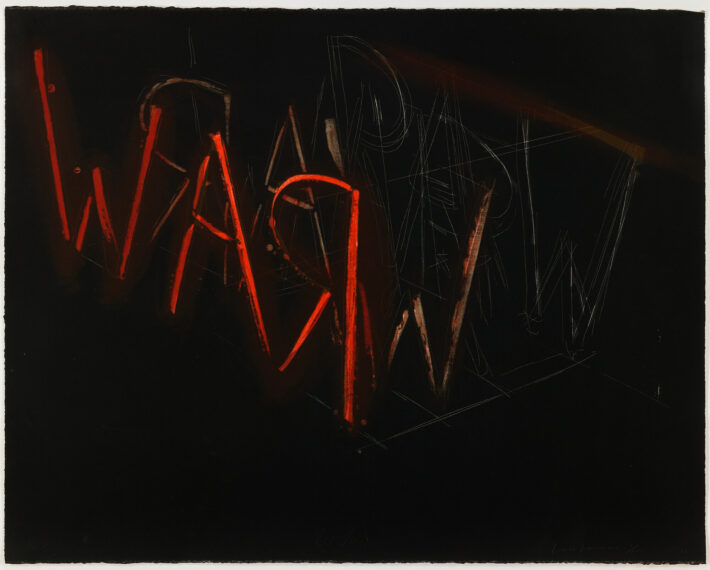
Bruce Nauman, Raw-War, 1971, color lithograph. The Richard Lewis Hillstrom Fund and gift of funds from the Print and Drawing Curatorial Council. 2008.94.
Artist Bruce Nauman’s work often involves language, human interaction, and the cultural and social implications of visual symbols. Raw-War is one of Nauman’s early word-play prints, in which he chooses single words, phrases, or idioms to provoke the viewer to seek underlying truths about the human condition. This lithograph was produced during the Vietnam War, and its spiky, menacing aura serves as a statement on the high human cost of warfare.
Elizabeth Olds
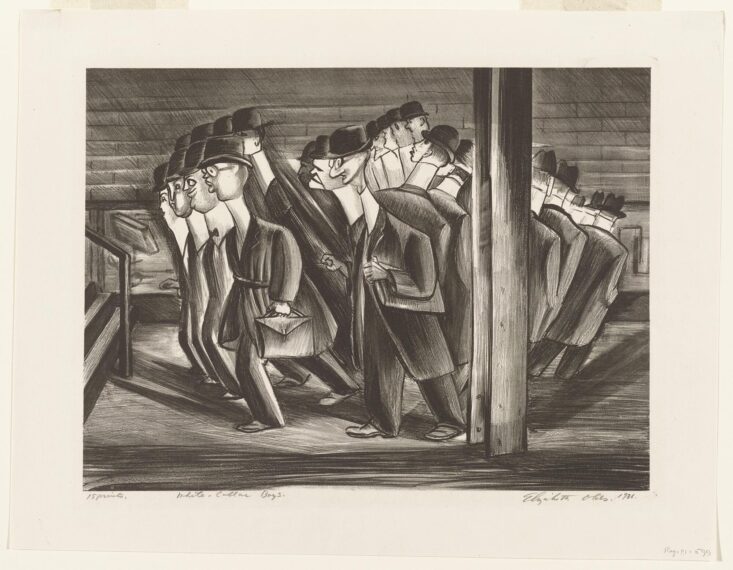
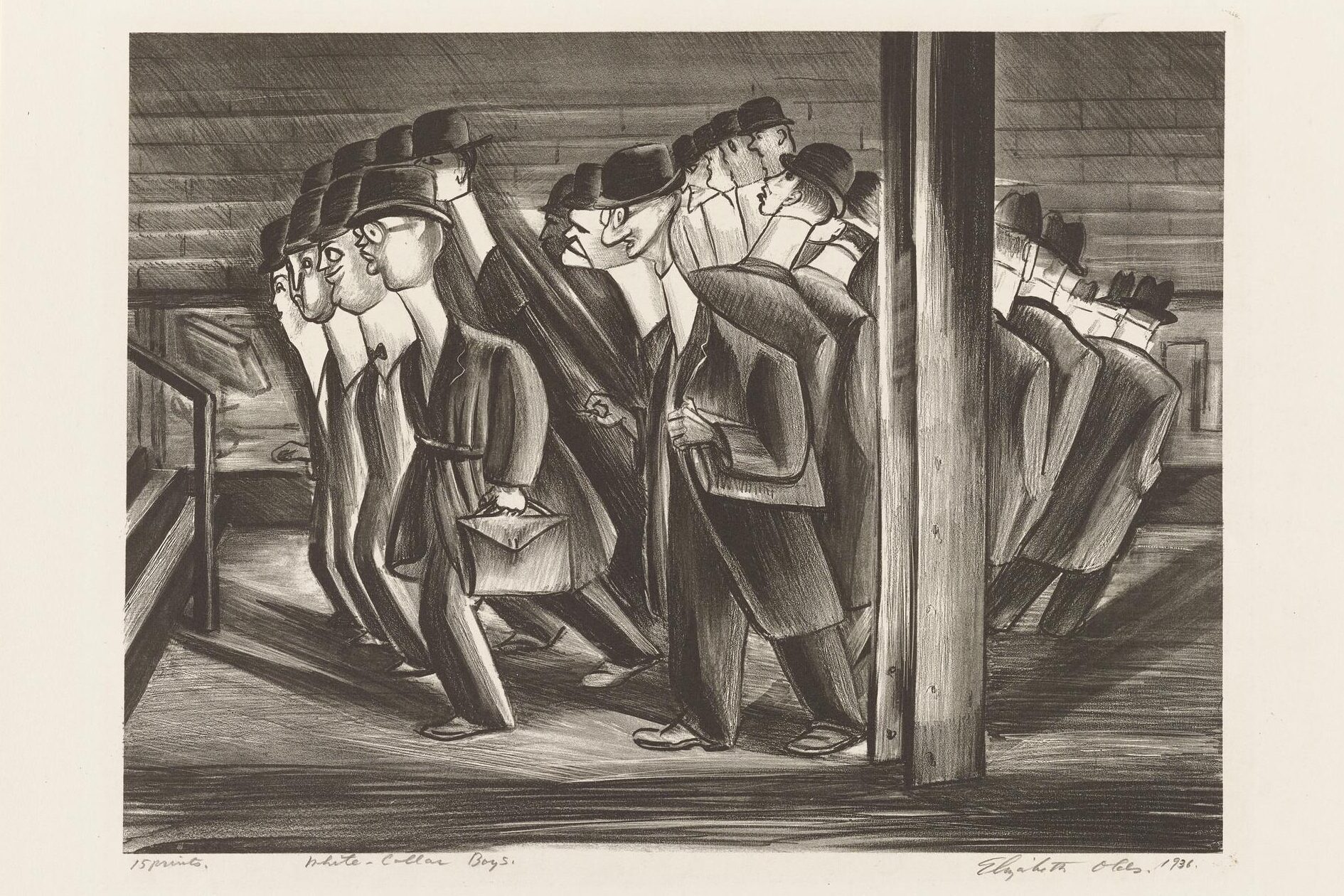
Elizabeth Olds, White Collar Boys, 1936, lithograph. Gift of the Art History Club, 1938 P.11, 599.
Between 1935 and 1940, Minnesota artist Elizabeth Olds participated in the Works Progress Administration Federal Art Project (WPA-FAP) in New York City, a New Deal program established by President Franklin D. Roosevelt to create employment for artists during the Great Depression.
This caricature of businessmen scurrying along a New York subway platform presents a lighter interpretation of working life. Olds gently mocks her subjects’ similar styles of dress and mannerisms as they hurriedly make their way to the office. The layering of the figures adds a sense of movement to the piece, nearly echoing the motion of a swaying train.
About Lori Williamson, Supervisor of the Herschel V. Jones Print Study Room at Mia
 Lori Williamson creates mini-exhibitions and teaches classes and Print Study Room visitors about the museum’s rich collection of works on paper. She’s the primary caretaker for more than 40,000 prints, 6,000 drawings, and 600 artist’s books, collaborating with curators in American, European, and Global Contemporary Art to make these holdings accessible. Williamson supports scholars through research and inquiry, and advocates for the inclusion of works on paper in exhibitions, social media, and outreach, helping to connect diverse audiences with this dynamic collection.
Interested in seeing something in the Print Study Room? All are welcome by appointment. Email Lori Williamson and copy the Print Study Room to make an appointment.
Meet the other curators in the Department of European Art.