

Print Study Picks: Three Indigenous Artists in Mia’s Collection
By Lori Williamson
November 17, 2026—In this edition of Print Study Picks, we’re celebrating the diverse artistic traditions, histories, and contemporary perspectives of Indigenous cultures and communities with a striking selection of works in Mia’s collection by Indigenous artists.
George Morrison
George Morrison (American [Grand Portage Anishinaabe], 1919–2000). Untitled (Lake Superior Landscape), 1999. Pen and colored inks on paper. Gift of Bill and Krista Thorburn. 2017.94.2
Morrison didn’t limit himself to the expectations of others about what Native art should encompass in subject matter or design. In 1960, he was at the forefront of Abstract Expressionism, a post–World War II art movement that flourished in New York City and prioritized spontaneous emotional expression, improvisation, and the physical process of creation over traditional realistic painting.
Among the final works Morrison created during his six-decade career, this boldly colored, abstract landscape encapsulates the artist’s creative philosophy and aesthetic vision.
Angelique Merasty Levac
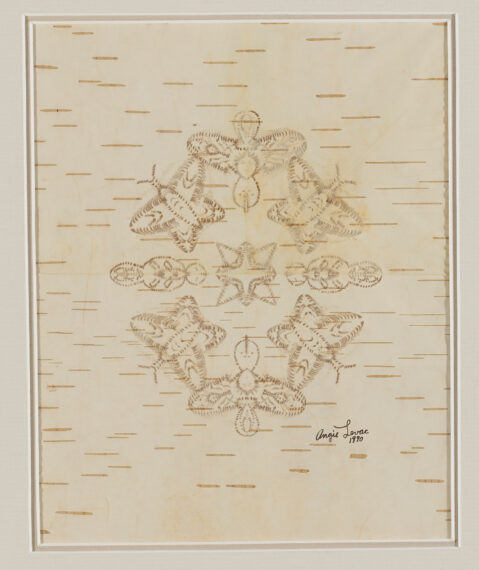
Angelique Merasty Levac (Canadian, Anishiinaabe, born c. 1955). Bitten birch bark design with birds, butterflies, and starburst, 1990. Gift of Raymond A. and Ruth A. Reister. 2016.76.6
Angelique Merasty Levac is a Métis artist and entrepreneur who’s played a vital role in preserving and revitalizing birch bark biting (called azinibaganjigan in Ojibwe), a centuries-old Indigenous art form of which this playful piece offers an example.
Birch bark biting is a traditional practice of taking a piece of bark, folding it, biting it carefully to create a pattern, and then unfolding the bark. These designs may originally have been patterns for later beadwork.
Dyani White Hawk
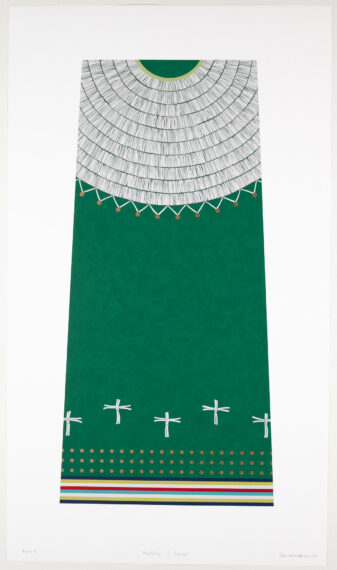
Dyani White Hawk (American, Sičáŋǧu Lakota, born 1976). Nakíčižiŋ | Protect, 2019. Color screenprint with metallic foil. Highpoint Editions Archive, The Friends of Bruce B. Dayton Acquisition Fund and the Christina N. and Swan J. Turnblad Memorial Fund, 2020.85.136.4
Lakota contemporary artist Dyani White Hawk was inspired in part by her mother, a Navy veteran, to make the series Takes Cares of Them in 2019. It includes four life-sized screenprints published by Minneapolis-based Highpoint Editions: Nakíčižiŋ | Protect, Wačháŋtognaka | Nurture, Wówahokuŋkiya | Lead, and Wókaǧe | Create.
“Through acts of creation, nurturing, leadership, love, and protection carried out in infinite forms, our grandmothers, aunties, sisters, cousins, nieces, and friends collectively care for our communities,” the artist says. “As a suite, these works speak to the importance of kinship roles and tribal structures that emphasize the necessity of extended family, tribal and communal ties as meaningful and significant relationships necessary for the rearing of healthy and happy individuals and communities.”
About Lori Williamson, Supervisor of the Herschel V. Jones Print Study Room at Mia
 Lori Williamson creates mini-exhibitions and teaches classes and Print Study Room visitors about the museum’s rich collection of works on paper. She’s the primary caretaker for more than 40,000 prints, 6,000 drawings, and 600 artists’ books, collaborating with curators in American, European, and Global Contemporary Art to make these holdings accessible. Williamson supports scholars through research and inquiry, and advocates for the inclusion of works on paper in exhibitions, social media, and outreach, helping to connect diverse audiences with this dynamic collection.
Interested in seeing something in the Print Study Room? All are welcome by appointment. Email Lori Williamson and copy the Print Study Room to make an appointment.
Meet the other curators in the Department of European Art.