
Print Study Picks: Three Works that Reframe Queer Art History
By Lori Williamson
June 16, 2026—LGBTQ+ artists have always enriched the art world using their talents, experiences, vision, and creativity, even when the art world didn’t love them back. Here are a few pieces celebrating queer artistry.
Jacoba van Heemskerck
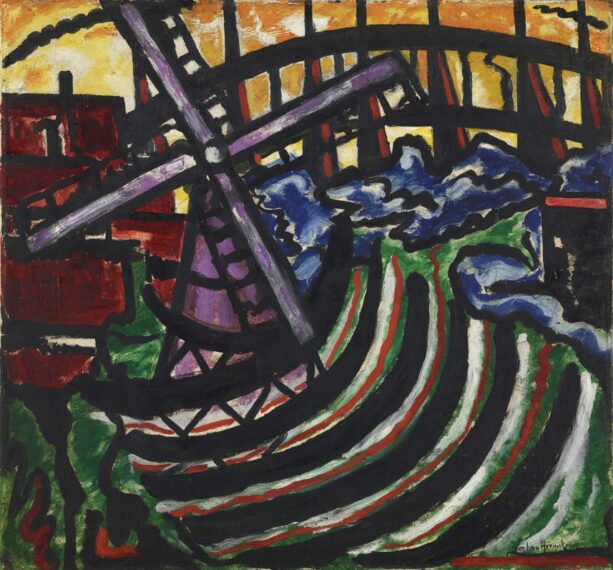
Jacoba van Heemskerck. Picture 56 (Dutch Mill), 1916, oil on canvas. © Neue Nationalgalerie, Stiftung Preußischer Kulturbesitz, Berlin
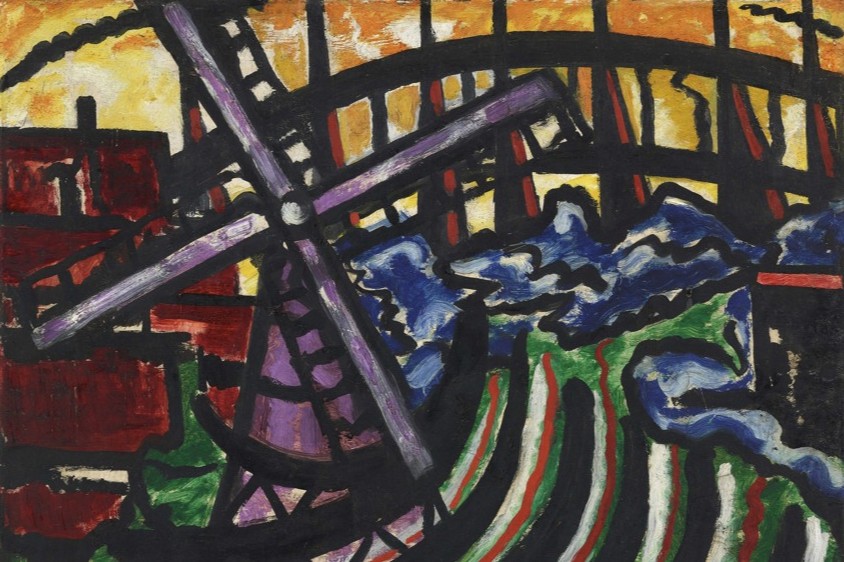
Jacoba van Heemskerck was an Expressionist artist known for her vibrant color schemes in both paint and stained glass. She was the most frequently represented woman artist in exhibitions at Der Sturm, a Berlin gallery founded by fellow Expressionist Herwarth Walden.
Van Heemskerck met collector Marie Tak van Poortvliet in The Hague. Together, they formed a powerful bond based on similar ideals, spiritual curiosity, and ambition. Van Poortvliet even had a studio built for van Heemskerck in her garden. Their relationship pushed the limits of acceptability in its time.
See this painting and others like it in “Modern Art and Politics in Germany 1910–1945: Masterworks from the Neue Nationalgalerie, Berlin,” on view through July 19, 2026.
Simeon Solomon
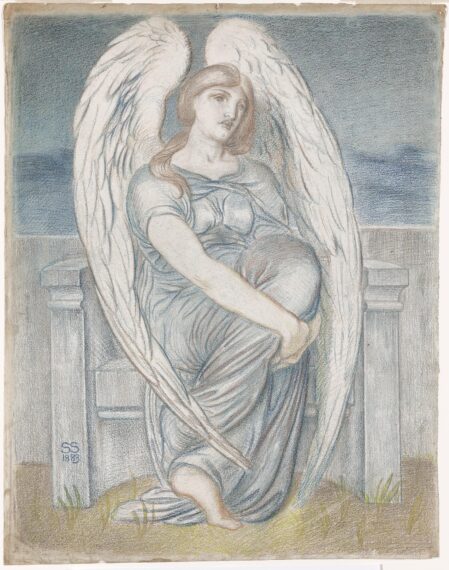
Simeon Solomon. Seated Angel, 1883, colored chalk on paper. Gift of The Henfield Foundation, 65.59
Simeon Solomon was a former child prodigy who exhibited his paintings at the highest level for almost half his life, starting at 18. By the time Solomon completed his studies at the Royal Academy, he had befriended a small, influential group of older artists who called themselves the Pre-Raphaelite Brotherhood. These artists rejected Impressionism and nearly every other trend in popular art going back to the late Renaissance, finding these developments vapid.
In 1873, Solomon was arrested for a sexual encounter with another man. It was the Victorian era, and homosexuality had, up until 1861, been punishable by death in England. Solomon became a social outcast, abandoned by his friends in the Pre-Raphaelite Brotherhood. Nevertheless, he continued to make art; this image of a lonely angel was made 10 years after that arrest.
Listen to this episode of The Object podcast to learn more.
Hollis Sigler
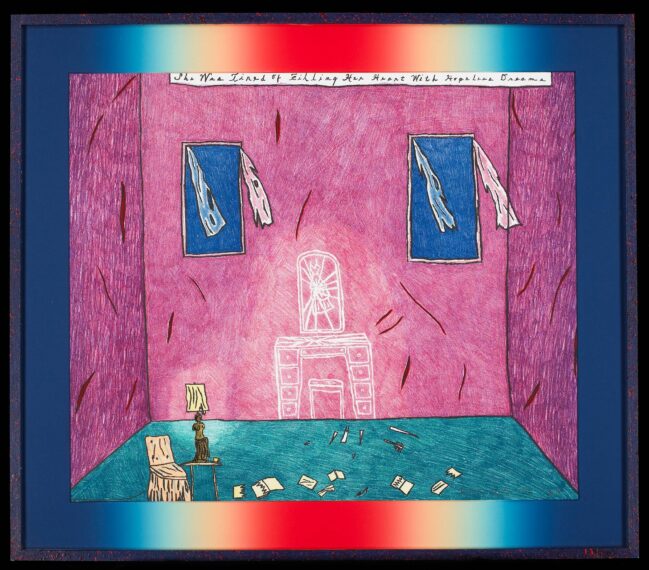
Hollis Sigler. She Was Tired of Filling Her Heart with Hopeless Dreams, 1982, color lithograph, screenprint, and collage (gold-leaf Japanese paper) with color-printed mat and hand-painted frame. Vermillion Archival Collection, The John R. Van Derlip Fund, P.92.5.24
Hollis Sigler attended art school in the early 1970s at the School of the Art Institute of Chicago, receiving her master’s in 1973. Taking issue with the male-dominated art scene at the time, she decided to lean into a faux-naïve approach, using tropes associated with femininity, such as dollhouse-like settings and bright, playful colors.
Early in her career, Sigler focused her art on feminist issues and struggles, intermingling them with her own lesbian identity. After she was diagnosed with breast cancer in the mid-1980s, her work grew even more personal, and she added words to her works that described her emotions or facts about the disease.
While scenes such as the one above at first seem whimsical, upon closer inspection, we see the rage it contains: a smashed mirror, torn curtains, and a notebook’s pages scattered across the floor. The only thing intact? A lamp statue in the shape of a woman.
About Lori Williamson, Supervisor of the Herschel V. Jones Print Study Room at Mia
 Lori Williamson creates mini-exhibitions and teaches classes and Print Study Room visitors about the museum’s rich collection of works on paper. She’s the primary caretaker for more than 40,000 prints, 6,000 drawings, and 600 artist’s books, collaborating with curators in American, European, and Global Contemporary Art to make these holdings accessible. Williamson supports scholars through research and inquiry, and advocates for the inclusion of works on paper in exhibitions, social media, and outreach, helping to connect diverse audiences with this dynamic collection.
Interested in seeing something in the Print Study Room? All are welcome by appointment. Email Lori Williamson and copy the Print Study Room to make an appointment.
Meet the other curators in the Department of European Art.