
Wearing the Cosmos: The Symbolic Significance of Daoist Priest Robes
By Laura Silver
December 1, 2025—When Daoist priests don their lavishly decorated robes, they become living embodiments of the cosmos, bridging the earthly and heavenly worlds. Every element of the robe—color, cut, embroidery, and ornament—is designed to align the priest’s body and presence with the Dao, or natural order of the universe. Its symbols, such as the sun and moon, cosmological diagrams of paradise, dragons, the five sacred mountains, and the 12 zodiac animals—among many others—express Daoist cosmology, theology, and worship. They’re embroidered on every inch of fabric, which is often yellow, blue/green, red, black, or white (the five symbolic colors of the universe).
“Threads of the Way: Daoist Priest Robes from China’s Qing Dynasty,” an exhibition of Qing dynasty robes drawn from Mia’s rich collection, illuminates the spiritual meaning, artistic brilliance, and ritual power woven into these rare and resplendent garments. The exhibition is on view in Gallery 281 through February 6, 2026.
Here are just a few of the most eye-catching symbols you’ll see, and a rundown of their meanings and significance.
The Cosmic Diagram: Heaven, Earth, and Humanity
Daoism envisions a universe governed by harmony, natural order, and the promise of a heavenly paradise. Many Daoist robes are patterned as miniature cosmic diagrams—turning the priest’s body into a living cosmos. The celestial symbols (sun, moon, stars, clouds, dragons) usually appear on the upper part of the robe. They connect the priest to celestial realms and gods.
The earthly symbols (mountains, waves, animals, plants) appear on the lower hem. They anchor the priest’s body to the terrestrial world.
The human realm (plain or with auspicious symbols) lies between the two. The robe is a sign of the priest’s authority as a mediator between heaven and earth.
Celestial Symbols

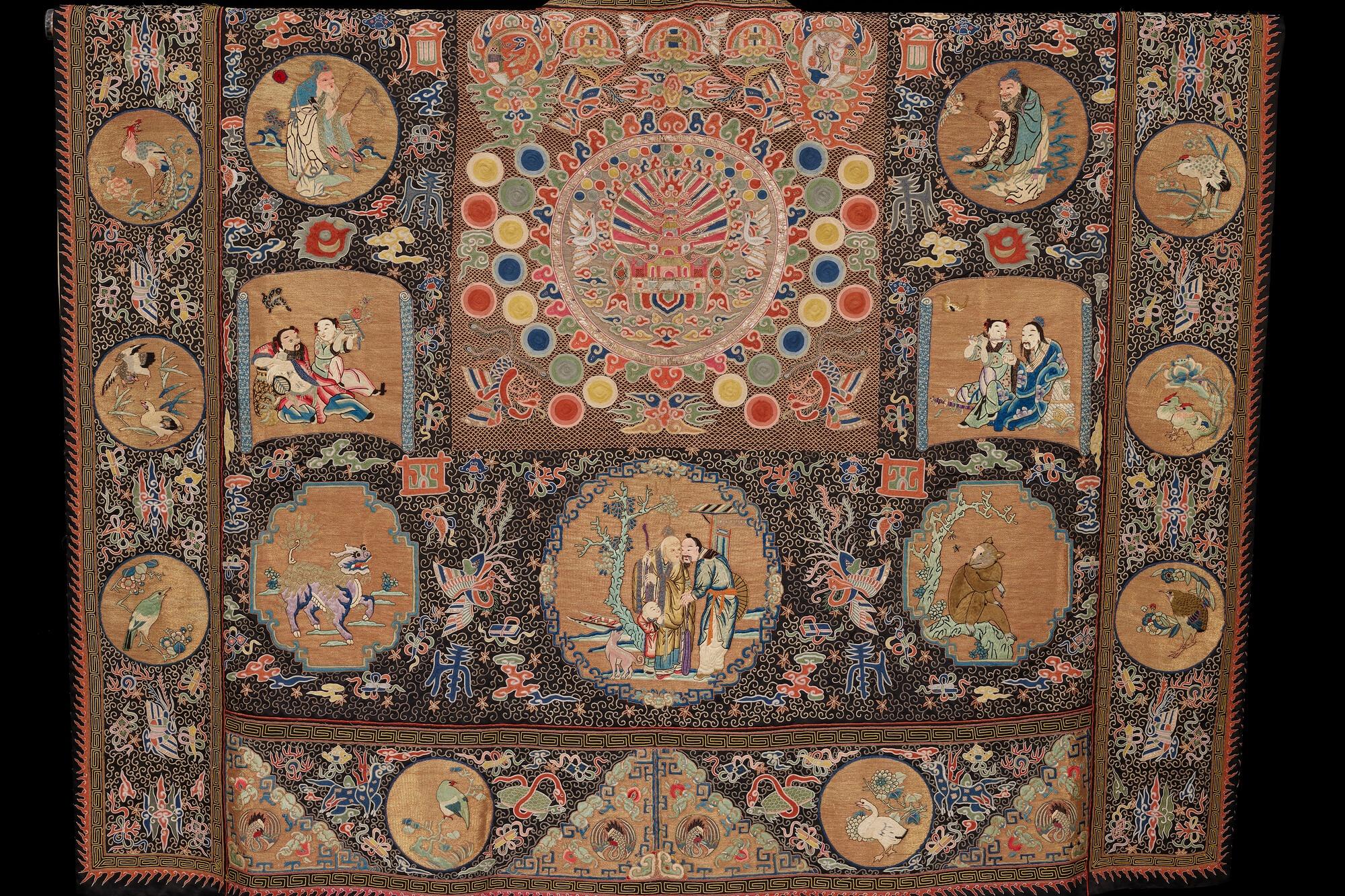
Cosmic diagram: Daoist priest’s robe (jiangyi) (detail), 1662–1722, silk. The John R. Van Derlip Fund, 42.8.296. The cosmic diagram typically appears on the upper back of the robe.
Celestial symbols reflect Daoism’s focus on cosmology—the order and origin of the universe. This particular design consists of a central roundel with a heavenly pagoda encircled by multicolored circles that represent the 28 Lunar Mansions (or constellations)—where the moon rests as it journeys around the earth each month. The moon (upper right) and sun (upper left) are just above the center circle. Inside the moon, a rabbit mixes the elixir of immortality. The crow, another deity, lives in the sun.
Dragons and Clouds
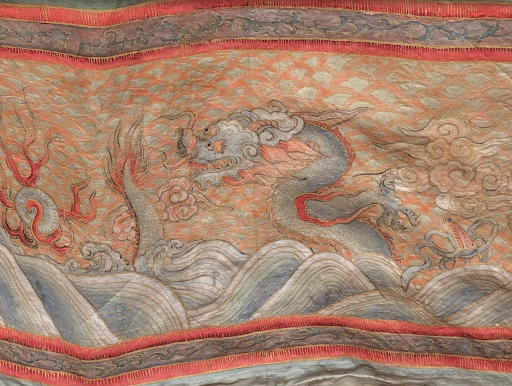
Dragon and clouds: Daoist priest’s robe (hechang) (detail), 19th century, silk, cotton. The John R. Van Derlip Fund, 42.8.293
Dragons are symbols of vitality, transformation, and strength. They often appear coiled among clouds, expressing spiritual ascent and control over the elements. Clouds represent qi—the vaporous breath of the cosmos—linking the visible and invisible worlds. Some Daoist immortals (beings who have achieved immortality and supernatural powers through Daoist practice) are dragons or can transform into them to travel to heaven.
The Eight Sacred Trigrams
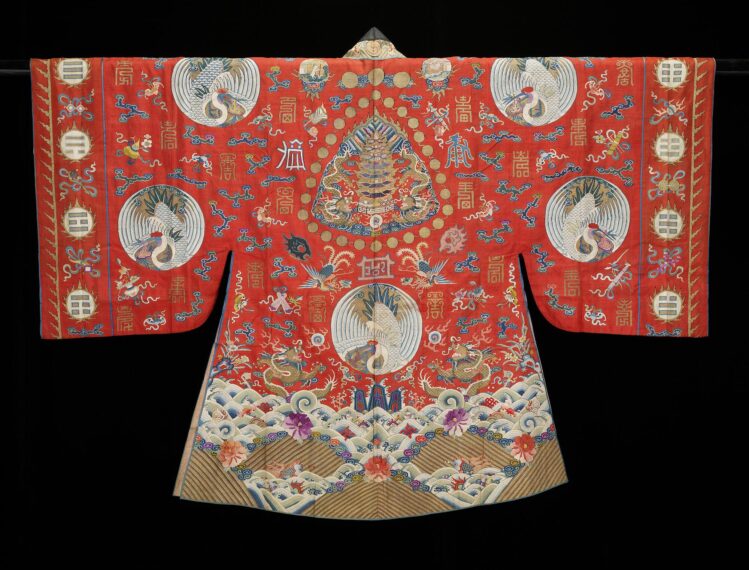
Sacred trigrams on the sleeve bands. Daoist priest’s robe (hechang) (detail), 1821–50, silk. The John R. Van Derlip Fund, 42.8.118
Trigrams are symbols of the cycle of yin and yang (female and male) energy present in all things. Each of the Eight Trigrams consists of three horizontal lines. Yang energy is depicted as a continuous line and yin energy by a broken line. Each trigram is read from bottom to top. The lowest line represents the earth; the center, humanity; and the top, heaven.
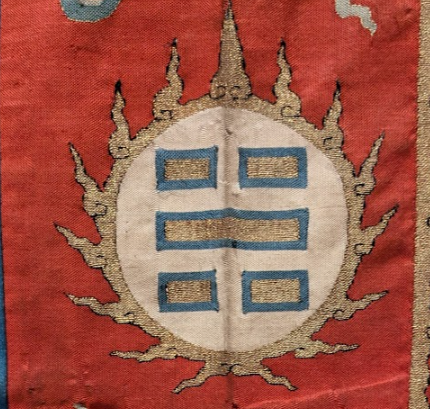
Detail of the Kan trigram. Daoist priest’s robe (hechang) (detail), 1821–50, silk. The John R. Van Derlip Fund, 42.8.118
Placed symmetrically on the robe (here on the sleeve bands), trigrams declare the priest’s alignment with universal order.
The Human Realm: Auspicious Emblems
Auspicious symbols on Daoist priest robes transform the wearer into a spiritual intermediary. The white crane, fabled to live for a thousand years, symbolizes longevity and transcendence (they carry immortals to heaven).
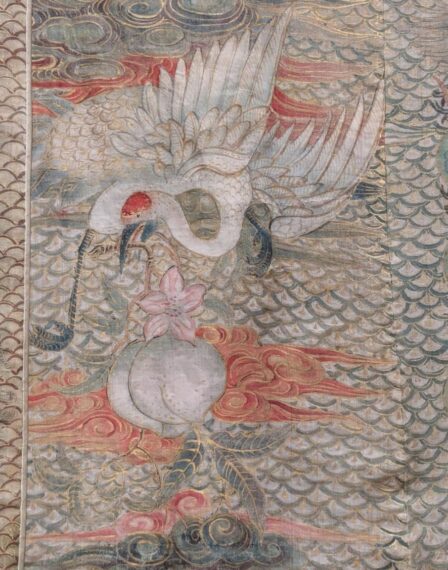
Crane and double peaches symbolize long life. Daoist priest’s robe (hechang) (detail), 19th century, silk, cotton. The John R. Van Derlip Fund, 42.8.293
Here, it’s displayed with double peaches, a symbol of good fortune. Other auspicious motifs, such as turtles, pine trees, and phoenixes, evoke balance, resilience, and transcendence. They help situate the priest within a world that is both natural and divine.
Earthly Symbols
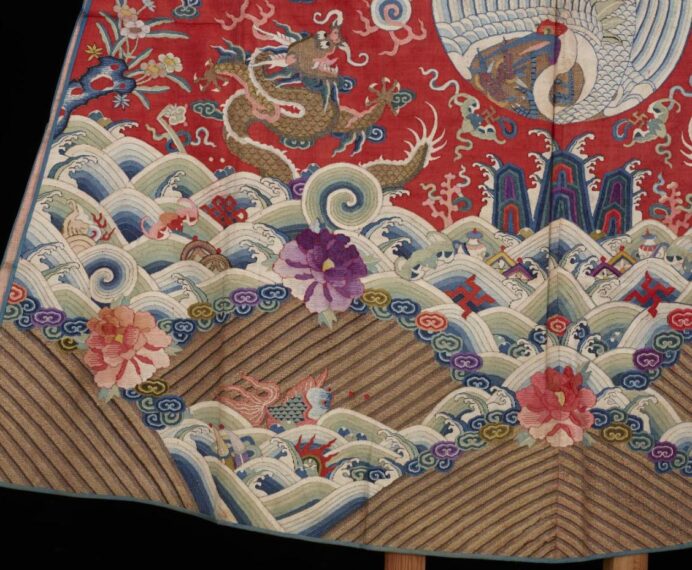
Waves symbolize the earthly realm. Daoist priest’s robe (hechang) (detail), 1821–50, silk. The John R. Van Derlip Fund, 42.8.118
Many “earthly” symbols, such as mountains, waves, plants, and animals, are also auspicious and convey wishes for long life and good fortune. The lower border of the robe above teems with waves, blossoms, bats, swastikas (symbols of eternity), and other auspicious motifs.
Why All This Symbolism Matters
The robe is not mere attire. It’s a portable universe, its symbols transforming the priest into a vessel of the Dao.
Come explore that universe in “Threads of the Way: Daoist Priest Robes from China’s Qing Dynasty,” at Mia through February 6, 2026.