
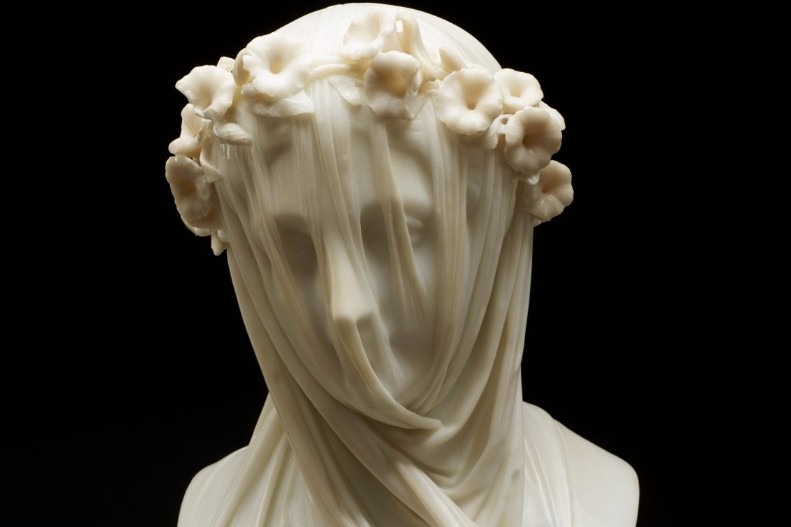
Secrets of the Veiled Lady: The Passion and Politics Behind Mia’s Marble Masterpiece
By Tim Gihring
April 1, 2026—On October 12, 1846, William Spencer Cavendish dropped by the studio of Raffaelle Monti, in Milan, Italy, to inquire about a lady. Cavendish was the 6th Duke of Devonshire, widely known in England as the “bachelor duke.” He had eight of the finest homes in Britain. He had 200,000 acres of British soil. He had a banana named after himself—the Cavendish, cultivated in his gardens and soon to become the world’s most popular variety. And now, at 56, he wanted a certain young woman, demurely and paradoxically hiding behind a veil of stone.
Veiled figures, usually carved from marble and suggesting a face or body partly obscured behind fabric, had first become popular a hundred years earlier, in the 1700s. The effect is an illusion, of course, enabled by translucent marble and a clever composition. It’s no more real than a lady being sawed in half onstage and was a kind of parlor trick for Late-Baroque sculptors to show off their chops.
But as illusions go, it’s mesmerizing, and sculptors competed to put all manner of subjects under “see-through” garments, from the Virgin Mary to Mary Magdalene. Cavendish was friends with Antonio Canova, a fellow bachelor and popular Italian sculptor who adored a veiled Christ carved by Giuseppe Sanmartino in 1753, once declaring that he would have given up 10 years of his life to have created such a masterpiece.
Monti was certain he could do it. Though he was only in his late 20s when Cavendish came by, he had proven himself a preternaturally gifted sculptor. Like the duke, he had inherited his vocation. His father, Gaetano, had a prominent sculpture business, and Monti had learned at his side as well as at the Fine Arts Academy in Milan, where he earned a gold medal at 20. He then spent four years in Vienna, sculpting busts of the Austrian royal family, before returning to Milan just as the Austrian Empire was solidifying its grip on northern Italy.
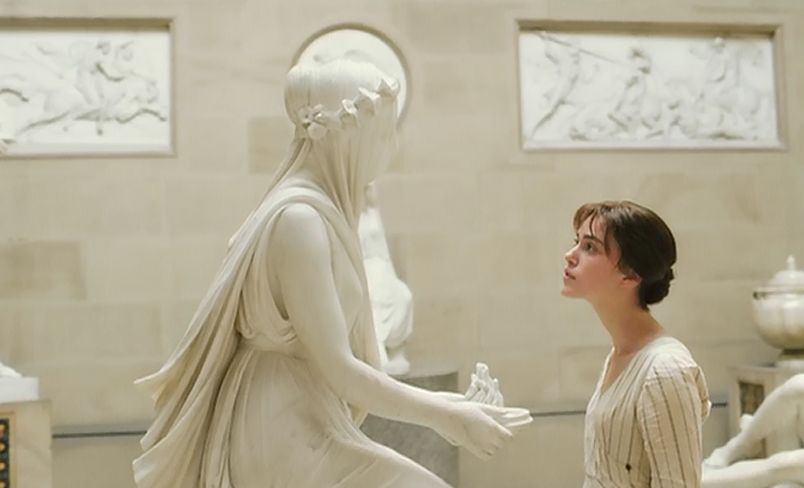
Keira Knightley admires Raffaelle Monti’s Veiled Vestal Virgin, in the 2005 film “Pride and Prejudice.”
The duke was sold. A few days after meeting Monti, he left the young sculptor with a substantial deposit for one veiled vestal virgin.
When the sculpture arrived in England, in the spring of 1847, the duke apparently displayed it in his villa west of London, known as Chiswick House. But in 1999, it moved to Chatsworth House, the likely inspiration for Mr. Darcy’s estate in Jane Austen’s Pride and Prejudice and the stand-in for the home in the 2005 film version of the story. In one of the film’s most tender moments, Elizabeth Bennett (Keira Knightley) encounters Monti’s masterwork in the home’s sculpture gallery. And in the veiled woman’s visage she seems to find the compassion she has yet to see in Mr. Darcy himself.
For the duke, the sculpture was one in a vast collection of white marble he had been building for 30 years. But for Monti, it was a game-changer.
In 1848, a year after sending the duke his prize, Monti joined the Italian revolt against Austria. When the Italians lost an early battle, Monti left for London, never to return. There, the veiled virgin became his signature motif. Indeed, he helped inspire a cottage industry of veiled women, carved mostly by Italians, who sold them into Europe’s great estates as conversation pieces while making these anonymous, virtuous women a subtle symbol of patriotism.

Portrait of Raffaelle Monti by Camille Silvy, November 2, 1860. Albumen print.
© National Portrait Gallery, London.
The Veiled Lady as Italian “Everywoman”
In 1851, when the Great Exhibition opened in London, the Crystal Palace was crammed with some 100,000 supposed examples of the white man’s progress, from machinery to art. Several sculptures by Monti were among them, representing Italy. One of the sculptures is an overt allegory, a colossal man holding attributes of Italian heritage, from music to silk-making to the visual arts. Three other sculptures were of young women, all of them in veils—including the duke’s veiled virgin.
In just a few years, Monti’s art had become highly popular; his London workshop was busy. Sculpture was becoming seen as commercial art, ready-made and reproducible, a shift that benefitted Monti even as he strove to portray his work as fine art. When he discovered that one of his sculptures, sitting in a London gallery, had been photographed without his permission, his representative voiced Monti’s concern that it would be copied—“pirated in clay or porcelain by some of those persons who are to be distinguished from artists as ‘art-manufacturers.’”
Monti was perhaps even more concerned about Italy itself. Shortly after the Great Exhibition opened, Monti served as a spokesman for the Italian sculptors at a reception, toasting their English hosts with a vow to repay their hospitality “on the banks of the Po and the Tiber.”
About 10 weeks into the show, however, a correspondent for The Times of London reported that Austria had succeeded in solidifying its grip: “Every pass, every fort, every city gate, is in her indefinite possession.” As the reporter noted, “the total destruction” of Italy’s push for independence was at hand.

An engraving, made from a daguerreotype, of Monti’s “Circassian Slave at a Market in Constantinople,” as displayed at the Great Exhibition of 1851. The original sculpture is now lost.
When the show was over, Monti was a celebrity. Some six million people had filed through the Crystal Palace, about 42,000 a day. One of his sculptures, in particular, had been a major draw: A Circassian Slave in the Market Place at Constantinople. It depicted a nude woman sitting on the ground, with a long bare back and a veil over her face.
The veil, critics believed, was the real crowd-pleaser—and they weren’t happy about it. It was a “trick,” a “trivial accessory,” they wrote, “captivating and surprising as a novelty” but “beneath the dignity of sculpture” as a recurring motif.
Nevertheless, Monti persisted. Around 1860, he carved the Veiled Lady, now in Mia’s collection, and by then such figures were clearly associated with the Risorgimento, the Italian unification movement. The veil, masking any distinctive features, suggested the everywoman of Italy. The burgeoning country’s Britannia or Lady Liberty.
In 1862, at the International Exhibition in London, Monti exhibited what is perhaps the pinnacle of his veil effects—a sculpture called The Sleep of Sorrow and the Dream of Joy. Now at the Victoria and Albert Museum, it shows one figure awakening the other hovering overhead, suggesting a transition from grief to hope.
The Enduring Power of Illusion
Italy eventually prevailed, and by 1870 was largely unified for the first time. Monti, however, was in poor shape. Deeply in debt after taking on ambitious but profitable public projects, he reportedly never went out after dark anymore, fearing he would encounter someone he owed. He mostly worked as a designer for silversmiths and porcelain makers like Wedgwood, having sold his carving tools.
Monti’s wife and daughter had apparently followed him from Italy to England, in 1850, a few years after he arrived. Other research suggests he largely kept the company of a chosen family: the bachelor artists and connoisseurs who found expression in the making or collecting of sculpture. At the end of his life, in any case, Monti lived as a boarder in the home of a German watchmaker, in the West End of London, and died there in October 1881, a fellow sculptor at his side.
Perhaps both stories are true, as Monti negotiated the vicissitudes of fame and fortune, and found his people. Life changes, but his work found its way into the popular imagination and stayed there. Recently, when Sotheby’s mounted an exhibition in New York of art from Chatsworth House, it tapped David Korins, the Broadway set designer from Hamilton, for creative direction. The veiled virgin, in his staging, was the highlight—elevated even above a Leonardo da Vinci drawing and paintings by Rembrandt.
At Mia, the Veiled Lady continues to entrance, a trick that is also a treat. Every year, around Valentine’s Day, the museum invites visitors and staff to place paper hearts beside their favorite artworks. This year, the floor around the Veiled Lady was covered in hearts—the second-most of any object in the museum.
Where to See the Veiled Lady
You’ll find Monti’s masterwork in Gallery 357 on the third floor of Mia, keeping company with other Victorian art.