
Domestic Dread: A Closer Look at Nik Nerburn’s “The Milkman”
By Tara Kaushik
May 4, 2026—Something bad happened in Nik Nerburn’s family. “We don’t have all the details,” he says, “but my great-grandmother was found dead, most likely pushed down the stairs by my great-grandfather.”
It was the 1920s. Nerburn’s paternal grandfather’s family had moved from Michigan’s Upper Peninsula to Oak Lake Park, a now-nonexistent Minneapolis neighborhood near what is today the Walker Art Center’s Sculpture Garden. After the incident, “My great-grandfather disappeared, and my grandfather and his siblings were scattered to different orphanages across the Twin Cities,” says Nerburn.
Family Lore, Unearthed
The tragedy became an entryway for the artist. He began weaving this family history together with a lighter, though no less complicated, maternal story: his grandmother in Grand Forks had had a child with the local milkman. Investigation revealed the milkman had actually fathered children with a number of different women in the town.
“And I was just fascinated by that story,” Nerburn says. “It’s kind of a classic American story. I talked to my uncle, whose dad was the milkman, about it, really learning everything I possibly could. And then it sort of went from there.”
In his Minnesota Artists Exhibition Program (MAEP) show, “Nik Nerburn: The Milkman,” now on view at Mia, he merges moving image, sculptural installation, and sound to explore the private corners of a troubled household. At its heart is The Milkman, a multichannel film installation composed of projected vignettes and immersive audio.
A House Full of Omens
The short film takes place over a single evening. Interactions among family members, punctuated by the arrival of a mysterious late-night visitor, unfold in a quintessential American family home, lit by the glow of the TV and moonlight reflecting off the grain mills outside. The mood inside, meanwhile, oscillates between the mundane and the hair-raisingingly dramatic. The TV drones, milk trickles into a mug of coffee, glass clinks and then crashes. Stairs creak. A door slams shut. Just a quiet evening at home with the family—or is it?
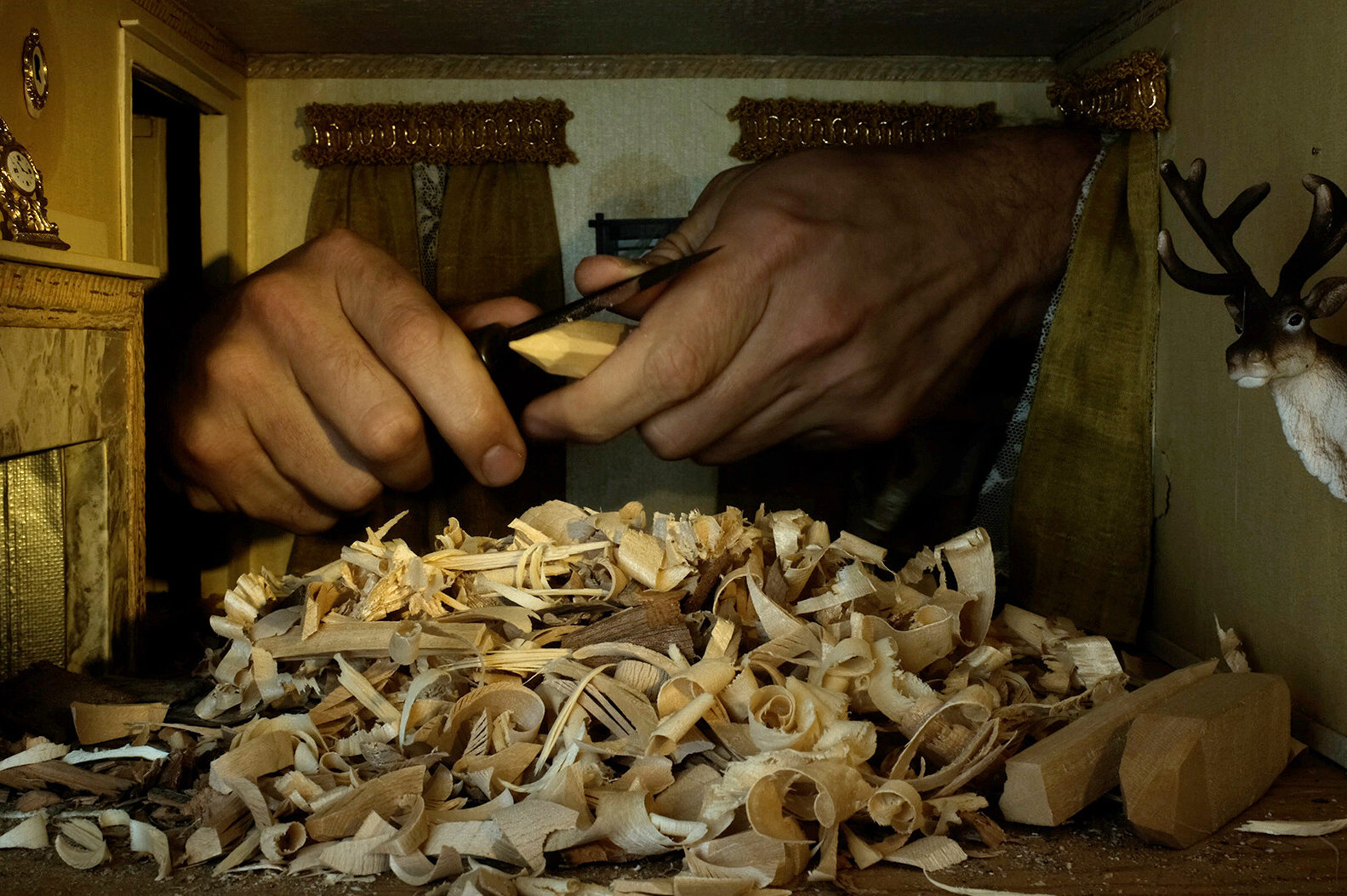
The primary perspective is that of a child, watching the grown-ups around them behave in strange and startling ways. Forgoing human characters, Nerburn uses symbolic stand-ins for the members of the family, though the viewer could read them in various ways. An enormous pair of hands smoking a cigarette and whittling wood could be a father, a jar of milk scuttling down the hall might be the mysterious milkman. The mother is nowhere to be seen—but she may also be a large, moody cat.
Nerburn finds, repairs, and sometimes re-destroys discarded dollhouses as sets in which to stage these dramas. “They become a way to capture a house that doesn’t exist anymore,” he says.
Puppets, Play, and Unease
The Milkman marries its heavy source material with the decidedly more playful media of stop-motion animation and puppetry. What seems like a pairing of opposites actually ends up feeling less incongruous than one might expect. Nerburn cites the “tall tale” traditions of the Upper Midwest, where humor and the surreal have long been used to convey and cope with grimmer realities. He also draws on the European puppetry tradition, specifically Czech puppetry. The art form flourished under Prussian occupation, dismissed as mere entertainment, while traditional theater was banned.
“Puppets allow us to speak things we can’t otherwise say,” says Nerburn. “Whether speaking truth to power or just voicing what is unspeakable in our own lives.”
Multichannel video allowed Nerburn to play with the possibilities of divided attention, the format mimicking the experience of peering into the various rooms of a dollhouse simultaneously. “I was really entranced by that ‘corner of your eye’ feeling,” says Nerburn.
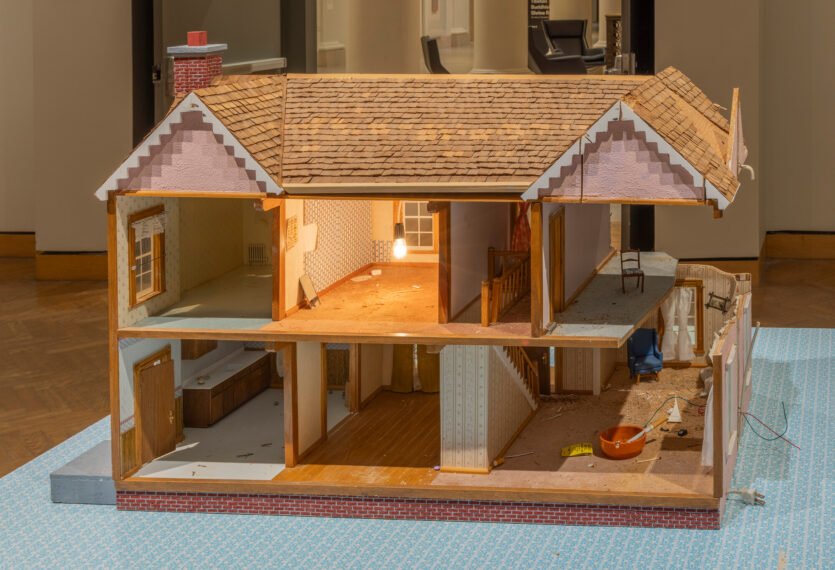
View of the exhibition “Nik Nerburn: The Milkman” installed in the U.S. Bank Gallery at Mia. The exhibition is on view March 21–June 21, 2026.
As the short film loops, it rewards multiple viewings with blink-and-you’ll-miss-it details. Your eyes ping-pong across the screens, trying to catch it all. It’s not unlike the experience of being a child in a volatile home, trying to watch for signs that things are about to go very wrong.
A common metaphor in art about family life is the web, deployed to represent the delicate interlinking of relationships. Nerburn plays with the idea of a web, too, but his film suggests eerier, unsettling connotations—namely, of being caught in one.
The artist is interested in exploring the ambivalence and hostility that can permeate family life. His film paints a stark, lightly horrifying portrait of domesticity in the American Midwest, the antithesis of a Norman Rockwell painting.
“I’m not trying to expand what the happy family can represent,” says Nerburn. “I’m trying to represent troubled families.”
About the Exhibition
“Nik Nerburn: The Milkman” is on view through June 21, 2026, in the U.S Bank Gallery.
This exhibition is part of the Minnesota Artists Exhibition Program. Support provided by RBC Wealth Management.