
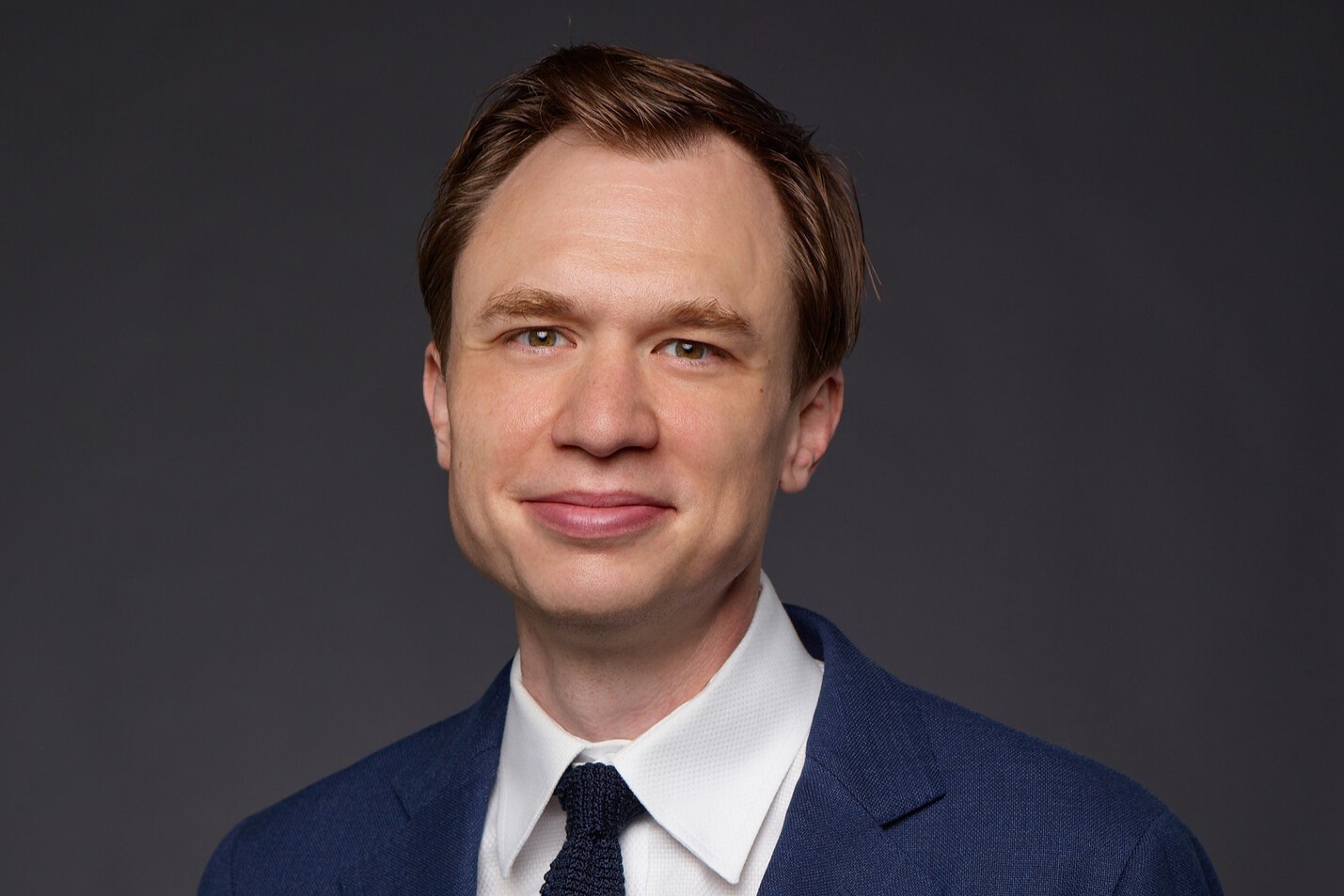
Chief Curator Kevin Tervala on Art History, Museums, and the Minnesota Artists Exhibition Program
His freshman year of college, Kevin Tervala took an African art history class to fulfill a requirement. “I knew nothing about art history,” he says, “And yet, through the class, I came to see the kind of profound human connection that art enables, one that allows each one of us to transcend time and space.”
The interest stuck. Tervala went on to earn his PhD in African Studies and History of Art and Architecture from Harvard University before beginning an 11-year tenure at the Baltimore Museum of Art.
As the new Mary Ingebrand-Pohlad Chief of Curatorial Affairs and Exhibitions at Mia, Tervala leads the curatorial division, overseeing curatorial departments, collections, exhibitions, acquisitions, and scholarship while helping shape the museum’s future artistic direction.
That includes the Minnesota Artists Exhibition Program (MAEP), which recently turned 50, and which he cites as one of the things that attracted him to the job. “I’m excited to see the program evolve,” he says, “and to participate in helping shape these innovative projects.”
We sat down with Kevin to hear more about his thoughts on the MAEP program.
How would you describe the Minnesota arts landscape?
I’ve been here about six weeks now, and I’ve been meeting lots of people and visiting local galleries, but I feel I’ve just dipped my toe in the vast sea that is the Minnesota arts landscape. I know it’s an arts community with a rich history and a national reputation. And I see why.
Take the MAEP, for example. It prioritizes giving a platform to local artists from across the state, at all stages of their careers. That’s something Mia has focused on, and done, much earlier and for much longer than many other museums. It’s been really wonderful to hear the stories of artists whose careers the program has helped shape and who have gone on to do great things.
How do you envision shaping Mia’s curatorial direction?
Mia’s global collection gives us an opportunity to tell stories and highlight artists from around the world, across time and space. And this collection is paired with the incredible global city that is Minneapolis–St. Paul, where many people are first-, second-, or third-generation immigrants, or have deep connections of all kinds to places around the world.
So I’m thinking about exhibitions that are not only going to speak to the various different audiences that we have here in the Twin Cities, but also speak to national and international audiences, because we are connected. Mia is connected to the rest of the world through our partnerships, our staff, and the people who visit the museum. When people talk about Mia, they talk about bringing great art from around the world to Minneapolis. And we want to keep doing that, but we also want to send great art that is here in Minneapolis around the world as well.
What experiences with art have influenced the way you think about curating and the role museums play in people’s lives?
The first art history course I took in college truly changed my life. I knew nothing about art heading into it, and the class blew my mind. It was an intro to African art history course, and through it I learned how to understand the creative impulses that drove an artist to do something a certain way. Someone who might have lived hundreds of years ago, on a different continent than me, who was so different from me in so many different ways. And yet I could see the kind of profound human connection that art enables, one that transcends time and geography.
Art museums, in particular, can be this wonderful, connective experience. They are profoundly humanistic enterprises. Art lets us see each other and see ourselves. And that lets us connect across time and space. There aren’t many places anymore about which you can say that, and that is the energy I would like to amplify in the exhibition program and in the galleries.
How do you create connections in a collection as vast as Mia’s?
Although Mia’s collection is installed in a certain way, largely centered around geographic areas, we have to understand that the borders of our contemporary world are both artificial and porous. People move, ideas move, artists move, materials move. Artists take inspiration from one another, and they look to other artists from other time periods and places. That’s the case now as much as it was 5,000 years ago. So making connections is actually quite easy. All you have to do is stay attuned to the truly global flow of the world.
Contemporary artists are also essential to making these connections. They’re vital to this museum, to every museum. This kind of art pushes boundaries and lets us see things in new ways. Contemporary artists help us to imagine new futures. They create worlds, and we get to enter them, and, in the process, expand our own conceptions of what’s possible.
When an artist exhibits their work through MAEP, what do you hope they get out of it?
I hope artists learn what it’s like to work with a museum for the first time, since for many of them, it’s their first time in this kind of institutional setting. It’s a unique sort of thing to put together an exhibition at an institution. So, my hope is that every artist will learn institutional processes in a friendly, supportive environment where we’re able to collaboratively realize their vision.
I’m also hoping artists will show their work here, and that people who wouldn’t ordinarily get to know them will get to know them and fall in love with their work. And that their work will evolve and expand, or not, based on those interactions. The hope, overall, is to give people exposure and experience that they can use and grow with, in terms of mounting a show and working with installation crews, art packers and shippers, the media, and having your own work sort of explained and mediated by others—which is a weird experience, I have no doubt.
What are some things that would probably be surprising for someone exhibiting in a museum for the first time?
Timelines. Museums operate on very long timelines. Everything is planned, considered, and accounted for far in advance. People should also know that exhibiting in a museum means working with a curator, which means someone will be interpreting and shaping your work, situating it, and helping bring forth the meaning. There’s a creative dialogue between the curator and the artist that results in what you see—hopefully a more contextualized, deeper exploration of the artist’s work.
Take a virtual walk with Tervala through Mia’s galleries.