
Print Study Picks: All About Love
By Lori Williamson
February 12, 2026—Love is in the air. And in the media, and in the shops, and online, and pretty much everywhere else. It’s a good time to remember that love isn’t just romantic—Greek philosophy proposed there were actually several distinct forms, all of which have long been reflected in art.
Here, a look at a selection of works that each reflect a different kind of love: agape (unconditional love; often understood as love of humanity); philia (deep friendship); and eros (passionate love).
Agape
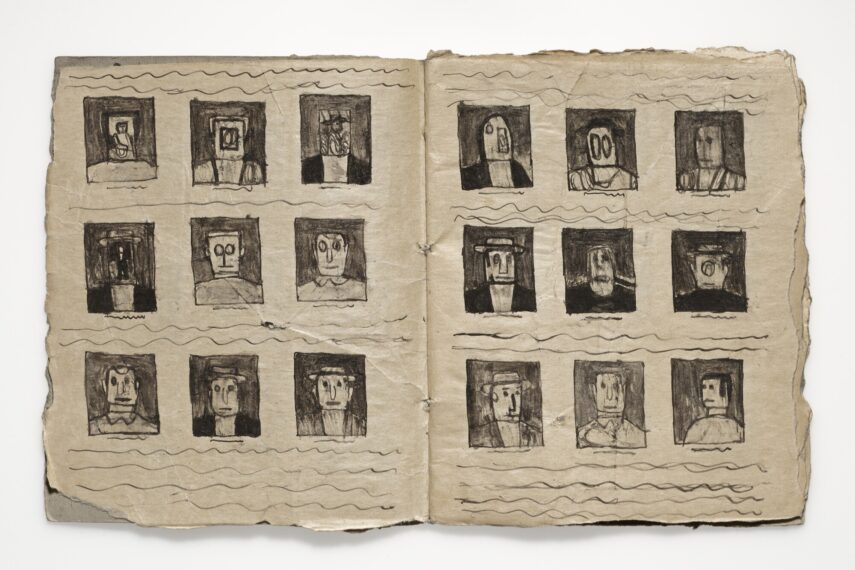
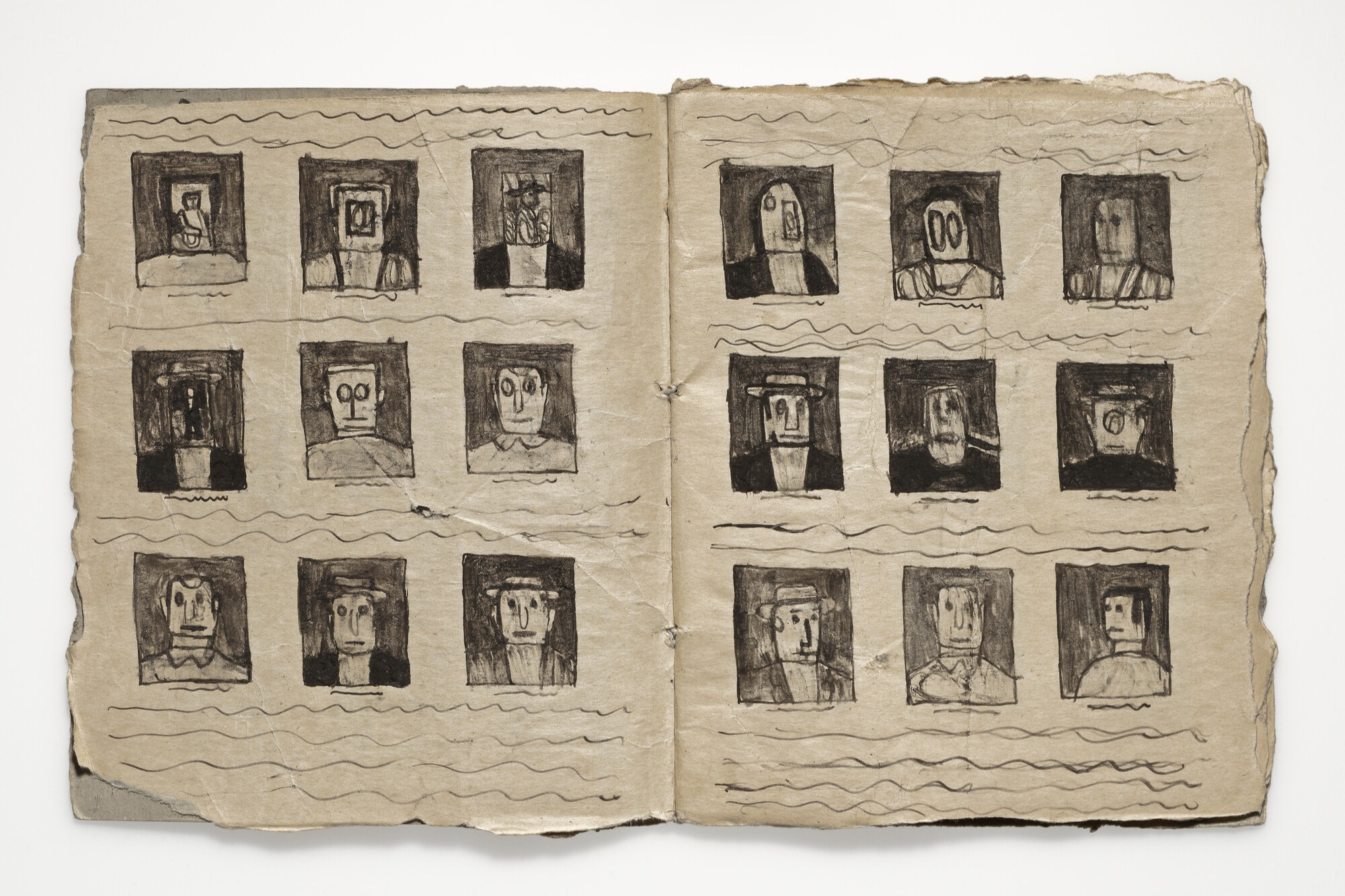
James Castle (American, 1899–1977), Untitled (Sugar Honey Maid Graham Crackers Book), after 1930, soot and soot wash drawings on found beige paper, in covers fashioned from thin gray cardboard faced with beige paper (commercially printed Sugar Honey Maid graham crackers packaging), bound with white cotton string. The Mary and Robyn Campbell Fund for Art Books and the David and Margaret Christenson Endowment for Art Acquisition, 2015.46
Born in rural Idaho, James Castle was a self-taught artist who lived with family members throughout his life. Deaf from birth, Castle didn’t speak or ever learn to sign, read lips, or write. His connection and interaction with the world were through art. He made more than 20,000 works, and his remarkable achievements are now recognized internationally.
Consisting of more than 100 individual hand-drawn images on 16 sheets of found paper, this untitled and undated artist’s book is a distinctive blend of material originality and expressive content. Using stove soot and saliva to form an ink, Castle produced pages of unique individual portraits. The result is reminiscent of a school yearbook.
Castle relied on multiple sources for his imagery, including publications, commercial packaging, and his own imagination and memories. These careful observations, paired with his sophisticated art style, demonstrate his love of the world around him, as well as a persistent need for self-expression.
Philia
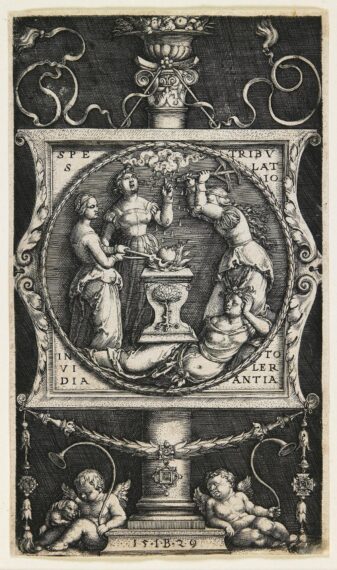
Master I.B. (German, active 1523–1530), The Forge of the Heart, 1529, engraving. Gift of Herschel V. Jones, 1926, P.10,996
This incredible engraving was likely intended as a bookplate for Willibald Pirckheimer, a prominent humanist and scholar and best friend of painter and printmaker Albrecht Dürer. It’s an allegory showing how a heart is made—through the combination of hope, tribulations, envy, and tolerance, here personified as four figures.
Tribulation beats an anvil, Envy casts a disdainful glance, Hope looks up to see soothing drops fall on the flaming heart, and Tolerance rests patiently below. The lesson is that patience in the face of hardship brings grace, which is fitting, as Pirckheimer was ill when the engraving was completed and died the following year, two years after Dürer.
Eros
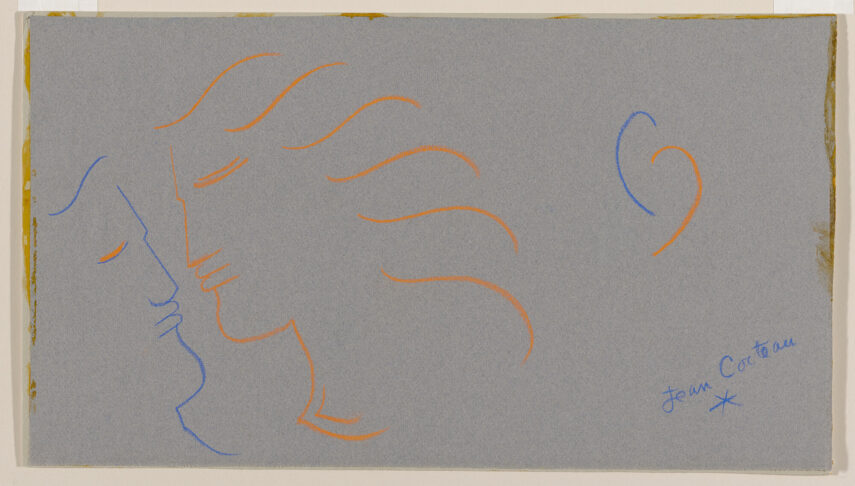
Jean Cocteau (French, 1889–1963), Les Amoureux (The Lovers), c. 1959, colored chalks. Gift of Mrs. Patrick Butler, 69.13.9
Jean Cocteau was a French visual artist, writer, designer, critic, and film director. He was a prominent avant-garde artist in the early 20th century. For all his renown and the complexity of his work, this piece is delightful in its simplicity. It shows two stylized heads, coming together in the moment before a kiss. The anticipation is keenly felt by the viewer, and the pair’s future seems promised by the heart formed from their respective colors coming together—a charming representation of eros.
Share the Love
Celebrate Valentine’s Day at Mia! Transformed briefly into the Minneapolis Institute of Hearts, the museum offers guests paper hearts to leave by their favorite artworks. Love is truly in the air as hearts scatter on the gallery floors.
Stop by through February 15, 2026, for this free annual event. No tickets are required. Hearts are available at the visitor experience desk in the lobby.
About Lori Williamson, Supervisor of the Herschel V. Jones Print Study Room at Mia
 Lori Williamson creates mini-exhibitions and teaches classes and Print Study Room visitors about the museum’s rich collection of works on paper. She’s the primary caretaker for more than 40,000 prints, 6,000 drawings, and 600 artists’ books, collaborating with curators in American, European, and Global Contemporary Art to make these holdings accessible. Williamson supports scholars through research and inquiry, and advocates for the inclusion of works on paper in exhibitions, social media, and outreach, helping to connect diverse audiences with this dynamic collection.
Interested in seeing something in the Print Study Room? All are welcome by appointment. Email Lori Williamson and copy the Print Study Room to make an appointment.
Meet the other curators in the Department of European Art.