
Self-Guided Tour
Celebrate Pride at Mia
Explore works virtually or in the galleries with this self-guided tour. As you move through, pause to reflect on how artists tell stories through their work. What stands out to you? What questions or connections emerge? Along the way, you’re invited to engage with and celebrate diverse queer perspectives and the artistic achievements of 2SLGBTQIA+ artists.
Paper copies of this tour are also available at Mia’s welcome desk.
Jeffrey Gibson: NOTHING IS ETERNAL, 2017 (Gallery 259)
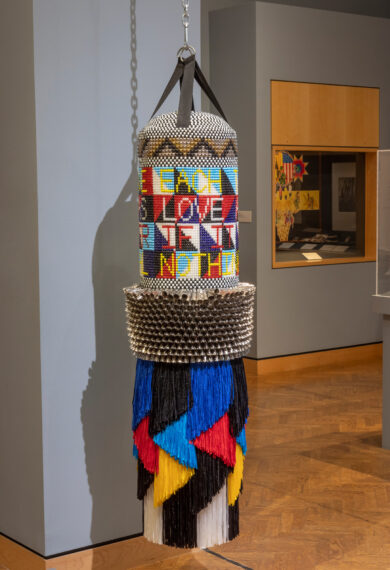
Jeffrey Gibson (American, Choctaw-Cherokee, born 1972), NOTHING IS ETERNAL, 2017, repurposed punching bag, acrylic felt, glass beads, metal jingles, artificial sinew, and nylon fringe. Gift of Mary and Bob Mersky. 2022.98.7
The embellished punching bag could represent the body of a dancer. Artist Jeffrey Gibson, who is part Choctaw and part Cherokee, may have had this reference in mind when he clothed the bag in the beadwork, jingles, and nylon ribbons typical of powwow regalia.
As a child, Gibson thought of powwows as conduits of tradition. Now, he sees them as a modern invention: “I define modernism as innovation or an invention responding to drastic changes in circumstances and environment, and powwow is one of those things; it evolved as a way to bring people back together.”
Kehinde Wiley: Santos Dumont – The Father of Aviation II, 2009 (Gallery 230)
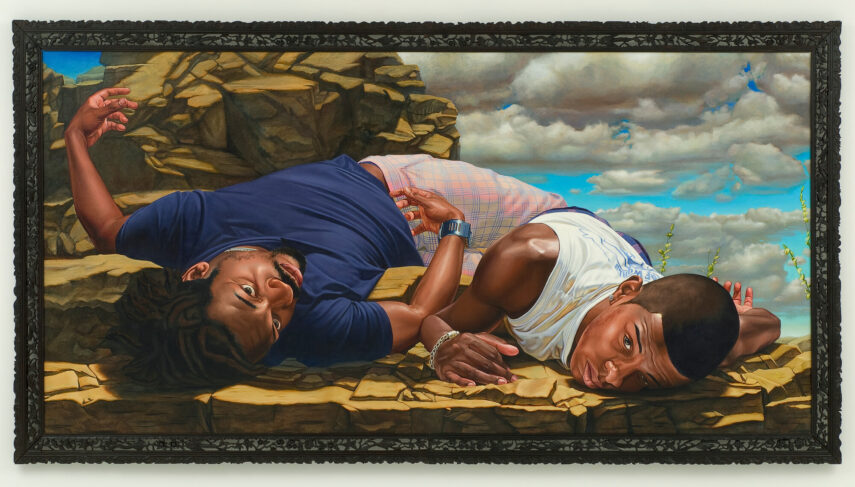
Kehinde Wiley (American, born 1977), Santos Dumont – The Father of Aviation II, 2009, oil on canvas. Gift of funds from two anonymous donors. 2010.99. © 2009 Kehinde Wiley
Kehinde Wiley is best known for his large-scale portraits of Black people posing as kings, prophets, and saints in the tradition of old master paintings of the Renaissance and Baroque eras. In placing Black bodies into the traditional settings of European portraiture, Wiley challenges racial discrimination in the art world and raises issues of identity and self on a global scale.
Wiley met the two young men featured in this painting in Rio de Janeiro, Brazil. They are posed as the two “fallen heroes” in a well-known public monument to Brazil’s pioneering aviator Alberto Santos-Dumont. By depicting these Black men as aviation heroes, Wiley immortalized them in oil paint.
Lorna Simpson: Untitled (6 Candles), 1992 (Gallery 373)
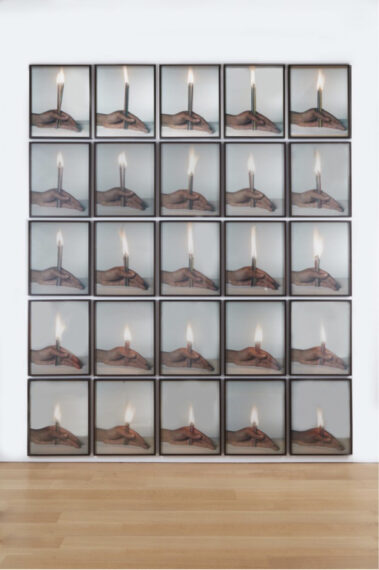
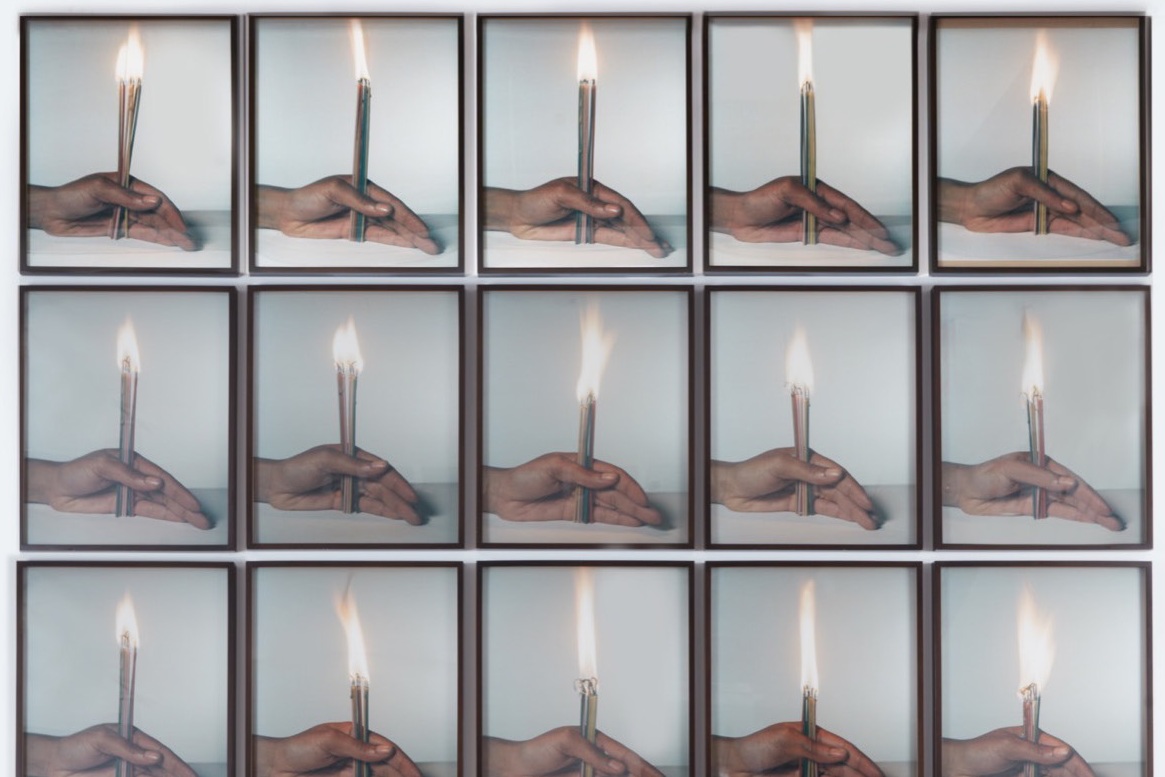
Lorna Simpson (American, born 1960), Untitled (6 Candles), 1992. Color Polaroid prints. The John R. Van Derlip Fund. 2025.44a-y
Created during a residency with the Polaroid Foundation at the height of the AIDS epidemic, Untitled (6 Candles) reflects Simpson’s grappling with, as she has said, “death and absence, using candles to reflect the passing of time.”
Simpson’s grant from Polaroid was arranged by the Aperture Foundation and gave her access to one of the only 20 × 24-inch Polaroid cameras in the world at that time. Fittingly, the camera was originally intended for medical research. In Simpson’s hands, it became a tool for creating 25 unique photographic prints that invoked the horrific loss of life due to HIV/AIDS in 1992—a year in which the virus was the leading cause of death for men ages 25 to 44.
Harmony Hammond: Coverup, 2012 (Gallery 374)
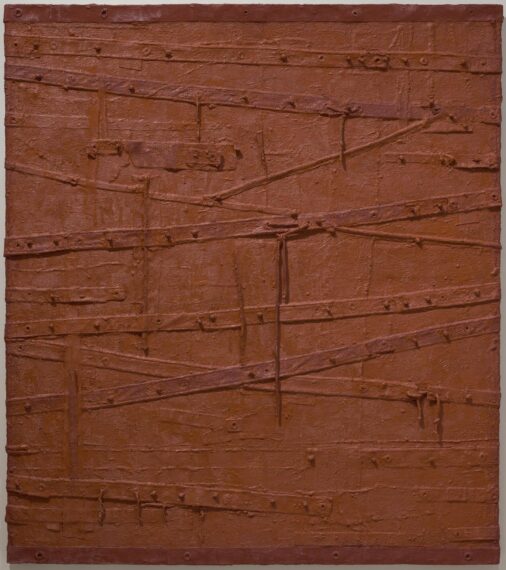
Harmony Hammond (American, born 1944), Coverup, 2012, oil and mixed media collage on canvas. Gift of Mary and Bob Mersky. 2020.96.5. © Harmony Hammond / Licensed by VAGA at Artists Rights Society (ARS), NY
Coverup belongs to a group of work that artist Harmony Hammond calls “near monochrome” paintings, in which layers of paint, handmade straps, and rope are layered into a three-dimensional composition. By using only one pigment (red ocher) in this work, Hammond transformed the act of painting from representation (depicting a person, scene, or object) to the creation of something sculptural and organic.
Hammond often describes the canvases of her paintings as “skins,” saying, “The grommeted straps are wrapped around the painting as objects and body (suggesting bandage, bondage, binding) but do not cinch or constrict. The straps do not hold the painting together; the paint (and therefore the act of painting) does.”
Bernard Perlin, Autumn Leaves (Robert Drew), 1947 (Gallery 360)
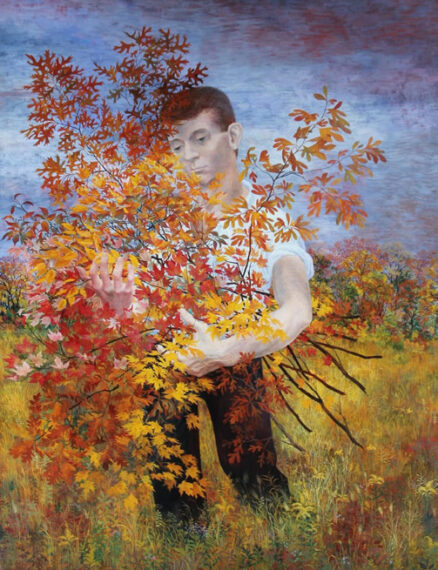
Bernard Perlin, Autumn Leaves (Robert Drew), 1947, L2014.234.260
Bernard Perlin depicted his then lover, Robert L. Drew (1924–2014), carrying an armful of boughs. Their leaves have turned golden yellow and deep red, merging and blurring to appear as if on fire. Drew practically wears them like a garment, dressed in the delights of autumn in New England.
Drew was a fellow artist and designer who taught at the New York School of Interior Design. For a time, he was the partner of William Meredith, the first openly gay U.S. poet laureate. Perlin and Drew were part of inclusive and vibrant cultural circles that touched every aspect of the arts.
Laura Aguilar: Grounded #109, 2006–7 (Gallery 365)
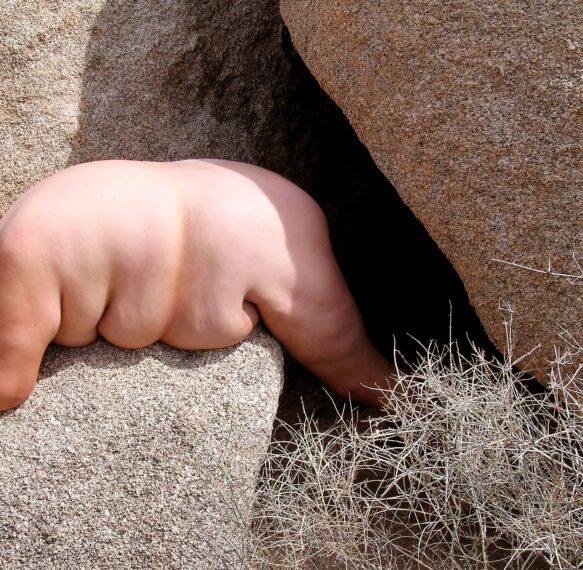
Laura Aguilar (American, 1959–2018), Grounded #109, 2006-2007, inkjet print. The Alpha Gustafson Endowment. 2022.41.4
Laura Aguilar was an artist born and raised in Los Angeles who struggled for recognition throughout her life. As a photographer, she trained her greatest attention upon the human body—and, often, her experiences as a large-bodied, queer, Mexican American woman.
With an extraordinary capacity for vulnerability, Aguilar created several series—including three titled Motion, Stillness, and Grounded—in which she arranged her nude body outdoors as an extension, enhancement, or echo of the natural world. Grounded #109 monumentalizes her form within the desert landscape, the soft curves of her torso meeting stone and scrub in a full-bodied embrace: a homecoming.
Jess T. Dugan: Andrea, 54, Minneapolis, MN, 2016 (Gallery 365)
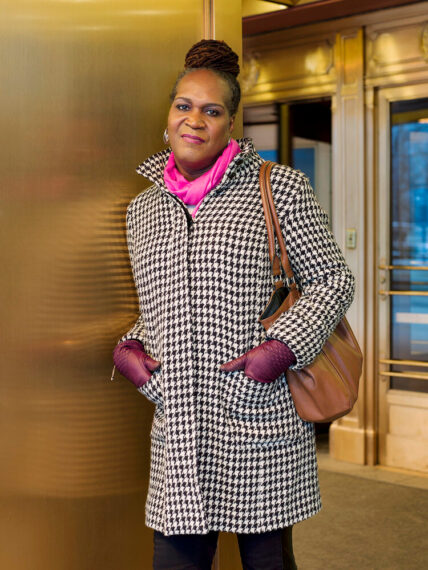
Jess T. Dugan (American, born 1986), Andrea, 54, Minneapolis, MN, 2016, pigment print. Gift of Jess T. Dugan and Catherine Edelman Gallery, Chicago. 2020.61
This portrait of Minneapolis City Council member Andrea Jenkins is intentionally iconic: framed by the brass walls and doors of an office building, Jenkins resembles a figure within a gilded altarpiece. An activist, curator, and oral historian, Jenkins has long served diverse communities in Minneapolis, and in 2016—the year of this portrait—she announced her campaign for a seat on the city council. One year later, Jenkins became the first Black openly transgender woman elected to public office in the United States.
Catherine Opie, Untitled #14 (Icehouses), 2001 (Gallery 365)

Catherine Opie (American, born 1961), Untitled #14 (Icehouses), 2001, color coupler print. Gift of Donna and Cargill Macmillan Jr., 2010. 58.1
In the winter of 2001, Catherine Opie traveled from her home in the California desert to northern Minnesota to photograph the temporary villages of fishing shacks (ice houses) planted amid the abundant frozen lakes in that region. Opie used a large-format camera to make Untitled #14, offering an expansive view of the terrain in which the humble shelters appear small and exposed in the all-encompassing whiteness of the scene. The huddle of shacks traces the faintest horizon line in an otherwise disorienting landscape, underscoring the ultimate vulnerability of human life in the country’s northernmost woodlands.
More Pride
Mia is celebrating the historic creative and cultural achievements of 2SLGBTQIA+ artists. This June, join In-Gallery Conversations, Thursdays through Sundays at 1 p.m., to explore works in Mia’s collection that address social constructs of gender, gender identity, and queer joy. And mark your calendar for Pride in Concert, on Thursday, June 25, from 5 to 9 p.m.!