
“The Moments After Grief:” Q&A with Artist Ziba Rajabi
On Sunday, October 18, 2026, join us for a conversation with artists Ziba Rajabi and Katayoun Amjadi. Following the talk, Rajabi and Amjadi will be in the U.S. Bank Gallery to meet guests and answer questions. Reserve free tickets.
By Tara Kaushik
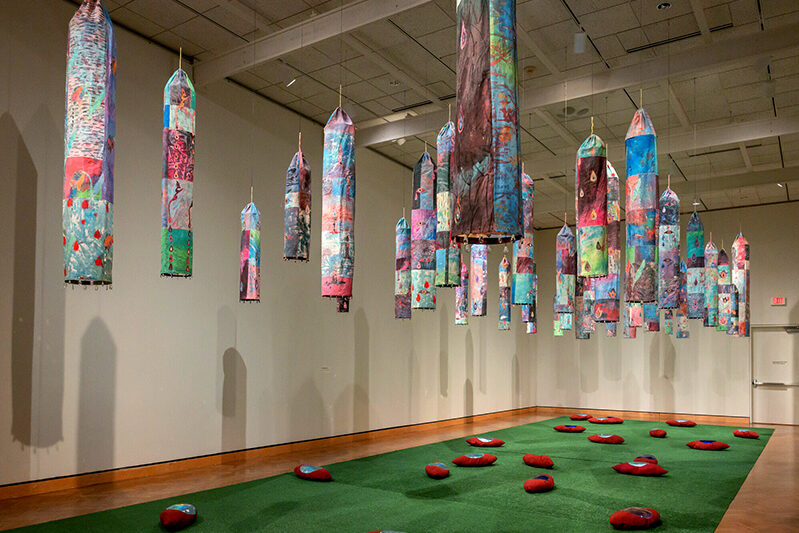
August 8, 2026—Ziba Rajabi considers grief a motivating force, not something to avoid or run from. The Minnesota-based, Iranian-born artist is interested in the momentum generated by acts of collective, communal grieving, and the revolutionary possibilities they enable. Here, she discusses her MAEP exhibition “Ziba Rajabi: Belly Laugh at a Funeral,” which draws on ancient practices from the Iranian plateau and Mesopotamia, and features textile works that explore the emotions following grief: peace, acceptance, healing, and progress. Her immersive installation Kotál, composed of rows of colorful, cylindrical flags, invites visitors to gather in the gallery. Rajabi hopes they leave with “a sense of peace, calmer nerves, and a lighter heart.”
Tell me about the origins of this exhibition, and how it fits into your broader practice.
For the past few years, I’ve been investigating how I might break the boundaries of painting, which is traditionally bounded within frames, and create a painting that interacts with the surrounding space. I wanted to see if a painting could reach outside of those borders and interact with its surroundings. I think about installations as painting in that expanded field.
Conceptually, I’m interested in architecture and ancient architecture specifically. My last exhibition involved researching sacred spaces designed for a spiritual function, like ziggurats, Persian gardens, and mausoleums. From there I created Zarīh, which was an installation exploring the ornate lattice structure that surrounds a grave in Islamic tradition. So I was thinking about death and grieving and all those kinds of things, and I started to research practices and rituals around grief, which became the starting point for this exhibition.
What interested you in researching and cataloging mourning rituals and practices?
Thinking about the world that we are living in right now. I live in Minneapolis and I’m from Iran. This winter, both places have been through a lot. The killings of Renée Good and Alex Pretti in Minneapolis, and the events of January 8 and 9 in Iran, preceding the U.S.-Israeli war on Iran, have left people in both places in a state of collective grief. This deep sense of loss made me keep thinking about mourning.
When I started researching, I realized that so many present-day rituals around grief are rooted in practices and rituals that our ancestors had. We do the same practices to express grief and mourn that we’ve been doing for thousands of years, at least where I come from. That was very interesting for me, and I wanted to share just an excerpt of that research with the viewer, to connect past and present. It felt like an opportunity to acknowledge commonalities in human emotions and experiences despite these huge differences in time and geography.
Did you encounter anything in your research that reshaped the way you think about grief?
The more I read about grief, the more it felt like a shared experience more than anything else. Most of us have gone through different kinds of grief. It can look different, with something as big as a community grief, as with the events of the last winter in Minneapolis, or it can be something very personal, like losing your pet. My research made me think about grief as a human experience more than anything else. And how grief is more communal and collective than other sentiments. For example, if you have a birthday party, close friends are usually invited. Whereas if you’re going through a loss, everyone who knows you—at least in my culture—everyone who knows you reaches out and sends their condolences or shows up. So that showed me how grief has a more social aspect to it than other sentiments that we as humans experience.
You’ve mentioned wanting to pay homage to feminist movements and creative traditions through your installation Kotál. Could you share a bit about that?
In the wake of the Woman, Life, Freedom movement in Iran, I began trying to unlearn and relearn a lot of things. I wanted to actively bring feminine approaches and also domestic art practices into my work. In Kotál, the choice of materials, the choice of color, the imagery, and also the kind of raw and pure sentiment that is used in the imagery is one of the ways that I wanted to replace a more patriarchal approach with something that for me is inspired by more domestic, traditionally feminine approaches in art—things I have seen female members of my family do, like stitching and sewing, and using materials like muslin, that are often used in the kitchen.
I learned how to knit and crochet from my mom and my grandma, but I actually learned how to sew from my dad. I don’t come from a heavily patriarchal family. It’s actually more of a matriarchy than a patriarchy, if anything.
Kotál invites visitors to spend time together in a shared space. What was important to you about this collective experience?
This exhibition is the imagination of the moment after grief. What I learned from these ancient practices and stories was that if we go through grief and process it, especially collectively, as a society, it leads us to more awareness and action. That is exactly what happened in Minneapolis. The collective grief that we experienced over the murder of George Floyd, for example, led us to more awareness about racism and its devastating consequences, which led to widescale action—action that made a lot of structural and systemic change.
I wanted to create a large piece addressing what our society is experiencing right now. However, I wanted to also create a space for people to spend a little bit more time. I wanted people to slow down, pause, sit or lie down for a moment, look at their reflection in the mirrors, listen to the music that was created by Aida Shahghasemi specifically for this exhibition. I didn’t want this to be an exhibition that was just about me and my work, I wanted it to be a place for the community to gather. I actually saw a few people in the gallery sitting together, crying, and hugging and that was very moving to see.
About the Exhibition
“Ziba Rajabi: Belly Laugh at a Funeral” is on view July 18 through October 25, 2026, in the U.S. Bank Gallery. Admission is free.
Drawing on ancient mourning practices from the Iranian plateau and Mesopotamia, Ziba Rajabi explores what can emerge in the wake of grief: peace, acceptance, healing, and progress. Through textile works, sound, and an immersive installation with cushions that invite visitors to sit and gather, the exhibition creates a space for collective reflection and shared experience.
Born in Tehran, Iran, Rajabi was the inaugural recipient of the DAG Prize in Visual Art from the DAG Foundation and has received additional support from the Jerome Foundation and Mid-America Arts Alliance. Her work has been featured in national and international exhibitions at Crystal Bridges Museum of American Art, Arkansas; CICA Museum, South Korea; 21C Museum, Arkansas; and Araan Gallery, Iran, among others. She has participated in residencies at Skowhegan School of Painting and Sculpture, Vermont Studio Center, and Terrain Residency. Rajabi received her MFA from the University of Arkansas, Fayetteville, and her BFA from Sooreh University in Tehran.
This exhibition is part of the Minnesota Artists Exhibition Program.
Support provided by RBC Wealth Management.