
Art in Bloom: A Bit about This Year’s Signature Artwork
By Tara Kaushik
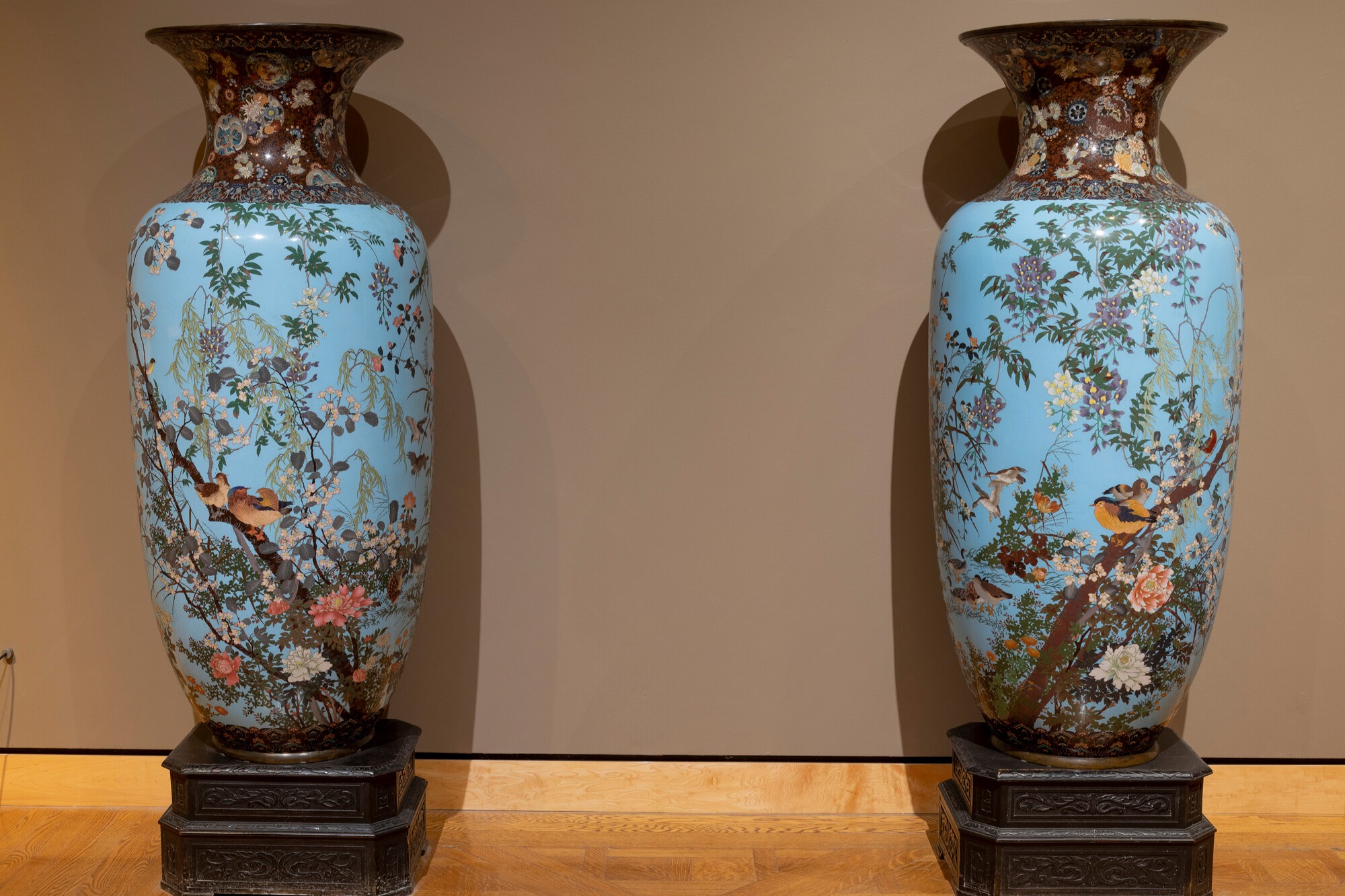
April 3, 2026—Every year, the Friends of the Institute select a signature artwork for Art in Bloom. It serves as a kind of artistic anchor for the festival, celebrating a floral work in the collection. This year, it’s a pair of tall, robin’s-egg blue vases from Meiji-era Japan, adorned with delicate depictions of birds, leaves, and flowers. Tremendously springy.
The Craft of Cloisonné
The vases offer a striking example of cloisonné, a technique for creating designs on metal vessels by placing colored-glass paste, or enamel, within compartments formed by copper or bronze wires bent or hammered into a desired pattern. Known as cloisons (French for “partitions”), the compartments are generally either pasted or soldered onto the vessel.
The glass paste, or enamel, is colored with metallic oxide and painted into the contained areas of the design. The vessel is then fired at a relatively low temperature, about 800°C. Enamels commonly shrink after firing, so the process must be repeated several times to completely fill in the designs. Once complete, the vessel’s surface is polished smooth and gilded, often on the edges, interior, and base.
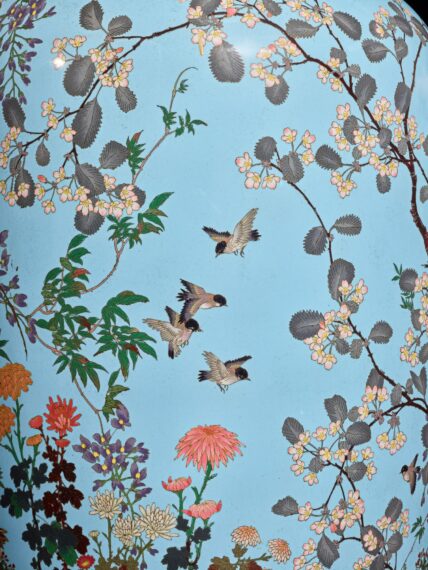
Japan, Meiji era (1868–1912), Presentation vases decorated with birds and flowers (detail), 1890s, cloisonné enamel; gold, silver, and copper. Gift of the James J. Hill Reference Library, 2019.142.2
It’s an incredibly painstaking, labor-intensive process. “The work on Japanese cloisonné ware generally exhibits the quality suggestive of unwearying labour and patience,” wrote Professor Harada Jirō, curator of the Imperial Household Museum (now the Tokyo National Museum), in 1911, in “Japanese Art and Artists of Today – VI. Cloisonné Enamels” in the journal The Studio.
Originating in Europe, cloisonné spread to China around the 13th or 14th century, where cloisonné objects were primarily used in temples and palaces. Japanese artisans of the late Edo and Meiji periods borrowed and transformed the technique, experimenting with design and form to push the boundaries of enamelwork. The Meiji period (1868–1912) is often called the “golden age” of Japanese cloisonné. International demand for these objects spiked after the 1873 Vienna Exhibition, a world’s fair where the Nagoya Cloisonné Company won first prize. By the early 1900s, Japanese enamels would outshine everything previously achieved in this medium.
A Minnesota Connection
It was around that time that American railroad magnate James J. Hill (1838–1916) purchased this pair of vases, among the tallest ever made, for his New York City apartment. Hill was an avid art collector—his mansion on Summit Avenue in St. Paul includes a skylit art gallery.

View of the reading room at the James J. Hill Center from the second-floor balcony. The vases can be seen at the entrance. Evan Frost | MPR News
After Hill’s death, the vases were displayed for more than 100 years in the James J. Hill Center in St. Paul. The Center closed in 2019, and the vases were gifted to Mia, where they’ll be interpreted at Art in Bloom this year by more than 20 florist artists, with displays throughout the museum.
Celebrate Spring at Mia
Free and open to the public, Art in Bloom exhibits imaginative floral interpretations of selected works of art from Mia’s permanent collection, created by more than 100 individual and commercial florists. Everyone is invited to experience the floral beauty and fragrance throughout the museum, take a free guided tour, and enjoy family activities for our younger guests. Presented by the Friends, this year’s four-day festival takes place April 23–26, 2026.