

Harmony in Motion: Celebrating Mia’s Shiva Nataraja Sculpture with Dance
By Tim Gihring
May 12, 2026—When Mia acquired its Shiva Nataraja sculpture in 1929, there were only a couple of others in American museums. The legendary art dealer C.T. Loo had loaned it to Mia with the idea that someone would step forward and make the arrangement permanent. Someone did: Sarah Belle Pillsbury Gale, who lived just across the park from Mia with her husband, Edward. It was the first sculpture from India in the collection.
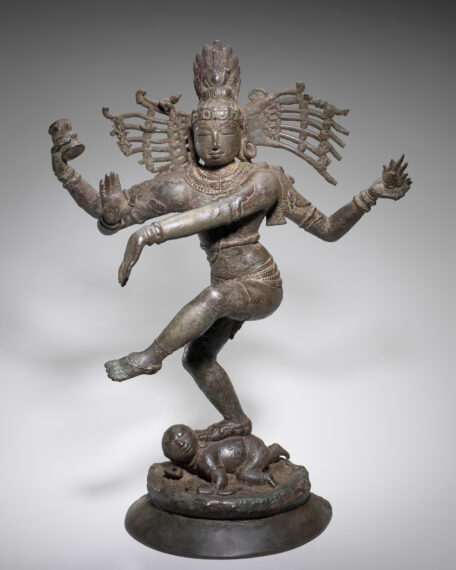
The Shiva Nataraja bronze at Mia
Restoring a Cosmic Icon
The sculpture depicts the Hindu god Shiva in his incarnation as Lord of the Dance, symbolizing the rhythm of the cosmos—the endless cycle of creation and destruction that ensures regeneration. Pujan Gandhi, Mia’s former Jane Emison Assistant Curator of South and Southeast Asian Art, dates the piece to the 10th or 11th century and says that for some time it was buried—perhaps for hundreds of years—to prevent it from being looted or melted down during conflict. Parts of Shiva’s hair were broken and glued on, and previous repairs had caused moisture to build up and degrade the base. The piece had become too unstable to loan and required conservation.
The process included tests (X-radiography, gamma radiography, and X-ray fluorescence) that confirmed burial deposits on the sculpture’s surface and revealed how the piece was cast, during the height of the Chola period, when a desire for deities to participate in temple processions spurred a golden age of bronze sculpture. “It’s so solid and so pure,” Gandhi said. “The force of the leg and the suspension—nothing is stagnant, it has to have a lift to it.” Shiva Nataraja, after all, is in perpetual motion.
The Sacred Language of Dance
Mia commissioned Aparna Ramaswamy, co-director of Ragamala Dance Company, to celebrate the sculpture’s reemergence. The company works within the Bharatanatyam tradition of classical Indian dance, which developed in the temples of southern India along with the famous form of Shiva Nataraja itself. In January 2021, Ramaswamy performed the new piece at Mia, choreographed by her teacher, Alarmel Valli, to music composed by a South Indian king in the 19th century.
Watch Aparna Ramaswamy, co-artistic director of Ragamala Dance Company, dance in celebration of Mia’s sculpture of Shiva Nataraja.
“Shiva, in his form as Nataraja, is performing the Ananda Tandava—the dance of bliss—in a state of heightened enlightenment,” Ramaswamy said. “In this piece, I describe him as the magnificent, the glorious—austere and fearsome. Yes, he dances in the halls of the temples but also on the cremation grounds. He is the one who wears ash on his body. He wears a garland of skulls. . . . I describe the rapture the devotee feels in witnessing his dance and asking for his grace.”
Ramaswamy, who has known this image of Shiva Nataraja all her life, remains in awe of its sweeping symbolism. “In one hand is his rattle drum, the sound of the universe, everything he creates,” she said. “In his other hand is the flame of destruction that destroys everything he creates. The connection of the sacred and the mythological, the body and the cosmos—it all comes together in this statue.”
In the early 1900s, shortly before becoming the first curator of Indian art in the United States, Ananda Coomaraswamy wrote evocatively of the Shiva Nataraja form and its revelatory meanings—part of his long crusade to elevate the cultural achievements of India in the eyes of the West. He was persuasive. In 1915, the French sculptor Auguste Rodin described the dancing Shiva as the most “perfect expression of rhythmic movement in the world.” In a 1961 interview, the British intellectual Aldous Huxley lamented the lack of a comparably profound icon in the West: “We don’t have anything remotely approaching such a comprehensive symbol, which is both cosmic and psychological as well as spiritual.” By then, the image of Shiva Nataraja had become a symbol of India itself.
Bridging the Human and the Divine
Shiva Nataraja sculptures are now in the collection of nearly every major art museum in the United States, each uniquely styled. “Our Nataraja is especially tender,” Gandhi said, noting the blissful expression. Shiva is the god of destruction and renewal, yet he remains unaffected, and that tranquility is reflected in his features. His eyes, Ramaswamy says, “emphasize the concept of darshan, or sight—to see and be seen, the active connection between deity and devotee.”
Ramaswamy began to learn Bharatanatyam at the age of 5 and has long understood the potential of art as a means of transcendence, a way of connecting with the divine. Indeed, the desire for a more direct, devotional relationship with the gods became an impetus in Hinduism for both temple building and artistic production. If devotees were to commune with the gods, they would need a particular place to do it, and the arts would facilitate that relationship.
Sculpture and dance were closely connected. If the sculptors’ task was to make a vessel worthy of housing the divine, the dancers’ charge was to bring out this spiritual force, enabling a dialogue with the divine.

A dancer and musician depicted in sculpture at the Nataraja Temple in Chidambaram, India.
“Dancers were mediums between the gods and the public,” Ramaswamy says. “While the sculpture portrays the beauty of the body in posture, the dancer must breathe life into the movement, imbuing it with feeling.”
Even after Bharatanatyam moved from the temples to theaters several centuries ago, the link between dance and spirituality remained strong among many choreographers. “There are many compositions that explore the soul’s longing for the divine,” Ramaswamy said, “that personal relationship between ourselves and the sacred.”
A Living Heritage at Mia
In her dance at Mia, she was once more facilitating that connection. “That’s my singular focus,” she said. “The idea is that the audience is not just an audience. . . . You make them feel something, but you’re not performing for them. It is a dynamic relationship happening in that moment. It is a prayer.”
Ramaswamy was born outside of Calcutta and moved to Minnesota with her parents in 1978. Her sister, Ashwini, was born a few years later, and they grew up in Burnsville, about 20 miles south of Minneapolis. Mia, in many ways, seemed distant. “Our existence was that of the Indian community in the suburbs, the temple,” said Ramaswamy. “I don’t know that our family went to the museum often when I was very young.”
Things changed in the early 1980s. Her mother, Ranee, was dancing and teaching in the Twin Cities and traveling often to India for further study. In 1984, she and Aparna met Alarmel Valli, an internationally acclaimed exponent of Bharatanatyam, when Valli came to Minneapolis for a two-week residency that included a lecture at Mia. Valli became their guru. Ranee began performing at Mia, and after she founded Ragamala in 1992, the relationship continued between the museum and the company, from Family Day shows to special programs for guides. It remains a potent partnership.
The Ramaswamys’ ongoing study with Valli has inspired a way of seeing artistic heritage as progressive—not stuck in time or place, still relatable to the present, still capable of revelation. Understanding the old, Aparna said, “enables us to see our lives in this prismatic way.” It’s this perspective that informed her dance in celebration of the Shiva Nataraja sculpture. It feels at once ancient and immediate, a “cosmic boom,” as Gandhi put it.
“One reason our art form pairs so beautifully with the museum is that we see this dance form, though it has a 2,000-year-old history, as constantly evolving through its practitioners, an ever-expanding language still carrying the beauty of the form that was given to us,” Ramaswamy said. “The same is true of pieces in the museum. They give us so much relevance in our world today. They’re alive and living.”