
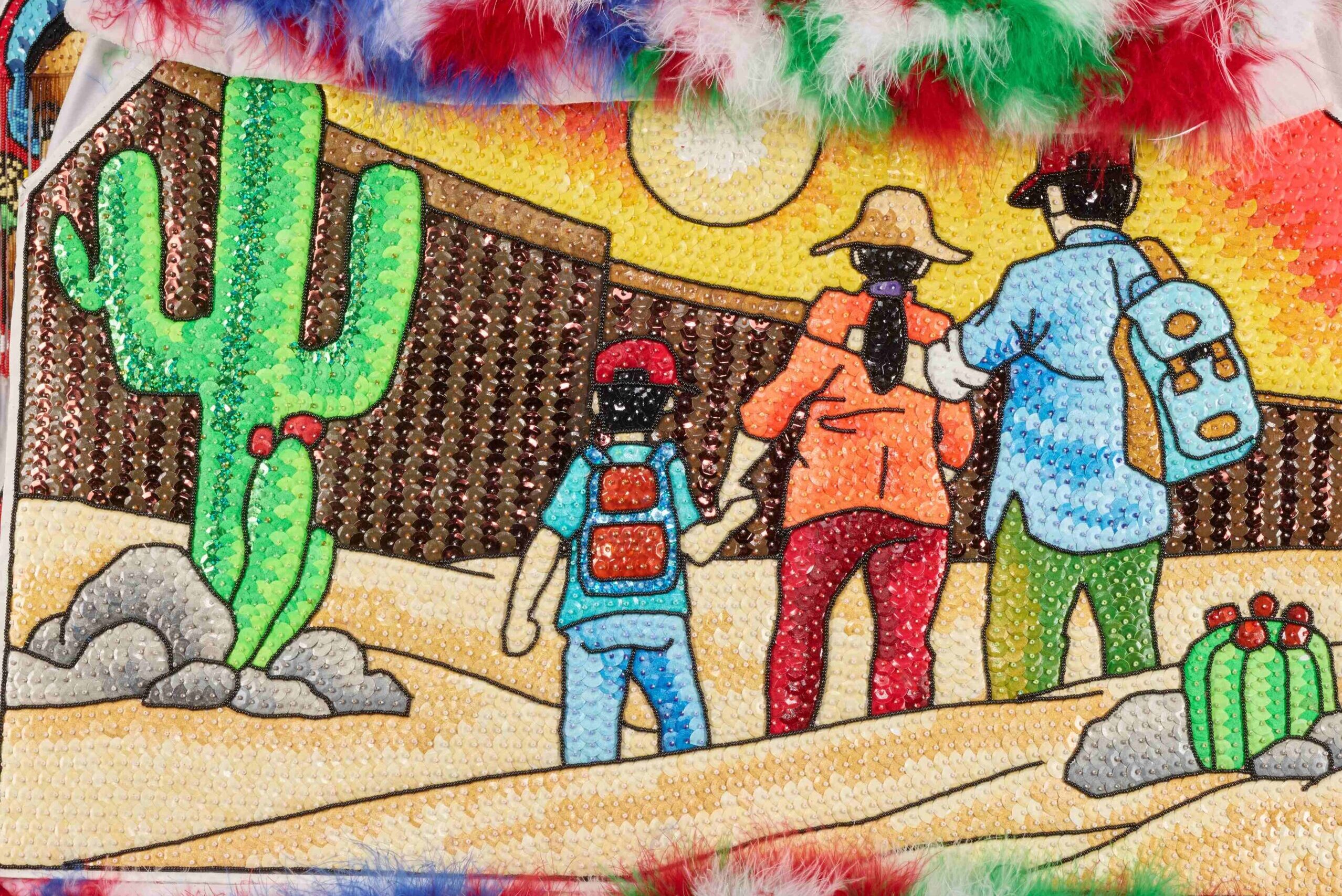
What a Mexican “Chinelo” Costume Says about Immigration and Protest in Minnesota
By Tim Gihring
September 9, 2026—“‘Immigrants’: A Gift from Morelos to Mia,” now on view in Gallery 281, features a single artwork: a feathered, beaded costume with boots, a robe, a headdress, and a mask depicting a stereotypical conquistador—blue eyes, pointy beard. It is a chinelo, a kind of artistic disguise first worn by Mexican dancers centuries ago to mock the country’s wealthy landowners while incognito. At Mia, it suggests not just resistance but solidarity, as it was made and donated by a family in Morelos, the state that is the origin of most Mexican immigrants to Minnesota.
The gift began with Xavier Tavera, an art professor at Carleton College. He’s an immigrant himself, having left law school in Mexico to take a photography job in Texas before settling in Minneapolis in 1996. For the past 10 years, he’s been photographing the U.S.-Mexico border, depicting a desolate landscape full of tension yet still a place of cultural exchange.
“I’ve long been interested in the idea that not only do people migrate but culture migrates, too,” Tavera says. Chinelos are a relatively recent example—a custom that came across with the boom in Mexican immigration that began in the 1980s and peaked in the 2010s.
While on sabbatical in 2023–24, Tavera photographed the costume in what he calls the chinelo diaspora: New York, New Jersey, North Carolina, and Illinois, as well as Minnesota. Then he photographed the garments in their natural environment: the raucous Carnival celebrations that happen every February throughout Morelos in the lead-up to Lent. Here, after all, in the hill country just north of Mexico City, is not just the primary source of workers recruited to Minnesota’s construction, health care, and agriculture industries but also the heart of chinelos tradition.
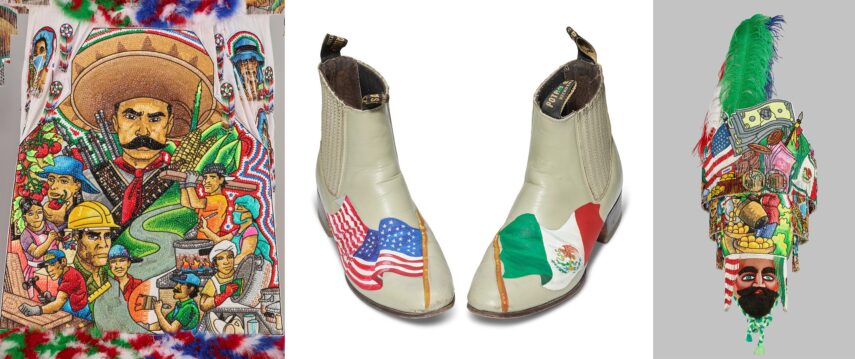
Elements of the “Immigrants” chinelo, from left: the robe, the boots, and the headdress with mask.
The Morelos-Minnesota Connection
It was a St. Paul family of chinelo dancers who introduced Tavera to a family of chinelo makers in Yautepec, a small city in Morelos closely identified with the costume. He asked the artisans (Mauricio Hernandez Chepetla, Maria Rendon Cruz, Viridiana Chepetla Rendon, Karla Bautista Galindo, and Esau Chepetla Rendon) for a design that would evoke the Morelos-Minnesota connection.
“I didn’t want to over-guide them,” Tavera says, but suggested a few occupations to depict in the mural-like composition made of beads that covers the costume’s robe: cooks, construction workers, farmhands.
The artisans came back with a drawing featuring all of those figures plus Emiliano Zapata, the gun-toting, heavily mustachioed hero of the Mexican Revolution, which elevated laborers in the early 1900s. Zapata was born in Morelos, and his followers—the Zapatistas—made Yautepec a center of workers’ rights, a legacy that endures in the town’s chinelos. Tavera loved the image: “I said, ‘Let’s do Zapata a little more prominently.’”
The final costume has the guerilla leader front and center as well as on the fringes that hang down from the sleeves. Half the costume is decorated in the colors of the Mexican flag (red, white, and green) and half in the colors of the U.S. flag (red, white, and blue), illustrating the symbiotic relationship between the countries. They are equals, it suggests—each benefitting the other, each rooted in revolution.
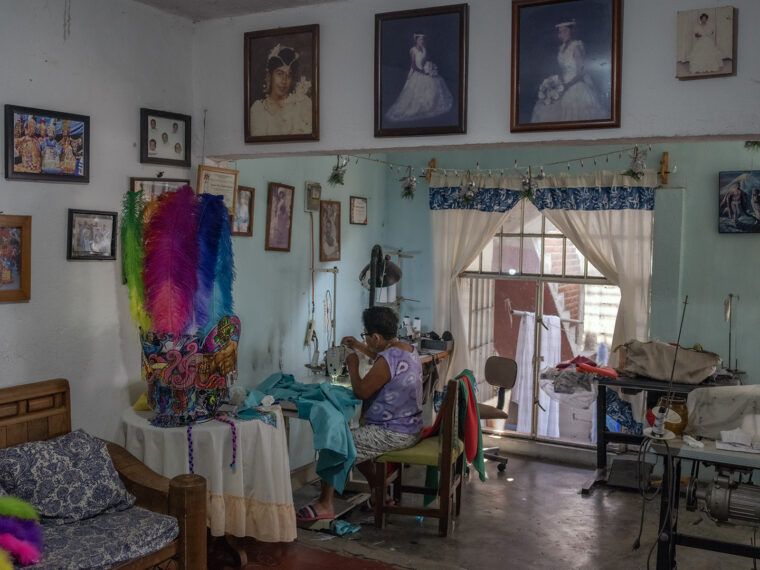
Chinelos being made in Morelos. Photo by Xavier Tavera.
The Cheeky History of Chinelos
Though Mexico had won its independence from Spain in 1821, wealth and power remained with the hacendados, the landowners of European heritage. By the end of the century, tensions between rich and poor were flaring. In Morelos, workers banned from the Carnival balls hosted by the hacendados began to stage their own, more subversive celebrations with masks and costumes—called chinelos after the local Nahuatl word for “disguise.”
The original chinelos were made from old clothes decorated with beads, paired with ridiculously large hats meant to mock the hacendados’ affectation of European fashions. The costumes were danced in furtive parades, a small, regional release of steam that eventually merged with the growing spirit of rebellion across the Mexican countryside—and Zapata’s armed uprising.
Today, chinelos are a national symbol, coveted by collectors, and can be highly elaborate. In Yautepec, they’re often made of velvet covered in sequins, imitation gems, embroidery, and imported Czech beads. The finest sell for thousands of dollars.
Tavera knew that the one he commissioned would go to Mia, where it would be displayed in a darkened, air-conditioned gallery, but first he wanted to be sure it was danced. Paraded in the streets. “Taking on that layer of soulfulness,” as he puts it, not to mention sweat.
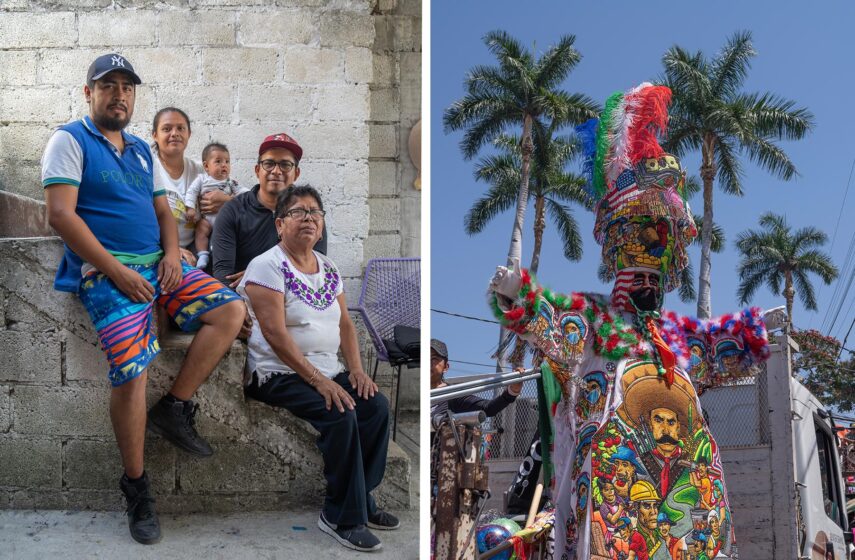
The Morelos makers of the “Immigrants” chinelo (left) and the dress being danced at the Carnival parade in Yautepec, Mexico. Photos by Xavier Tavera.
Coming to Minnesota
In the winter of 2025, one of the chinelo makers wore it at the Carnival parade in Yautepec. Tavera was moved by his story of attempting to cross into the United States a decade ago and being deported. Now his handiwork has made the journey instead.
“He poured everything into this dress, knowing that the dress was coming here and he couldn’t,” says Tavera. “There is this complicated relationship that people have with the U.S.—ultimately a story of hard work and dreams.”
The costume is formally titled “Immigrants,” and at Mia it can be seen as a straightforward act of creation—an artwork on a pedestal like any other. But even in this light it’s not static, creativity being essential to progress, to imagining new things into existence, as Tavera notes: “It might be a sculpture, it might be a different government, a different way of relating to each other.”
In Minnesota, chinelos are often danced at celebrations, including religious festivals, quinceañeras, and Mexican Independence Day in mid-September. And though they haven’t appeared at recent protests over immigration enforcement, they share the same mocking spirit as the dancing frogs and foxes that have been on the front lines. After Operation Metro Surge pushed many immigrants in Minnesota into hiding, Tavera says displaying the chinelo at Mia feels like a coming out.
Ultimately, like many of the Latin American objects at Mia, “Immigrants” can be seen as affirmation. “There is this essential part of the immigration experience where you can feel like you’re only here temporarily,” Tavera says, as though something or someone—perhaps yourself—will compel you to turn back. “So to know that a part of you is here, that a part of your culture is preserved in the museum, is to know that you belong here.”
How to See the “Immigrants” Chinelo
“Immigrants” is on view through February 28, 2027, in Gallery 281 at Mia.
During Hispanic Heritage Month, from September 15 to October 15, Mia guides will lead free, one-hour tours of art from Spanish-speaking countries every week, Thursday to Sunday at 1 p.m., leaving from the Info Bar in the museum lobby. Self-guided tour pamphlets are also available in the lobby.
More Latin American Art at Mia
“María Berrío: Songlines” features the Colombian artist, now living in Brooklyn, known for her monumental scenes that combine layers of cut paper with areas of painting. Find her art in Galleries 275 and 276.